What Enterprise Leaders Are Missing: Portfolio Visibility for Strategic Decisions
Enterprise transformations usually have ambition and a strategy. Fewer have the visibility needed to to make decisions against them.
Most leaders recognize the pattern. The investment intent is there. But when the moment arrives to act on strategy, to fund the capabilities that will deliver it and make the portfolio trade-offs that funding requires, the necessary visibility often isn't.
That's the visibility gap: the distance between the decisions enterprise leaders need to make and the portfolio insight available when those decisions are made. And understanding where that gap comes from matters, because it shapes how you address it.
Every merger, regulatory change, and new initiative adds to the portfolio. Geopolitical instability, economic shifts, and rapid technology change compound this further, forcing leaders to revisit priorities more often and act under tighter time pressure. Rationalization requires sustained effort and budget, both of which are easily crowded out by competing priorities. Systems stay in production, dependencies accumulate, and over time, what nobody planned becomes the landscape everyone has to navigate.
Financial pressure sharpens the problem. According to Gartner's 2026 CIO and Technology Executive Survey, 57% of CIOs face pressure to improve productivity and 52% face pressure to reduce costs simultaneously. Without a coherent view across applications and technologies, that pressure has nowhere productive to land: leaders can't identify where to cut without risking operational stability, or where to invest without duplicating what already exists.
Most of the leaders we work with aren't short on strategic vision. They're operating with an incomplete picture of their own landscape. What they may not yet fully see is how much harder that gap has become to absorb.
"The strategy exists. The investment intent is there. But when critical decisions arise, the visibility to act on them often isn't."
Why Incomplete Portfolio Visibility Is Getting More Expensive to Ignore
The visibility gap has always existed in enterprise IT. What's changed is that three forces, each familiar on its own, are now converging in ways that make the cost of incomplete visibility much harder to absorb.
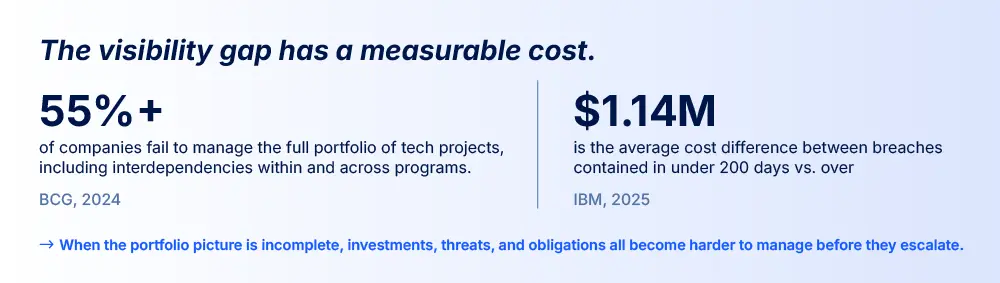
The pace of AI investment is outrunning portfolio insight. Organizations are funding AI initiatives before they have a reliable view of the data assets those initiatives will draw from, the systems they will touch, or the investments they may duplicate or displace. It's a pattern that shows up consistently across large-scale technology programs. BCG's research found that more than 55% of companies fail to manage the full portfolio of tech projects, including the interdependencies within and across programs. When that context is missing at the point of decision, governance is reactive by default and course-correcting later costs significantly more.
The speed of cybersecurity response has become a competitive differentiator. As architectures grow more interconnected, the blast radius of any single exposure has expanded. IBM's 2025 Cost of a Data Breach Report found that breaches contained in under 200 days cost an average of $3.87M. Those taking longer cost $5.01M, nearly 30% more. The ability to contain impact depends in part on how quickly teams can identify which systems are affected and know where to act. Having a current, accurate view of the technology landscape before an incident occurs is what makes that speed possible.
Regulatory frameworks are beginning to raise the bar for the kind of visibility enterprises need. DORA, in force across EU financial entities since January 2025, requires organizations to maintain a comprehensive, current register of ICT assets with dependencies mapped to critical business functions and third-party providers. The EU AI Act requires organizations to demonstrate active oversight of high-risk AI systems, including clarity on which systems qualify, what data they process, and who owns them. New York's RAISE Act, signed into law in December 2025, extends this direction further, mandating transparency and safety requirements for AI systems operating in the state. Together, these requirements make structured, auditable portfolio visibility increasingly difficult to treat as optional.
Resilience, in this environment, depends as much on alignment and agility as it does on stronger defences.
This is why strategic portfolio management has moved from an IT planning discipline to a business priority. The cost of operating without it is now measurable at board level.
“As architectures grow more interconnected, resilience depends as much on alignment and agility as it does on stronger defencses.”
Building the Portfolio Visibility Needed for Better Decisions
Strategic Portfolio Management (SPM) connects strategy to execution across investments, applications, technologies, and initiatives. It gives leaders a governed, structured way to decide what to fund, modernize, rationalize, or retire. But it delivers sustained value only when it's grounded in something reliable. Without a trusted view of the landscape underneath it, SPM becomes a planning exercise rather than the operational discipline it should be.
That foundation starts with Application Portfolio Management (APM) and Technology Portfolio Management (TPM).
- Application Portfolio Management gives leaders a maintained view of the applications that exist across the enterprise: what they cost, who owns them, which business capabilities and critical processes they support, and where lifecycle or technical risk is building.
- Technology Portfolio Management does the same for the underlying platforms, infrastructure, and standards those applications depend on, surfacing version fragmentation, end-of-support exposure, technology lifecycle risk, technical debt, and dependency risk before these issues become disruptive.
Most conversations about portfolio visibility treat the solution as self-evident. Better tooling, cleaner data, a bigger transformation program. That's not wrong, but it skips the harder question of where to start. Organizations that make meaningful progress don't wait for a perfect picture.
They start by:
- Anchoring the portfolio to their most urgent business priorities
- Inventorying business-critical applications and the technologies that support them
- Establishing clear ownership at the asset level
- Documenting the dependency relationships that matter most for near-term decisions
That partial foundation changes the quality of decisions significantly and builds the basis for broader coverage over time. And as that foundation matures, it's what allows Strategic Portfolio Management to operate as a repeatable discipline rather than a periodic planning exercise, moving through a continuous cycle of building visibility, analyzing in context, rationalizing complexity, and keeping the portfolio current through governance. That cycle is what separates organizations that sustainably close the visibility gap from those that close it temporarily and watch it reopen.
Closing the visibility gap starts by building enough portfolio insight to support the decisions in front of you, then expanding that foundation over time. Our guide shows how to build visibility in stages, operate SPM as a continuous discipline, and assess where your organization stands today.

FAQs
The enterprise technology visibility gap is the difference between what leaders intend strategically and what the organization can actually see, assess, and act on across its application and technology portfolio. It develops when portfolios expand faster than they're rationalized, legacy systems accumulate without documented costs and dependencies, and architectural complexity builds through individually pragmatic decisions over time. The result is that trade-offs can't be evaluated clearly, investment decisions rest on assumptions, and organizations default to managing change reactively. It's not a planning failure or a talent gap. It's a structural condition that builds through years of rational decisions made under real constraints.
AI projects and initiatives create dependencies across the existing enterprise landscape: the data they draw from, the systems they touch, the investments they may duplicate or displace. When organizations commit significant budget to AI before they have a reliable view of that landscape, governance is reactive by default and course-correcting later costs significantly more. BCG's research found that more than 55% of companies fail to manage the full portfolio of tech projects, including the interdependencies within and across programs. That pattern is especially costly for AI, where the pace of investment is outrunning the portfolio insight needed to govern it well.
Bizzdesign Alfabet is the platform within the Bizzdesign Enterprise Transformation Suite that enables Application Portfolio Management, Technology Portfolio Management, and Strategic Portfolio Management in one connected view. It gives organizations a governed, maintained view of what applications and technologies exist across the enterprise, what they cost, who owns them, what they support, and where the dependencies and lifecycle risks lie. That foundation connects directly to strategic planning and investment decisions, helping leaders evaluate trade-offs, prioritize modernization, manage risk, and sequence transformation based on what's feasible as well as what's strategically important. Additionally, Bizzdesign Alfabet is recognized as a Leader in The Forrester Wave™: Strategic Portfolio Management Tools, Q2 2026.
Application Portfolio Management focuses on inventorying, assessing, and governing applications to align the application landscape with business strategy and architectural standards. It addresses visibility into application ownership, lifecycle, cost, business fit, and technical health. Technology Portfolio Management focuses on the technologies that support those applications: standards, versions, lifecycle risk, vendor exposure, and dependencies. It addresses technology sprawl, version fragmentation, standards enforcement, and end-of-support risk.
Together they provide the foundation Strategic Portfolio Management requires. Bizzdesign Alfabet brings Application Portfolio Management, Technology Portfolio Management, and Strategic Portfolio Management together in one connected view, so the foundation that strategic planning depends on is continuously maintained rather than periodically assembled.
Strategic Portfolio Management supports AI governance and investment decisions by making the application and technology landscape that AI initiatives depend on visible before commitments are made. Each AI initiative creates dependencies across the existing portfolio: the data it can access, the systems it touches, the risks it introduces, and the investments it may displace or require.
Without portfolio visibility, AI planning becomes speculative and governance becomes reactive. With Strategic Portfolio Management in place, organizations can evaluate AI opportunities against enterprise priorities, architecture constraints, data and technology dependencies, lifecycle risk, and security exposure. Bizzdesign Alfabet supports this with capabilities including AI portfolio management, strategic investment planning, and portfolio-wide analysis across applications, technologies, and dependencies.