
Strategic Portfolio Management in Practice
A Practical Guide to Strategic Planning Grounded in Enterprise Architecture and Portfolio Visibility
The gap between strategic intent and operational reality widens every quarter. Leaders know they need to modernize, reduce costs, launch new digital services, and respond to market pressure. Yet when critical decisions arise, such as which business strategies to invest in, what resources are need to realize them and how to fund them, the necessary visibility is often simply not there.
Over time, portfolios spanning applications, technologies, services, products, processes, and strategic initiatives expand and architectural dependencies become opaque. What begins as temporary workarounds hardens into permanent technical debt, and transformation initiatives compete for funding without clear prioritization criteria. The challenge intensifies under pressure from cost reduction mandates, mergers, business disruption and the need to scale emerging technologies like AI.
Without visibility into what exists today and what is already in flight, including what it costs, who owns it, what it supports, and where dependencies lie, strategic decisions are made in the dark. Organizations can’t know whether a new initiative will conflict with or disrupt development projects already underway, and when the business needs to course correct, they lack the foundation to confidently cancel, redirect, or merge initiatives without creating new risk.
Strategic Portfolio Management (SPM) addresses this by connecting and optimizing portfolios of applications, technologies, projects, and digital products to support key business initiatives through execution. It delivers sustained value when planning decisions are grounded in enterprise architecture reality: The dependencies, lifecycles, risks, costs, and governance structures that determine whether strategy can actually be executed.
That foundation is provided by Application Portfolio Management (APM) and Technology Portfolio Management (TPM). Together they give strategic planning a reliable view of ownership, lifecycle position, cost, risk exposure, and architectural dependencies. Without this base layer, Strategic Portfolio Management lacks the enterprise context to move from periodic planning to credible, continuous execution.
This guide explains how to build Strategic Portfolio Management on the right foundation, and what becomes possible when you do.
What is Strategic Portfolio Management?
Strategic Portfolio Management is the discipline organizations use to turn strategic intent into execution. It helps leaders decide what to fund, modernize, rationalize, retire, or sequence based on business priorities, cost, risk, dependencies, and execution feasibility. The goal is to ensure that investment decisions, modernization efforts, and operational priorities align with enterprise objectives.
In practice, this means bringing business priorities and IT portfolio decisions into closer alignment. Organizations that do this well tend to share four characteristics:
- A clear strategy aligned to market drivers. Without strategic clarity, portfolio decisions fragment across competing priorities rather than advancing coherent objectives.
- Flexibility to grow into new segments and respond to disruption. The portfolio must support both operational stability and adaptive capacity as market conditions shift.
- The ability to adopt new technologies without vendor lock-in. Technology decisions should expand strategic options instead of constraining them through proprietary dependencies.
- Cost control while modernizing your architecture. Organizations must transition from current architecture to future state based on evolving business needs and technological change without sacrificing financial discipline.
When business demands and IT capabilities are aligned, leaders can direct attention and resources toward strategic priorities without constant distraction from tactical issues.
In summary: Strategic Portfolio Management connects strategy to execution by aligning investments, applications, technologies, and delivery initiatives with enterprise priorities. It shapes decisions about what to fund, modernize, rationalize, retire, or sequence based on business value, risk, cost, dependencies, and execution feasibility.
How Strategic Portfolio Management Aligns Business and IT Strategy
Reliable application and technology portfolio insight is what makes Strategic Portfolio Management operational rather than aspirational. With that foundation in place, organizations achieve four specific outcomes:
- Architectural visibility at all levels. Leaders can see how strategy, investments, applications, technology, and data interconnect across the enterprise, eliminating the blind spots that create execution risk and surfacing interdependencies before decisions are made.
- The ability to assess and rationalize obsolete applications and components. Technical debt becomes visible and addressable rather than assumed or ignored, freeing resources for strategic initiatives.
- Improved stakeholder accountability and ownership clarity. Organizations formalize responsibility for applications, technologies, and capabilities, ensuring decisions have clear owners who can act.
- Faster, better-grounded investment decisions. Portfolio visibility connects funding choices to operational reality, reducing the risk of misaligned investment and duplicated spend.
These outcomes sound compelling. Organizations are already achieving them. Coamo, the largest agro-industrial cooperative in Latin America, strengthened its IT governance by building a comprehensive inventory of applications, technologies, and dependencies. The resulting visibility enabled clearer investment prioritization and better alignment between technology decisions and business strategy.
Strategic Portfolio Management matters because the cost of unmanaged complexity is measurable. KPMG’s Global Tech Report 2026 found that 51% of technology executives say legacy processes contribute to poor ROI on technology investments, largely due to integration effort and accumulated technical debt. Without visibility into the process portfolio to replace outdated, inefficient processes, organizations continue investing in systems that erode returns. This is just one example of the necessity of continuous portfolio optimization. The question is not whether to pursue these outcomes, but where to start.
How to Build Strategic Portfolio Management Progressively
Strategic Portfolio Management is designed to rebalance investment, align funding with priorities, and govern enterprise change. These outcomes depend on one prerequisite: a reliable view of the current landscape. Organizations that build this foundation first create the conditions for every other capability to succeed.
Because Strategic Portfolio Management spans such a wide scope, organizations build the discipline progressively. The starting point is the layer that grounds strategic planning in operational reality: Application Portfolio Management (APM) and Technology Portfolio Management (TPM). These capabilities provide enterprise context and visibility into what exists, how it supports the business, and where lifecycle and dependency risks reside. Without this base layer, the broader Strategic Portfolio Management disciplines lack grounding.
On top of this foundation, organizations expand into additional portfolio domains, including business, project, information, cloud, service, and AI portfolios. These domains connect portfolio insight to investment planning and execution sequencing, creating a comprehensive view across the enterprise.
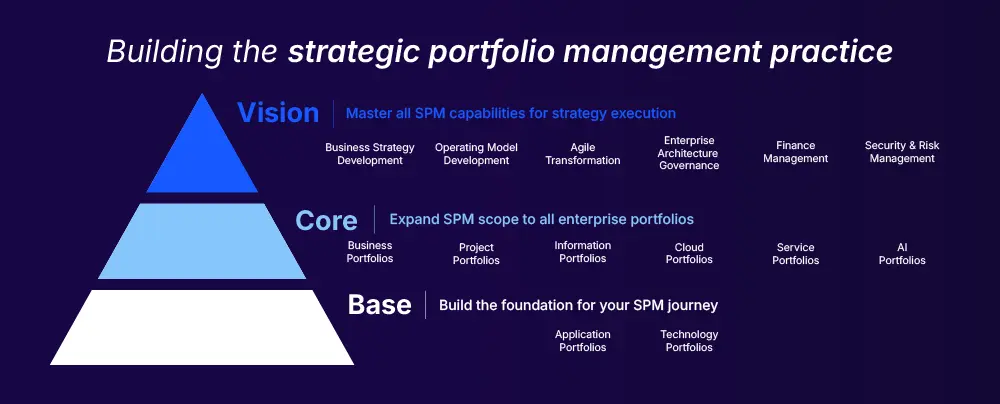
This expanded scope unlocks strategic capabilities that were previously out of reach: business strategies grounded in enterprise context, operating models that reflect actual capabilities, and transformation initiatives that advance objectives rather than fragment them.
In summary: Strategic Portfolio Management is built progressively. Organizations typically start by establishing reliable Application and Technology Portfolio visibility, then expand into related portfolio domains. This progression creates the enterprise context needed to align investment, modernization, governance, and execution decisions.
Application and Technology Portfolio Insights: The Foundation of Strategic Portfolio Management
Understanding what Application Portfolio Management (APM) and Technology Portfolio Management (TPM) actually entail, and how they work together, is essential to building the discipline effectively. Each addresses a distinct challenge, but together they create the architecture-grounded visibility Strategic Portfolio Management requires to function. Without this foundation, strategic planning becomes speculative and disconnected from the enterprise context that determines whether initiatives can be executed.
Application Portfolio Management: Addressing Visibility and Control
Applications sit at the center of most IT landscapes, but organizations typically struggle with limited visibility into lifecycle and licensing status and an unclear understanding of interdependencies. Changes to one application create unanticipated downstream impact because dependency relationships aren't documented or governed.
Application Portfolio Management (APM) is the discipline of inventorying, assessing, and governing applications to align the application landscape with business strategy and architectural standards. It reduces IT costs through rationalization, improves business agility through a simpler and more governable application landscape, and reduces risk by surfacing lifecycle exposure and dependency impact before decisions are made.
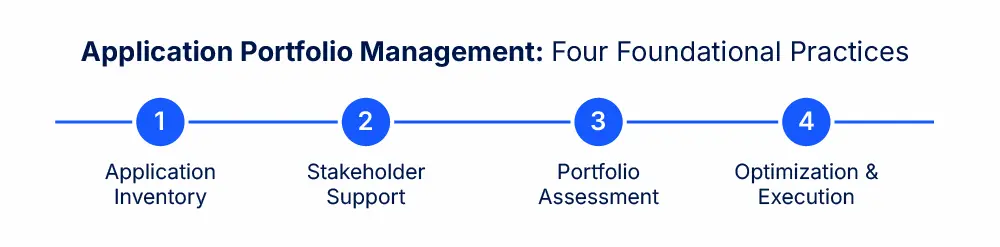
Organizations implement Application Portfolio Management through four foundational practices:
- Application Inventory. Establish a central repository for applications and gain the needed visibility for decision-making. Gather supplementary information such as business context, technology, information, and functional perspectives. Without a single source of truth, portfolio decisions fragment across teams.
Why: A central application inventory gives the whole organization one authoritative source of truth, enabling more efficient data management and the consistent, reliable visibility that all downstream portfolio decisions depend on.
- Stakeholder Support. Establish the right roles, processes, and responsibilities to enable information contribution. Use reports and visualization to answer questions and ensure stakeholder buy-in. Clear ownership ensures that application data remains current and that business and technology perspectives stay aligned.
Why: Sound portfolio decisions require input from multiple perspectives. Stakeholder support ensures that everyone involved in change decisions can contribute their knowledge to the system; and extract the information they need to do their job effectively.
- Portfolio Assessment. Analyze the portfolio across dimensions including technology health, technical debt, usage, and business fit. Assess application lifecycles to align technology support plans and understand roadmap impacts. This structured evaluation enables comparability across the landscape.
Why: Applying the necessary due diligence here ensures the integrity of pre-funding evaluations, rationalization candidate assessments, and modernization readiness and sequencing decisions.
- Optimization and Execution. Facilitate application rationalization to reduce budget utilization. Plan and manage transformation initiatives such as cloud migration. Rationalization, modernization, consolidation, and targeted investment decisions are sequenced intentionally.
Why: Following through on the need for change. Whether for cost reduction, cloud migration, post-merger integration, or where technical debt is blocking strategic progress, requires structured execution to turn portfolio insight into measurable outcomes.
When operated as a continuous practice, these four practices transform the application portfolio from a cost center into a governed, strategic asset. A well-maintained application portfolio delivers visibility into application health, ownership, cost, and lifecycle risk; strengthens governance that anticipates end-of-life exposure; supports rationalization that frees budget for strategic initiatives; and creates a better transformation path toward the desired future landscape.
In summary: Application Portfolio Management supports Strategic Portfolio Management by making the application landscape visible, assessable, and governable. It helps organizations understand application ownership, cost, lifecycle status, business fit, technical health, dependency exposure, and rationalization opportunities.
Technology Portfolio Management: Governing Standards and Risk
Technology Portfolio Management complements Application Portfolio Management by focusing on the underlying platforms, infrastructure components, and standards that support applications.
Technology Portfolio Management (TPM) is the discipline of inventorying, standardizing, and governing technologies to reduce risk, manage lifecycle exposure, and align technology choices with enterprise architecture and compliance requirements. It helps organizations stay ahead of technology obsolescence, expose technical debt, and focus investment on technologies that accelerate strategic goals.
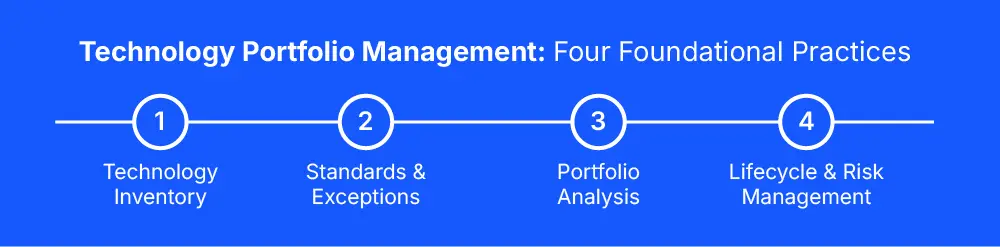
Organizations implement Technology Portfolio Management through four foundational practices:
- Technology Inventory. Establish a central repository for technologies, technology usage, and standards. Gather supplementary information such as usage by applications and providing vendors. This establishes the foundation for all subsequent technology governance decisions.
Why: A single source of truth for all technology data simplifies version maintenance and strengthens the integrity of impact assessments when disruptions (planned or unplanned) need to be understood quickly.
- Standards & Exceptions. Build a catalog of technology standards that accommodates regional, functional, and organizational variation. Manage exceptions to standards and ensure impact assessment. This provides clear guidance for technology decisions while maintaining necessary flexibility.
Why: Standardizing on a smaller, curated set of technologies improves agility, reduces costs, and lowers risk exposure across the portfolio.
- Portfolio Analysis. Identify where multiple technologies or versions serve the same purpose. Assess the impact of planned technology transformation and emerging innovations. This highlights areas of technical debt and identifies consolidation opportunities.
Why: Ongoing portfolio analysis is essential for consolidation planning, modernization programs, and any major technology shift that requires understanding the full impact across applications and their dependencies.
- Lifecycle & Risk Management. Align technology lifecycles to business applications. Use vendor information for creating technology roadmaps. Evaluate technology dependency and anticipate risk of failure. End-of-support exposure, vendor changes, and dependency risk are surfaced early, enabling proactive planning instead of emergency remediation.
Why: Staying current on end-of-support events, vendor changes, and security incidents ensures that the organization can assess impact quickly and act decisively to protect business continuity and integrity.
These practices matter because technology decisions create cascading consequences. When a zero-day vulnerability emerges or a vendor releases a critical patch, organizations need immediate visibility into which applications and business processes are affected. Without technology portfolio visibility, standardization decisions fragment across teams and version changes or end-of-support events trigger emergency remediation instead of planned transitions.
When these practices are in place, these risks become manageable. A strong technology portfolio improves governance through clear standards and controlled exceptions; manages lifecycle and vendor risk proactively; reduces non-compliance exposure by enforcing approved technology standards; and supports rationalization decisions that reduce technology sprawl.
In summary: Technology Portfolio Management supports Strategic Portfolio Management by making technology risk visible and governable before it becomes disruptive. It helps organizations enforce technology standards, manage end-of-support exposure, reduce version fragmentation, and assess the downstream impact of technology changes on applications and business continuity.
Connecting Application and Technology Portfolio Insights for Better Strategic Planning
Managing Application Portfolio Management and Technology Portfolio Management answer different questions, but those questions are inseparable in practice. Application Portfolio Management identifies which applications exist, what they cost, and what business capabilities they support. Technology Portfolio Management identifies which technologies underpin those applications, where lifecycle risk is building, and which standards are being enforced or ignored. Neither view is sufficient on its own.
When managed independently, the gaps are predictable. A decision to retire an application may overlook a shared technology dependency that affects three other systems. A technology end-of-support event may go unaddressed because the applications it affects haven't been mapped to it. Modernization initiatives get sequenced without visibility into the technical constraints that determine whether they're feasible.
When these portfolio views are connected, four things become possible that weren't before:
- Dependency mapping becomes actionable. Leaders can trace which business capabilities depend on which applications, and which applications depend on which technologies, in a single connected view.
- Impact assessment becomes faster. When a zero-day vulnerability or end-of-support event occurs, the affected application and business process scope is immediately visible rather than manually reconstructed.
- Rationalization decisions become better-grounded. Consolidating applications or retiring technologies can be sequenced based on actual dependency exposure rather than assumption.
- Investment trade-offs become clearer. Funding decisions reflect both the business value of applications and the technical risk of the technologies supporting them.
- Strategic Portfolio Management uses this connected view to frame investment, prioritization, and sequencing decisions. Without it, strategic planning rests on two incomplete pictures instead of one coherent foundation.
In summary: Application Portfolio Management (APM) and Technology Portfolio Management (TPM) are most valuable when connected. Applications depend on technologies, technologies carry risk, and both affect strategic execution. A connected portfolio view helps leaders evaluate trade-offs, prioritize modernization, manage risk, and sequence change with greater confidence.
Where Does Your Organization Stand? A Portfolio Visibility Maturity Check for Strategic Portfolio Management
The value of Strategic Portfolio Management depends in part on how well organizations understand the application and technology landscape behind their decisions.
This maturity check helps assess whether that foundation is reactive, managed, governed, or optimized. Most organizations operate at Level 1 or 2, where inventories may exist but decision-making remains reactive or only partially informed. Progressing toward Level 3 requires disciplined Application Portfolio Management and Technology Portfolio Management practice. Level 4 is where those practices inform Strategic Portfolio Management on a continuous basis.
Level 1: Reactive. Application and technology inventories exist in spreadsheets or fragmented tools. Ownership is unclear. Decisions are made in response to crises such as outages, audits, budget cuts, or urgent security events.
Level 2: Managed. Inventories are centralized and ownership is assigned. Lifecycle and cost data are tracked, but dependency mapping is incomplete, making it difficult to evaluate business impact or sequence change confidently.
Level 3: Governed. Dependencies are documented and portfolio decisions are evaluated against business impact, cost, risk, and lifecycle exposure. Rationalization is planned, not reactive.
Level 4: Optimized. Portfolio visibility is continuously maintained. Application Portfolio Management and Technology Portfolio Management feed Strategic Portfolio Management decisions, so modernization, cost control, risk management, and investment prioritization operate as a coordinated discipline.
Operating Application Portfolio Management and Technology Portfolio Management as Continuous Disciplines
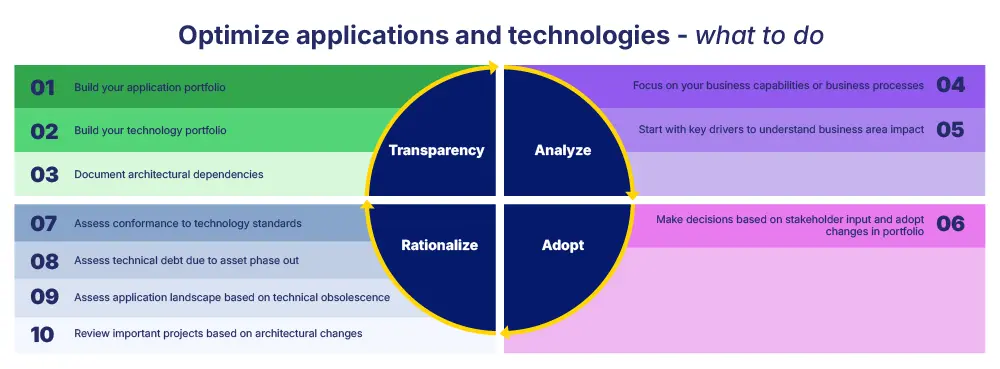
Application and technology portfolio visibility establishes the foundation, but Strategic Portfolio Management delivers sustained value when operated as a repeatable cycle that keeps portfolio decisions aligned to business priorities and enterprise context.
1. Visibility
Making the current state visible and usable means maintaining a dependable application and technology portfolio, documenting architectural dependencies, and establishing the baseline for all subsequent analysis and decision-making. Without this foundation, every downstream decision rests on assumptions rather than evidence.
2. Analyze
Use that baseline to evaluate applications and technologies in context, not in isolation. Analysis considers enterprise impact: alignment to business strategy and goals, capability support, usage and criticality, technical health, lifecycle status, cost, risk, user satisfaction, and technical debt.
Factor in dependencies across processes, applications, and technologies so decisions reflect real downstream impact. Start with key business capabilities or processes to understand where change creates the greatest business value.
3. Rationalize
Turn analysis into decisions that reduce unnecessary complexity and free capacity for change. Rationalization may include consolidating duplicated applications or technologies, addressing end-of-life risk, and redirecting investment toward higher-value transformation priorities.
Sequencing matters: removing or changing anything without dependency awareness creates avoidable disruption. Decisions are made collaboratively with stakeholders, then adopted formally into the portfolio.
4. Adopt
The Adopt phase ensures that the portfolio view stays current as the landscape evolves. This means reviewing important projects for architectural changes, assessing the application landscape for technical obsolescence, evaluating technical debt as assets phase out, and monitoring conformance to technology standards. Without this continuous governance, the portfolio becomes outdated, decisions lose grounding, and the cycle breaks. Adoption closes the loop so the next cycle begins with accurate data.
In summary: Strategic Portfolio Management delivers sustained value when it operates as a continuous cycle rather than a periodic planning exercise. By making the current landscape visible, analyzing applications and technologies in context, rationalizing complexity, and adopting decisions through governance, organizations keep strategy aligned with business priorities and enterprise architecture reality.
How to Get Started with Application and Technology Portfolio Visibility
You don’t need a multi-year program to start building reliable visibility across your application and technology portfolios. The goal is to create enough trusted insight to support better investment, modernization, risk, and rationalization decisions.
Start with these steps to support better Strategic Portfolio Management decisions:
- Anchor the portfolio to business priorities. Identify the capabilities, processes, or strategic objectives the portfolio must support, so rationalization decisions aren’t made on cost alone.
- Inventory what you have. Begin with business-critical applications and the technologies that support them. A simple first-pass inventory is enough to establish a baseline; the priority is to start with the assets most relevant to business continuity, cost, risk, and transformation.
- Assign ownership. Identify one accountable owner per application and technology. Without ownership, portfolio data quickly becomes outdated and less useful for decision-making.
- Document dependencies. Map which applications depend on which technologies, and which business capabilities or processes depend on those applications.
- Assess lifecycle risk. Flag applications and technologies approaching end-of-support or end-of-life, and identify where those risks could affect critical business capabilities, security exposure, or transformation timelines.
- Rationalize incrementally. Start with low-value, high-cost, duplicated, or high-risk applications and technologies. Quick wins build momentum and help demonstrate the value of portfolio visibility.
- Govern continuously. Review the portfolio quarterly or when significant business, technology, or architecture changes occur. Portfolio visibility is only valuable if it stays current enough to support decisions.
Creating A Durable Transformation Through Portfolio Discipline
Strategic Portfolio Management positions IT as a structured enabler of business strategy. Its impact grows when portfolio decisions are grounded in clear application and technology insight rather than assumptions.
The discipline begins with Application Portfolio Management and Technology Portfolio Management, which establish visibility into what exists, how it supports the business, and where lifecycle and dependency risks reside. When this visibility feeds Strategic Portfolio Management, organizations can make investment, modernization, and rationalization decisions with stronger evidence and greater confidence.
Our perspective is that Strategic Portfolio Management delivers the most value when connected to the enterprise context behind transformation decisions. Leaders need strategic clarity, but they also need to understand the architectural and portfolio reality that determines whether their plans are feasible.
Bizzdesign Alfabet supports this by bringing Strategic Portfolio Management, Application Portfolio Management, Technology Portfolio Management, and Enterprise Architecture together in one connected portfolio discipline. It helps organizations link strategy and investment decisions to the application and technology realities that shape execution, so teams can prioritize with confidence, manage risk earlier, and sequence transformation based on what’s feasible as well as what’s strategically important.
When operated as a continuous cycle, building visibility, analyzing against business impact, rationalizing complexity, and adopting decisions through governance, Strategic Portfolio Management reshapes how organizations execute strategy. Technology risk surfaces early enough to plan rather than react. Modernization accelerates because decisions are grounded in enterprise context. Portfolio rationalization frees budget for innovation by eliminating redundant systems and reducing maintenance overhead.
The pressures that create complexity aren’t going away. What changes is the organization's ability to respond with intention rather than urgency. With reliable portfolio visibility and continuous governance, leaders can close the gap between strategic intent and execution, making transformation decisions with greater clarity, confidence, and control.

FAQs
Strategic Portfolio Management is the discipline that connects business strategy to execution across demand, investments, architecture, applications, technologies, and initiatives. It helps leaders decide what to fund, modernize, rationalize, retire, or sequence based on business priorities, cost, risk, dependencies, and execution feasibility. The goal is to ensure that investment decisions, modernization efforts, and operational priorities align with enterprise objectives.
Enterprise Architecture provides the structural foundation that makes Strategic Portfolio Management credible and executable. It delivers a reliable view of ownership, lifecycle position, cost exposure, risk, and architectural dependencies across the application and technology landscape. Strategic Portfolio Management delivers sustained value when planning decisions are grounded in that context, including the applications, technologies, dependencies, capabilities, costs, and governance structures that determine what the organization can realistically change, fund, modernize, or retire.
Application Portfolio Management focuses on inventorying, assessing, and governing applications to align the application landscape with business strategy and architectural standards. It addresses visibility into application ownership, lifecycle, cost, business fit, and technical health. Technology Portfolio Management focuses on the technologies that support those applications: standards, versions, lifecycle risk, vendor exposure, and dependencies. It addresses technology sprawl, version fragmentation, standards enforcement, and end-of-support risk.
Together they provide the foundation Strategic Portfolio Management requires. Bizzdesign Alfabet brings Application Portfolio Management, Technology Portfolio Management, and Strategic Portfolio Management together in one connected view, so the foundation that strategic planning depends on is continuously maintained rather than periodically assembled.
Application Portfolio Management (APM) and Technology Portfolio Management (TPM) deliver sustained value when operated as a repeatable cycle through four phases.
- Visibility: Building and maintaining a dependable application and technology portfolio with documented architectural dependencies, establishing the baseline for all subsequent analysis and decision-making.
- Analyze: Evaluating applications and technologies against business alignment, technical health, lifecycle status, cost, risk, and dependency impact, so decisions reflect real downstream consequences rather than isolated assessments.
- Rationalize: Turning analysis into decisions that consolidate duplicated assets, eliminate low-value systems, address end-of-life risk, and redirect investment toward higher-value transformation priorities, sequenced based on dependency awareness.
- Adopt: Reviewing initiatives for architectural changes, assessing the landscape for technical obsolescence, and monitoring conformance to technology standards so the portfolio stays current and the cycle begins each iteration with accurate data.
This repeatable cycle keeps APM and TPM operating as continuous governance disciplines rather than a periodic planning exercise.
Strategic Portfolio Management supports AI governance and investment decisions by making the application and technology landscape that AI initiatives depend on visible before commitments are made. Each AI initiative creates dependencies across the existing portfolio: the data it can access, the systems it touches, the risks it introduces, and the investments it may displace or require.
Without portfolio visibility, AI planning becomes speculative and governance becomes reactive. With Strategic Portfolio Management in place, organizations can evaluate AI opportunities against enterprise priorities, architecture constraints, data and technology dependencies, lifecycle risk, and security exposure. Bizzdesign Alfabet supports this with capabilities including AI portfolio management, strategic investment planning, and portfolio-wide analysis across applications, technologies, and dependencies.
Technology portfolio visibility supports cybersecurity and vulnerability response by providing immediate insight into which technologies are affected by a vulnerability, which applications depend on them, which business processes are exposed, and which remediation actions should take priority. When a zero-day vulnerability emerges or a vendor releases a critical patch, organizations need to understand impact and sequence remediation based on business criticality and dependency exposure. Without technology portfolio visibility, vulnerability response becomes reactive and fragmented. Proactive lifecycle and risk management surfaces end-of-support exposure, vendor changes, and dependency risk early, enabling planned transitions instead of emergency remediation. With Bizzdesign Technology Portfolio Management, organizations can bring technology standards, lifecycle risk, vendor exposure, technical debt, and application dependencies into one governed view, helping teams prioritize remediation, reduce fragmentation, and connect technology decisions to architecture and compliance.
Organizations can get started with Strategic Portfolio Management by building reliable application and technology portfolio visibility first. Begin by anchoring the portfolio to business priorities, inventorying business-critical applications and the technologies that support them, assigning one accountable owner per asset, and documenting dependencies. From that baseline, assess lifecycle risk, rationalize incrementally starting with low-value or high-risk assets, and govern continuously through quarterly reviews.
The goal is to build enough trusted enterprise context to support better investment, modernization, risk, and sequencing decisions, then expand the discipline progressively into the broader Strategic Portfolio Management domains . Bizzdesign Alfabet supports this progression, starting from application and technology portfolio visibility and scaling across the full Strategic Portfolio Management discipline as organizational maturity grows.




Prioritize the right initiatives, maximize resource impact, and keep strategy on track.