
Bizzdesign AI Capabilities
Work Smarter, Move Faster
Scale Your Impact With AI
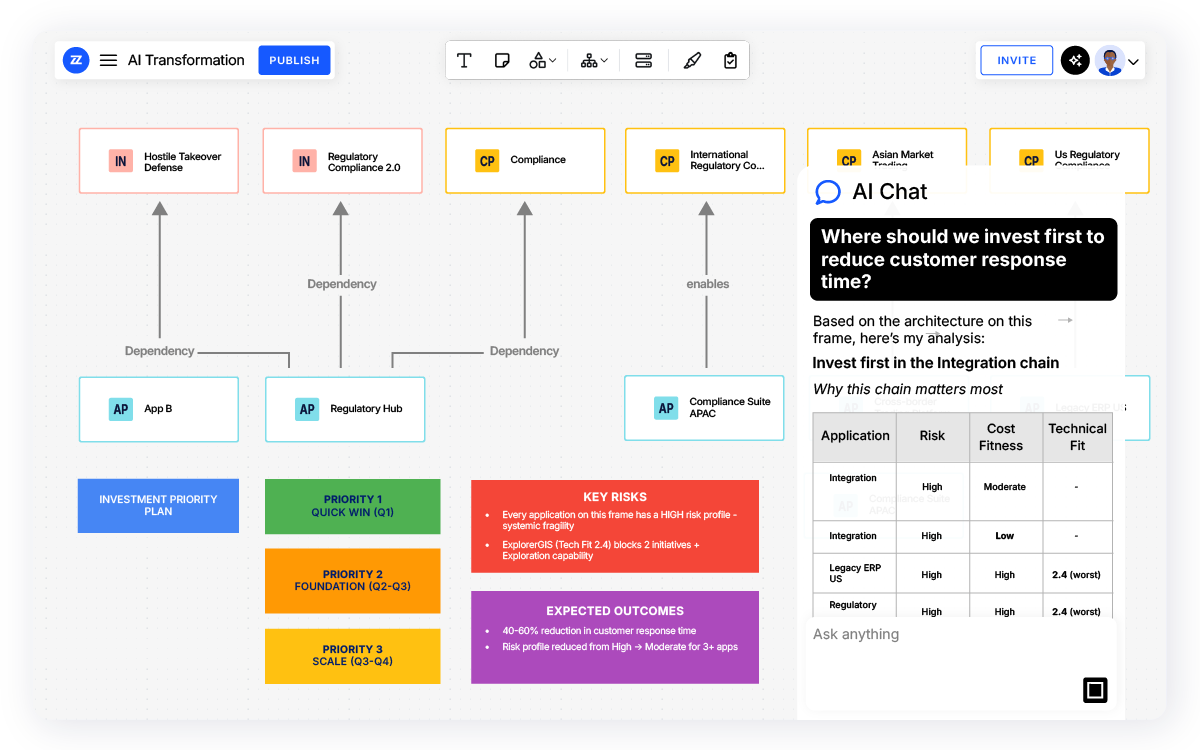
We've built AI capabilities into the Enterprise Transformation Suite to remove the manual work that limits impact. By handling time-consuming tasks and improving the flow and quality of information, these capabilities give architecture teams the space to focus on alignment, communication, and guiding transformation from strategy through execution.
Our AI Capabilities
Enterprise-Ready AI, Built into the Enterprise Transformation Suite
- Get started faster
- Bring context where needed
- Identify opportunities
- Collaborate on scenarios
- Turn opportunities into action
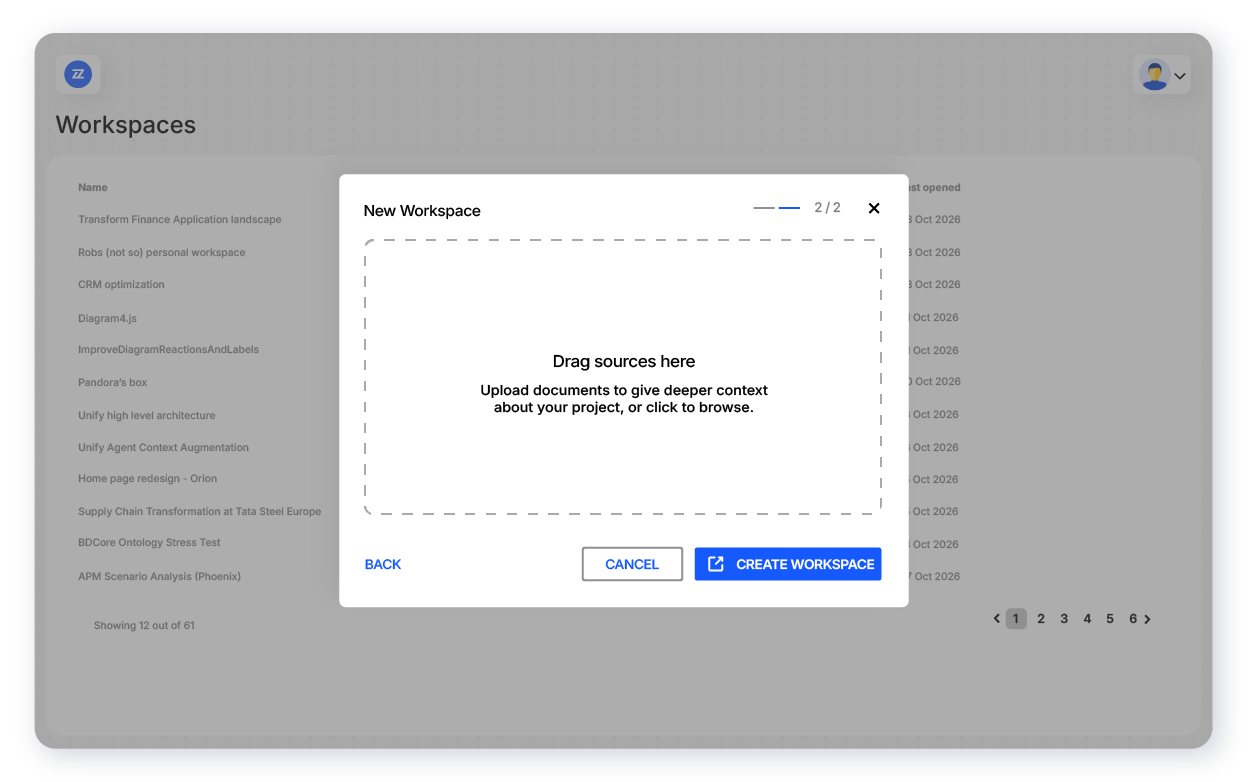
Get started faster
Reduce your mobilization timescales and find what you need quickly and easily.
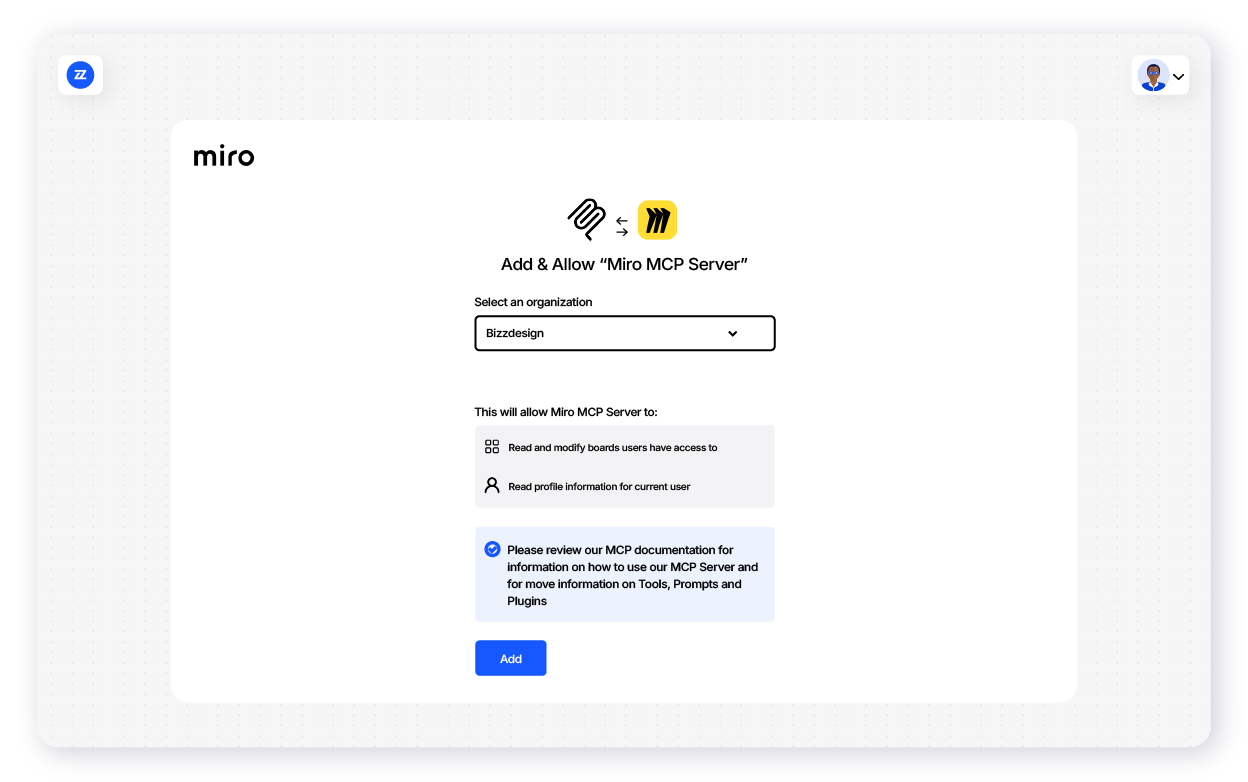
Bring context where needed
Accelerate your data connections with AI-assisted integrations.
Identify opportunities
Analyze and prioritize your opportunities with AI-powered insights and recommendations.
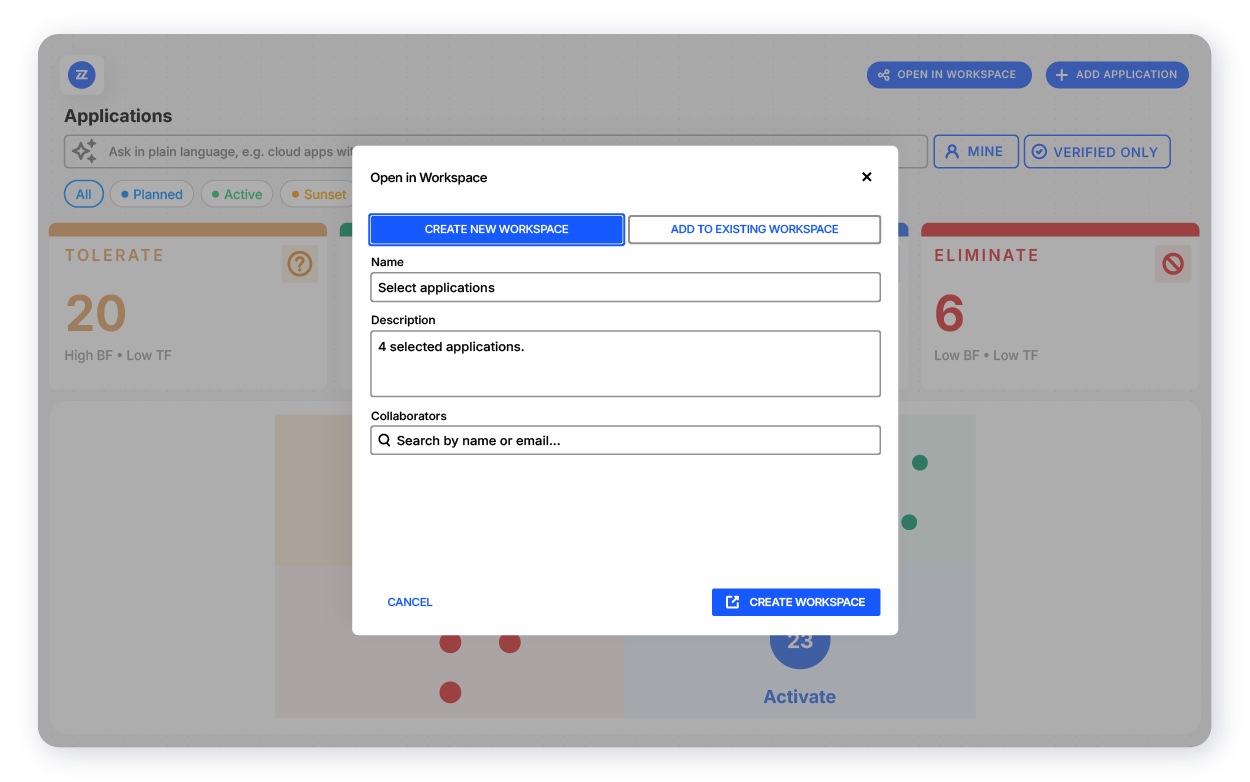
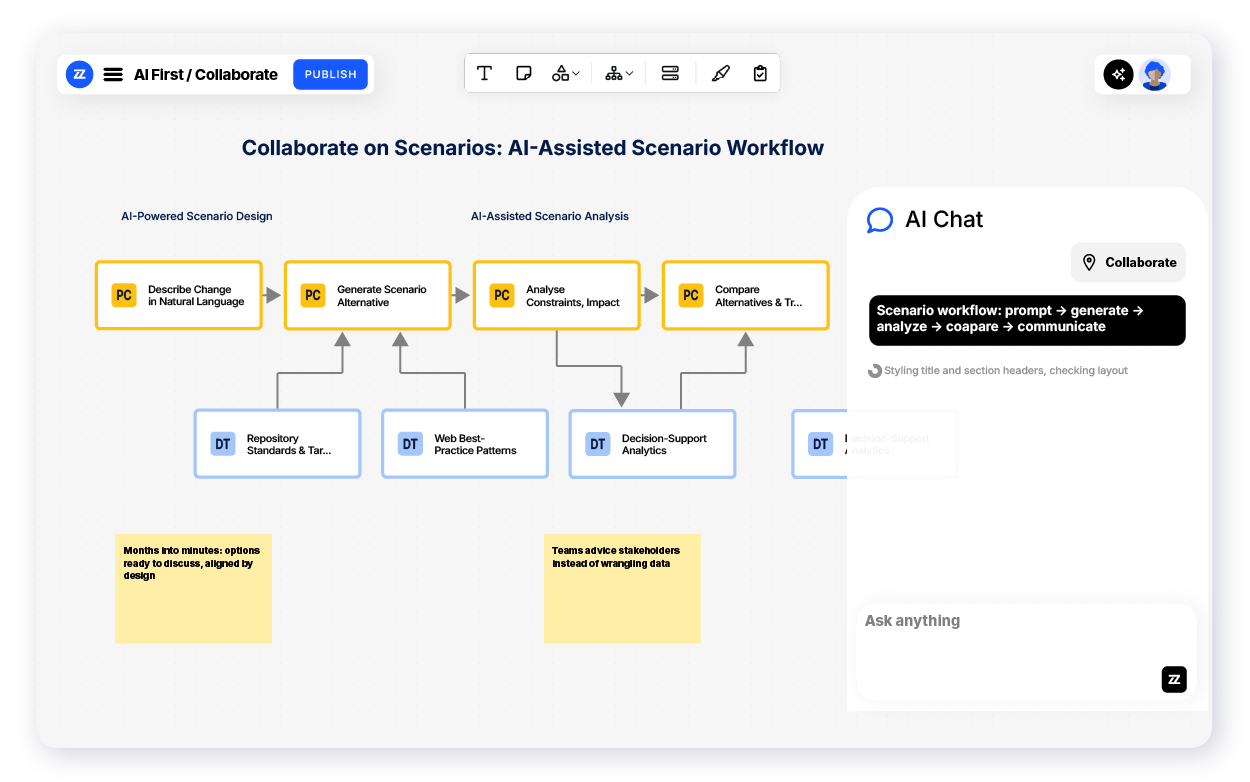
Collaborate on scenarios
Generate and compare alternatives fast while improving stakeholder engagement.
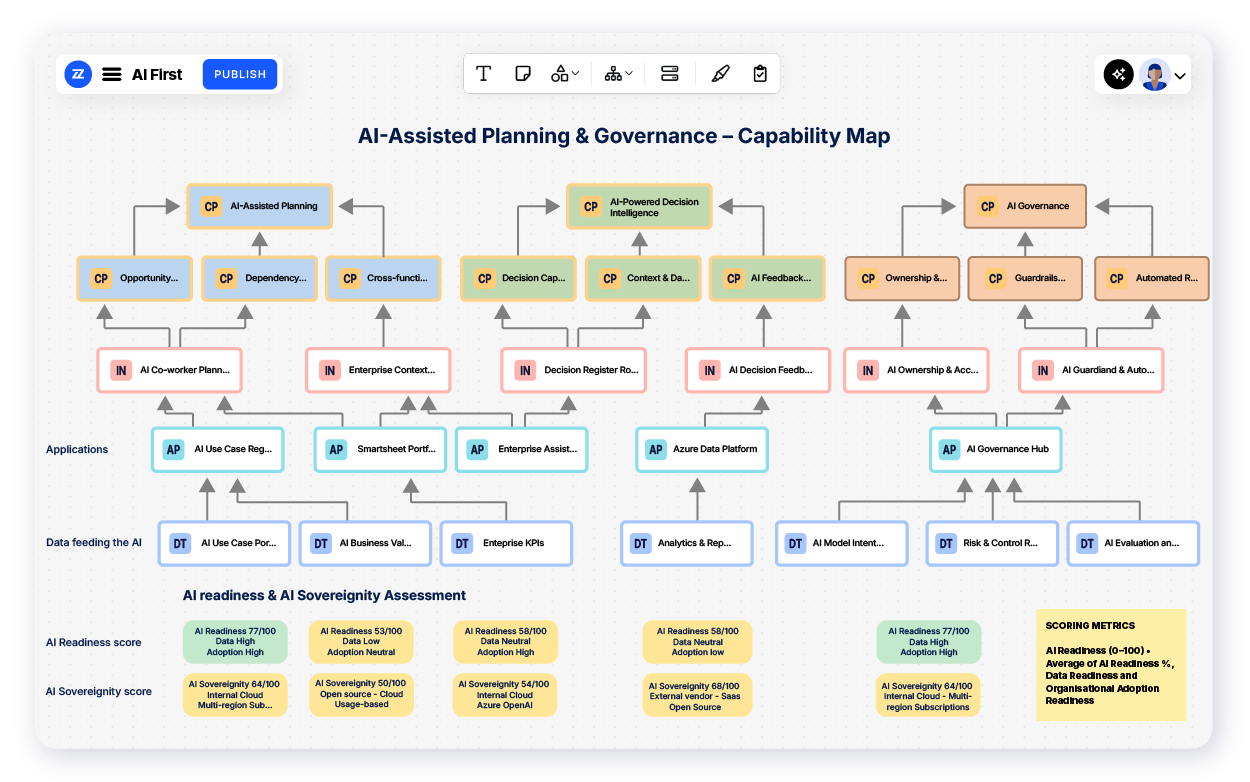
Turn opportunities into action
Advance your goals and reduce your risks through AI-assisted planning and governance.
Reduce your mobilization timescales and find what you need quickly and easily.
Accelerate your data connections with AI-assisted integrations.
Analyze and prioritize your opportunities with AI-powered insights and recommendations.
Generate and compare alternatives fast while improving stakeholder engagement.
Advance your goals and reduce your risks through AI-assisted planning and governance.
What changes when teams use Bizzdesign Unify
34%
of time reallocated
Less time gathering and documenting information. More time for decision-making and strategic advisory work.

25%
less transformation work
Moved from multi-week workshops to focused, real-time capability assessments with business stakeholders.

5 weeks
recovered
Per 12-week cycle, with baseline building reduced from weeks to days and more time for valuable insights.

FAQs
AI tools can do more than answer general questions. When they can access trusted information about your business and technology landscape, they can provide answers grounded in your organization, helping teams make better-informed decisions without manually gathering context from different systems.
Bizzdesign makes this possible in two directions. Its MCP Server gives compatible external AI tools, such as Claude, Gemini, and ChatGPT, access to enterprise architecture information held in Bizzdesign. Fast MCP Inbound Integration brings information from external tools into Bizzdesign through natural-language queries, where those tools support MCP.
By connecting AI tools with the enterprise context they need, organizations can get more relevant answers from their existing AI investments and apply them to real business and technology challenges. This connection is enabled by the Model Context Protocol (MCP).
When information is scattered across systems and teams, finding answers can mean searching multiple sources or relying on colleagues who know where to look. This slows decisions and makes it harder for teams to work from the same information.
Bizzdesign's AI Smart Search lets users ask natural-language questions to find information in their enterprise architecture repository, without needing to know specialist terminology or how the repository is structured.
This helps teams get to relevant information faster and use it to inform decisions. As part of Transformation Collaboration, accessible enterprise context helps connect people and decisions, reducing misalignment and keeping transformation work moving.
The best AI opportunities solve a meaningful business problem, support strategic priorities, and have a realistic path to delivering measurable results. Identifying them requires understanding where AI could improve performance and whether the organization has the foundations to support change.
Bizzdesign's AI Capability Assessment helps organizations identify business capabilities with AI transformation potential by assessing their strategic importance, operating model readiness, and the modernization profile of supporting applications and technologies. This helps teams pinpoint where AI could make a difference and where existing gaps may need to be addressed first.
Connecting these opportunities to business strategy helps teams prioritize AI initiatives based on the outcomes they need to achieve.
Application investment decisions require more than looking at technical health or maintenance costs alone. An application may be expensive to maintain but still support a critical business capability, while another may be technically sound but no longer meet the organization's needs.
Bizzdesign's AI Portfolio Analysis uses its AI Pathfinder skill to generate modernization and replacement recommendations, combining business value and technical health scores with strategic priorities and target outcomes. This helps teams understand which applications warrant further investment and which may be candidates for change.
Through Application Portfolio Management, organizations can assess their application landscape in the context of business needs and make more informed decisions about where to invest, modernize, consolidate, or retire applications.
A promising idea can look straightforward on a whiteboard but prove difficult to deliver once its impact on the wider business and technology landscape becomes clear. Comparing options early helps teams understand what each change would involve before committing resources.
Bizzdesign's Transformation Collaboration brings trusted enterprise architecture data into collaborative work. AI-Powered Scenario Design helps teams generate alternatives from natural-language prompts, while AI-Assisted Scenario Analysis reveals potential impacts, dependencies, constraints, and trade-offs.
Teams can compare options against their enterprise context while decisions are still open, making it easier to choose a feasible path before execution begins.
When teams make decisions across different meetings and tools, the reasoning behind those decisions can get separated from the work itself. People may revisit settled questions or move forward with different assumptions.
Bizzdesign Unify gives stakeholders a shared workspace for transformation work, connected to enterprise architecture and portfolio context. AI-Assisted Communications keeps discussions linked to relevant artefacts, while AI-Powered Decision Intelligence captures decisions and their rationale so teams can trace what was agreed and why.
This gives stakeholders a shared reference point as work progresses, helping them carry decisions forward without losing the context behind them.
A change to one application, process, or business capability can affect other parts of the organization. If teams discover these dependencies only after a plan is underway, they may need to revisit decisions or change course.
Bizzdesign Unify brings stakeholders from across the business into a shared visual workspace where they can use a whiteboard to explore ideas and shape initiatives. Its AI co-worker makes enterprise context accessible during these discussions, helping teams surface dependencies and understand potential impacts as plans take shape.
Connecting collaborative ideas to the business and technology landscape, teams can spot constraints earlier and shape plans around what the organization can realistically deliver.
AI governance should help organizations move forward with confidence, not create unnecessary barriers to adoption. That becomes difficult when teams lack visibility into where AI is being used, who is responsible for it, or how it relates to existing applications and business activities.
Bizzdesign's AI Governance capabilities are designed to provide the visibility, ownership, and guardrails needed to keep AI use under control while enabling decisions at speed. AI-Powered Decision Intelligence adds traceability by capturing the context and rationale behind decisions.
For broader oversight, Bizzdesign's guidance on AI portfolio governance explains how organizations can bring AI use across the application portfolio into view and connect governance with existing enterprise responsibilities. This helps teams establish a clearer basis for oversight without treating every AI initiative as an entirely separate governance exercise.

Connect AI to trusted business and technology context to uncover opportunities and make better-informed decisions.