
Model Context Protocol (MCP): Turning Enterprise Architecture into AI-Ready Intelligence
Your board approved the AI budget. Your teams deployed the tools. Pilots are running across the business. Yet when leadership asks a straightforward question about impact, the answer still takes too long to assemble.
In most organizations, the issue isn’t ambition or capability. It’s access. The information needed to support enterprise decisions already exists, but it’s spread across portfolios, architecture models, roadmaps, and governance processes. Worse, it exists in formats AI can't reliably use, such as documents, dashboards, and disconnected systems that force AI to infer context rather than reason over structure.
AI can accelerate isolated tasks. But without direct access to governed enterprise knowledge, AI has limited ability to inform enterprise decisions and is largely confined to supporting tactical tasks. Your architects still spend hours assembling context that could be instantly available. Your business leaders still wait days for answers that could take seconds.
That is the gap Model Context Protocol (MCP) can address, but only if the architectural foundation behind it is mature enough.
Model Context Protocol (MCP): The Interface Between AI and Enterprise Architecture
Making enterprise architecture machine-readable requires a standardized interface that AI can reliably query. MCP provides that interface. Its value lies in what it connects AI to, which is not raw data but the enterprise model itself as a structured, queryable system of record.
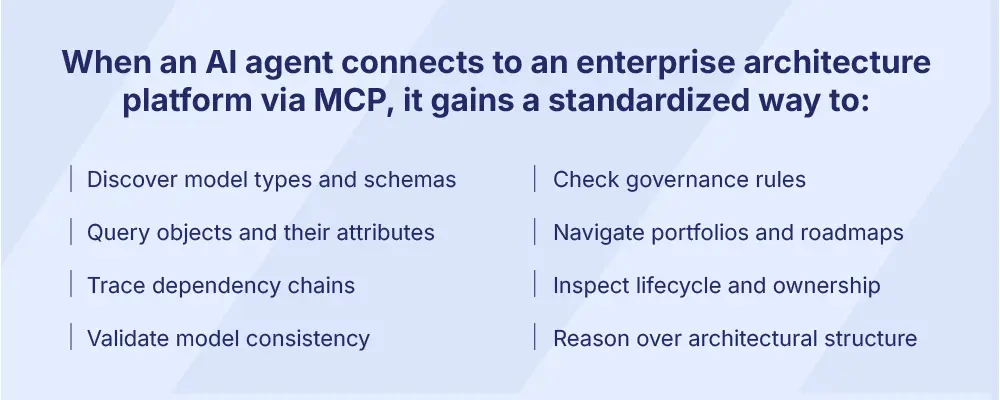
With MCP, AI applications can securely interact with an enterprise architecture platform and access models, attributes, relationships, ownership, lifecycle state, and semantics through a consistent protocol. When connected to an EA repository, AI agents can traverse dependencies, understand semantic relationships, and operate within architectural constraints while validating against governance rules.
The difference is fundamental. Instead of inferring context from documents and dashboards, AI reasons using the structural logic of your enterprise—understanding which applications depend on which processes, where risk concentrates, what breaks if a system retires, and who owns what across the portfolio.
This architectural access extends beyond the EA team. Because MCP standardizes the interface, it makes architectural intelligence accessible to business analysts, product owners, and transformation leads who can now interact with the enterprise model through AI without needing deep EA expertise. They ask questions in plain language. AI queries the governed model. Answers come back in seconds, not days.
But here's what determines whether that promise delivers: the architectural foundation MCP connects to.
How Does MCP Work in Practice?
In production environments, MCP operates as an execution layer between AI systems and your EA platform. When an AI assistant connects, it doesn't receive a static dataset or a document index. Instead, it connects to a server that exposes the architecture as a typed, queryable model with built-in semantics.
What does that mean in practice?
The MCP server exposes your enterprise as structured, queryable intelligence:
- Business object types, such as applications, risks, processes, controls, organizational units, capabilities, and compliance domains.
- Attributes, such as ownership, lifecycle state, criticality, cost, and risk.
- Relationships that define how these concepts connect across the enterprise.
- Governance rules that define what is valid, complete, and approved.
AI interacts with this model through discovery and structured requests. It can retrieve applications with high operational risk, identify business processes affected by regulatory change, trace which organizational units depend on systems approaching end of life, and map the path from a business capability to its underlying technical implementation.
This is the shift from document inference to architectural reasoning. AI agents evaluate structure, dependencies, and impact using governed enterprise models, making architectural intelligence accessible across the business through AI rather than confined to specialist tools. They can deliver comprehensive analysis in seconds, freeing enterprise architecture teams from manual tasks like translating whiteboards, cleaning metadata, and assembling reports so architects can focus on strategic design and complex architectural decisions that move transformation forward.
The difference shows up in outcomes. A chatbot operating on inferred context can sound convincing. An architectural assistant operating on the enterprise model can support consequential portfolio and transformation decisions.
But whether MCP delivers that level of intelligence depends entirely on what sits behind the protocol.

Why the Architectural Foundation Behind MCP Determines Everything
MCP's promise depends entirely on what the protocol connects to. While MCP defines how AI systems connect to enterprise platforms, it doesn't define what those platforms provide. The difference lies in the architecture platform behind the protocol. And that difference determines whether AI gains true intelligence or just faster access to shallow data.
Thin Implementations: Fast Access to Shallow Context
Thin implementations wrap a database or document store and expose it through MCP. In these environments:
- Enterprise concepts are flattened into generic records
- Relationships are shallow or implicit
- Semantics are limited or absent
- Governance is external to the model
AI can retrieve information, but it has little understanding of architectural intent or enterprise structure.
Consider a request like: “Show me applications at risk due to the EU AI Act.”
In this type of implementation, the response is limited to returning applications tagged with “EU AI Act” or a similar attribute. The result may be technically correct, but it offers no visibility into why those applications are exposed, which regulatory obligations apply, or where accountability and remediation sit. You get a list. Not intelligence.
Native Implementations: Architectural Reasoning at Scale
Native implementations expose a true enterprise knowledge graph. They provide:
- Rich relationship models across portfolios, processes, applications, and organizations
- Embedded governance and lifecycle management
- Multi-hop traversal across architectural layers
- Schema introspection and tool discovery for AI agents
In these environments, the architecture platform provides the structural and semantic foundation for architectural reasoning when accessed through MCP. Relationships, constraints, and governance rules are explicit, allowing AI to evaluate dependencies, impact, and alignment without inferring them from fragmented sources.
Using the same request referenced earlier, “Show me applications at risk due to the EU AI Act,” a native implementation can trace regulatory requirements to compliance controls, map those controls to affected business processes, identify the supporting applications and underlying infrastructure, and surface gaps in coverage, ownership, or lifecycle status. The output reflects how risk actually manifests across the enterprise, not just where a tag happens to exist.
A platform built for documentation exposes shallow context. A platform built as an operational system of record for transformation exposes a living enterprise model. MCP exposes that difference to AI.
The Durable Variable You Control
What determines whether AI creates value? Not the model you choose. Not the budget you allocate. The architectural foundation underneath.
Enterprise Architecture, exposed through MCP, provides the foundation AI needs to move beyond isolated use cases. The protocol facilitates the connection. The architecture determines which models, relationships, rules, and constraints are available through that connection for EA teams, business analysts, and AI agents alike.
AI models can be changed. Architecture compounds over time. It’s a durable variable you control. You can assess your current state, identify gaps in governance and semantic richness, and deliberately build toward an AI-ready foundation. When architecture becomes machine-readable, transformation flows more reliably from strategy to execution and from insight to action, across business and IT.
Your EA foundation determines what's possible. If it's mature, MCP can turn it into AI-ready intelligence today. If it's not, you've just identified the highest-leverage work your team can do.
FAQs
Model Context Protocol (MCP) is an open standard that defines a structured interface through which AI applications can interact with enterprise systems and data sources, as exposed by MCP servers.
In the context of enterprise architecture, MCP allows authorized users to ask questions in natural language through AI tools such as ChatGPT, Microsoft Copilot, and Claude. Those tools translate the request into structured queries against governed EA models. This makes it possible for business and technology stakeholders to explore applications, processes, capabilities, risks, and dependencies directly from the architecture repository, without needing deep architectural expertise.
MCP doesn’t replace or bypass enterprise security, access control, or governance. Instead, MCP defines a standardized way for AI to interact with systems that already enforce those controls, with MCP servers implementing that interaction at runtime.
When an MCP server is connected to an enterprise architecture platform, access to architecture data is governed by the same identity, role-based access controls, and authorization policies that apply within that platform. AI agents only receive data the authenticated user or system is entitled to access. Sensitive domains, regulated data, and restricted models remain protected.
At runtime, the MCP server acts as a controlled execution layer, evaluating each request against governance rules, lifecycle states, and approval status defined in the EA repository. This, in turn, ensures AI agents operate on trusted, current, and approved architecture data.
MCP provides AI with direct access to enterprise architecture models, including applications, processes, capabilities, risks, and their relationships. Instead of inferring context from documents or dashboards, AI can query the architecture as a structured, governed system and evaluate dependencies, governance rules, and impact across the enterprise.
A thin MCP implementation uses the protocol primarily as a connector, exposing low-level tools, raw data, or generic APIs with limited embedded semantics. As a result, AI must rely more heavily on prompting and inference to determine how to combine outputs, interpret meaning, and resolve intent. This can work for narrowly defined requests, but it breaks down as ambiguity increases, because relationships, constraints, and architectural context are reconstructed by the model rather than supplied by the system.
A native MCP implementation exposes domain-specific, semantically rich capabilities through the protocol, allowing AI to interact with a governed enterprise model instead of raw outputs. The intelligence lives in the platform, not the prompt, reducing inference error and enabling AI to operate reliably on structure, dependencies, and impact.
MCP enables AI to reason over complex enterprise contexts and insights, not just retrieve data. By linking AI assistants to governed EA data, teams can instantly surface dependencies, risks, and progress across applications, processes, and capabilities. This gives business and IT roles access to the same trusted, structured enterprise intelligence, helping them make confident, evidence-based decisions.
MCP makes architectural intelligence accessible beyond the EA team. Business analysts, product owners, transformation leads, and other authorized users can interact with the enterprise model through AI without needing deep EA expertise. It gives them secure, real-time access to trusted enterprise insights through the AI tools they already use, helping teams find answers and make decisions in seconds.
Behind the scenes, MCP is the enabler that connects data, AI, and people. It drastically scales the EA team’s strategic impact by reducing manual work, streamlining repetitive requests, and getting valuable insight into the hands of those who need it across the business.
MCP is most effective when deployed on top of a mature enterprise architecture foundation. Organizations that see the strongest results typically have:
- A well-defined metamodel with clear business and technology concepts,
- Governed ownership across applications, processes, and capabilities,
- Lifecycle management embedded into architecture workflows,
- Strong integration between portfolios, roadmaps, and delivery.
In these environments, MCP exposes a living enterprise model that AI can reason over immediately.




Automate repeatable work and make architecture insight easier to access across the business.