Enterprise Transformation Shifts That Will Define 2026
What 2025 Taught Us About Enterprise Transformation
Enterprise leaders are entering 2026 with no shortage of ambition, but far less tolerance for drift. After several years of sustained investment in AI, cloud, data, and security, boards and executive teams are no longer debating whether transformation is possible. They are asking a more demanding question: can it deliver consistent, measurable value at scale?
In many organizations, that pressure is most visible in one area: AI. Pilots and proofs of concept are no longer sufficient to demonstrate progress. Leaders now expect evidence that experimentation can translate into scalable operational outcomes, and that the organization itself is designed to absorb innovation at the pace the business requires.
The questions leaders ask are no longer, “Can AI work?” or “Should we modernize?”
It’s now, “How do we make this deliver measurable value, and how do we do it without losing control?”
The shifts shaping 2026 reflect this reality. They mark a new moment for enterprise transformation — one where long-standing architectural, governance, and portfolio disciplines are no longer optional, but central to delivering outcomes at scale.
The Three Shifts Shaping Enterprise Transformation 2026
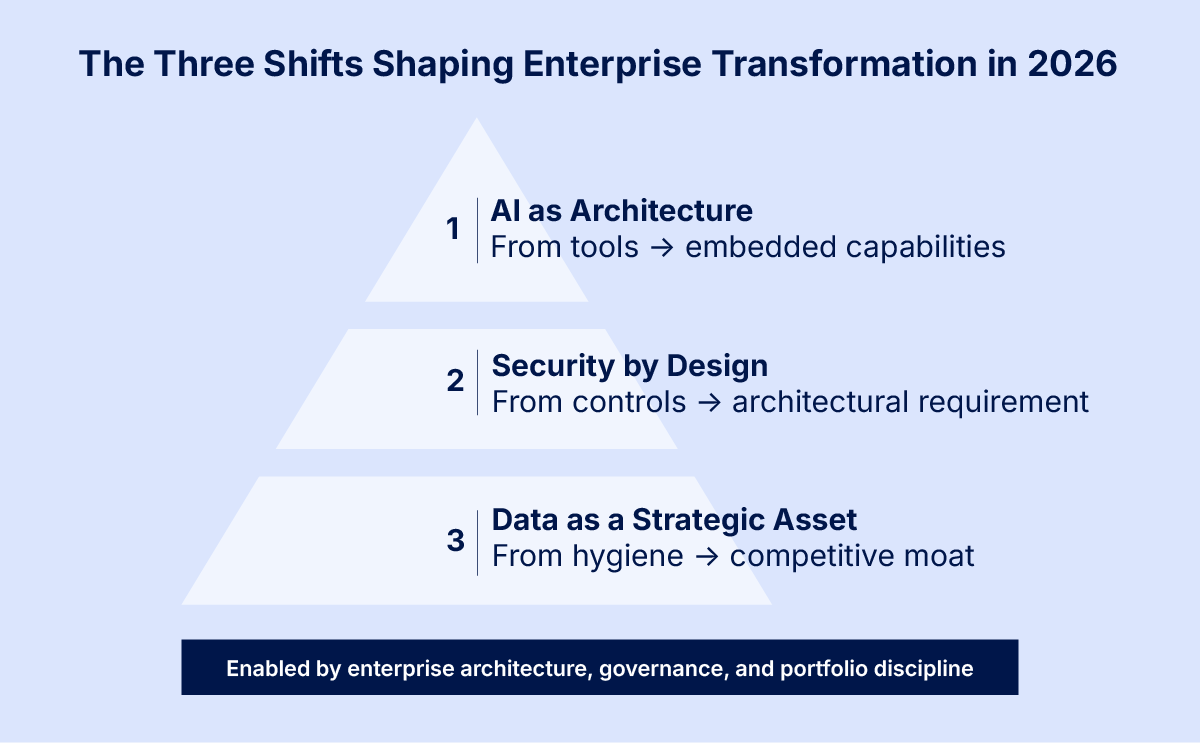
1. AI Moves to the Core of Enterprise Design
A clear divide is emerging between organizations that add AI onto existing ways of working and those that design AI into how the business actually runs. That distinction will increasingly define competitive advantage in 2026.
When AI is treated as a layer — a chatbot here, an automation there — value remains local and inconsistent. These initiatives may demonstrate technical potential, but they rarely compound into enterprise-wide impact. By contrast, when AI is treated as an architectural component, it is embedded into core business capabilities and governed as part of the operating environment, not deployed as a separate layer of tools and experiments. This means modeling AI agents and intelligent workflows alongside applications, services, data flows, and controls, so teams can see dependencies, manage impact, and deliberately scale what works.
Industry data highlights why this shift matters. Recent research led by MIT researchers found that nearly 95% of enterprise generative AI pilot programs fail to deliver measurable profit-and-loss impact, largely because AI tools are deployed as standalone solutions rather than being integrated into existing workflows and operating models.
This is where enterprise architecture becomes practical and operational, not theoretical. EA provides the enterprise-wide view leaders need to decide where AI creates real value, how it should interact with systems and processes, and how to avoid fragmentation as adoption grows.
In 2026, the organizations that realize sustained AI value will treat AI not as an add-on but rather as a first-class architectural design principle fundamental to how the enterprise operates.
2. Cybersecurity Becomes Architectural Design
A parallel shift is underway in cybersecurity. As AI increases autonomy and speed across the enterprise, it also amplifies the consequences of architectural weaknesses — particularly in security. With organizations now embracing more distributed, cloud-native, and AI-enabled architectures, security can no longer be applied after the fact. Controls designed for bounded systems and stable perimeters struggle in environments where decisions propagate faster, systems interact dynamically, and data moves across many more touchpoints.
Two forces are converging:
- AI increases speed and complexity across enterprise systems,
- Distributed architectures expand the attack surface and amplify the cost of late-stage controls.
As a result, cybersecurity is shifting from a protective layer to an architectural design requirement. Identity, segmentation, and governance must now be embedded directly into how systems are structured and how intelligent capabilities are introduced — not retrofitted once deployment is complete.
This shift is increasingly reflected in how security leaders are reprioritizing. Gartner’s top cybersecurity trends for 2025 identify generative AI evolution as a key driver reshaping security priorities, alongside digital decentralization and growing interdependencies. These shifts are prompting greater emphasis on coordinated, enterprise-wide security approaches rather than isolated controls.
For many organizations, this represents a meaningful change in mindset. Security has traditionally been treated as a compliance function or overlay applied after systems are designed and deployed. But as architectures become more interconnected and autonomous, that mindset no longer holds.
Crucially, secure-by-design architectures do not slow innovation; they enable it. When risk controls are embedded into design choices, organizations can scale transformation with greater confidence, reducing exposure while maintaining momentum.
In 2026, cybersecurity increasingly becomes a precondition for safe enterprise transformation, embedded from the start, rather than introduced after the fact.
3. Data Quality Emerges as a Key Strategic Priority
Data has always mattered. In 2026, AI makes that reality unavoidable.
As organizations move toward production AI, the quality of the data underneath becomes a strategic differentiator. High-quality, well-governed data enables accurate, enterprise-aware insights and consistent decision-making. Poor data produces disconnected or inconsistent outputs, and at scale, inconsistency quickly becomes operational risk and a loss of trust.
Recent research highlights how exposed many organizations are. A 2025 survey of senior business leaders across the US, UK, and France found that while 74% of companies plan to invest in AI this year, fewer than half are confident in their data quality, and 98% have already experienced AI-related data quality issues. These gaps are not theoretical: organizations report delayed deployments, rising costs, and declining confidence in AI outputs as direct consequences.
This is why data quality can no longer be treated as a technical hygiene initiative. Organizations need clarity on systems of record, shared definitions, and governed data foundations that support distributed decision-making across functions. Fragmented or unreliable data slows execution, increases risk, and undermines confidence in outcomes regardless of how advanced the models themselves may be.
Enterprise architecture plays a critical role in addressing this challenge. It provides the semantic context that connects data to processes, capabilities, systems, and risk, enabling AI to operate with enterprise awareness rather than generating isolated outputs. As AI becomes more embedded in operations, this context becomes indispensable.
Emerging standards such as Model Context Protocol are helping to operationalize this context, making enterprise semantics accessible to AI tools in a consistent, governed way. But the advantage never comes from technology in isolation. It comes from combining these capabilities with a deep understanding of the enterprise landscape and using that understanding to direct AI investment toward the outcomes that matter most.
In 2026, the organizations that succeed will be those that treat data quality as a strategic asset and competitive moat, grounded in deep understanding of their own enterprise landscape.
What Comes Next for Enterprise Leaders
Taken together, these shifts point to a broader truth about enterprise transformation in 2026: technology is no longer the limiting factor. Organizational readiness is.

AI, cybersecurity, and data may appear as distinct agendas, but they ultimately point to the same underlying challenge: whether the enterprise is architected to scale change without fragmenting, losing control, or eroding trust. When AI is designed into the architecture rather than layered on top, when security is embedded rather than retrofitted, and when data quality is treated as a strategic asset rather than a downstream concern, transformation stops being episodic and starts becoming repeatable.
This is where long-standing enterprise disciplines take on renewed importance. Architecture, portfolio management, and governance are no longer about documentation, oversight, or control for its own sake. They are the mechanisms that allow organizations to move faster with confidence, aligning strategy, execution, and risk as change accelerates.
In practical terms, leaders entering 2026 must ask whether their operating models, decision rights, and enterprise visibility are genuinely designed for the pace, autonomy and interconnectedness that AI introduces. If not, even well-funded initiatives will continue to stall at the point where pilots meet reality.
The organizations that succeed will be the ones that deliberately invest in coherence with a clear understanding of how their enterprise works, how change propagates through it, and how value is created and protected at scale.
What will ultimately distinguish leaders in 2026 is their ability to make transformation flow — consistently, securely, and with clear purpose.
FAQs
In 2026, enterprise architecture becomes a central enabler of transformation rather than a supporting function. As AI, distributed systems, and regulatory pressure increase complexity, the challenge for leaders is ensuring the organization can scale change without fragmenting or losing control. Enterprise architecture provides the coherence needed to align strategy, execution, data, and risk across the enterprise, enabling faster decision-making with confidence. Its role shifts from documentation to orchestration, helping organizations turn transformation from a series of initiatives into a repeatable, enterprise-wide capability.
Successful AI adoption depends less on deploying new tools and more on how AI is embedded into the enterprise. Enterprise architecture enables organizations to treat AI as an architectural design choice rather than a standalone solution by providing visibility into where AI creates value, how it interacts with existing systems and processes, and what dependencies or risks must be managed. By modeling AI alongside applications, data flows, and controls, enterprise architecture helps organizations avoid fragmented pilots and scale AI in a way that delivers measurable outcomes while remaining aligned with enterprise priorities.
To deliver consistent business value, AI must be designed into the architecture of the enterprise from the outset, embedded into workflows, systems, and governance structures. This means embedding AI into core workflows, modeling how intelligent agents interact with systems and data, and ensuring governance, security, and accountability are built in from the start. Enterprise architecture plays a critical role in making this possible, providing the visibility and structure needed to scale AI safely across functions and processes. In 2026, the organizations that succeed with AI will be those that architect it with coherence, not just speed.
In 2026, enterprise architecture evolves from a primarily descriptive discipline into an operational one, driven by the demands AI places on the enterprise. As AI introduces greater autonomy, speed, and interdependence across systems, leaders need real-time visibility into how decisions, data, and risks propagate through the organization. Enterprise architecture responds by becoming more dynamic and contextual, modeling AI agents, intelligent workflows, and their dependencies alongside traditional systems and processes. This shift allows organizations to embed governance, security, and accountability into design choices from the outset, enabling AI to scale safely while keeping strategy, execution, and risk aligned.
In 2026, regulations such as the EU AI Act will increasingly shape how AI systems are designed, extending governance into architectural and operational decisions from the start. Requirements around risk classification, transparency, and accountability mean that compliance can no longer be treated as a downstream activity. Organizations will need to embed governance, traceability, and oversight directly into their architectures and operating models. When this is done well, regulation becomes a catalyst for maturity, giving leaders the confidence to scale AI responsibly rather than slowing innovation.
In 2026, executives should prioritize the foundations that make transformation scalable and sustainable, including enterprise-wide design choices that determine how technology delivers value. That means investing in real-time visibility, governed data, embedded security, and a shared understanding of how value flows through the organization. By designing operating models that support autonomy without losing control, embedding AI and security into architectural design choices, and treating data quality as a strategic asset, leaders can ensure that innovation flows through the enterprise in a consistent, governed way. When strategy, execution, and governance are aligned, transformation moves faster — with greater confidence and impact.