2026 Enterprise Transformation Outlook: A Q&A with Bert van der Zwan
As we prepare for a pivotal 2026, we invited CEO Bert van der Zwan to reflect on the most defining lessons from the past year — and what they signal for transformation leaders navigating AI, modernization, and operating-model change.
This conversation distills the themes shaping boardroom agendas worldwide: the shift from experimentation to execution, the rise of AI-native operating models, and the expanding role of enterprise architecture in connecting strategy to outcomes.
We’re sharing this perspective with the Bizzdesign community to offer perspective on the trends that will define next year’s transformation agenda.
Looking back at 2025, what are the biggest lessons as we walk into 2026?
One of the biggest lessons is that experimentation alone doesn’t guarantee outcomes. The last two years brought a wave of pilot projects — from operating model redesigns to modernization efforts, cloud migrations, and yes, AI initiatives — but most organizations remain pilot-heavy and deployment-light, so the business impact hasn’t materialized. Without foundational readiness, even sizable investments delivered limited returns.
The data backs this up. A recent Forrester analysis shows only 15% of AI decision-makers reported any EBITDA lift in the past year, and fewer than a third can link AI activity directly to P&L. At the same time, enterprises are delaying 25% of AI spend into 2027, a clear signal that many are recalibrating and focusing on getting the fundamentals right before scaling.
Organizations have proven concepts work. The challenge now is translating successful pilots into operational production and adopting them at scale. That requires a shift from exploration to exploitation, and it demands a different operating model entirely.
So what changes in 2026? Are we entering a new phase for enterprise transformation?
2026 will be about proving value across the full transformation agenda. Organizations are moving beyond broad experimentation and putting more discipline around areas like cloud-native architecture, data modernization, zero-trust security, and platform engineering — the capabilities analysts now see as foundational for execution.
Composable architecture will also become a practical differentiator and AI is the reason why it's happening now. Composable architecture has long been an aspiration: modular capability blocks, reusable APIs, and event-driven patterns that let organizations assemble functionality faster and at lower cost. The challenge was always the complexity and effort required to configure and orchestrate those components. AI tools are changing that equation. With MCP, you can plug AI into platform documentation and programmatically configure capabilities for new purposes in minutes, not months. Even traditional applications can be elevated into reusable AI agents, enabling more adaptive, context-aware systems. The dream of composable architecture is becoming a practical reality because AI can now generate functional capability dynamically.
That same maturity is reshaping how organizations approach AI itself. The focus is no longer on how many pilots or tools are in motion, but on whether those AI initiatives are delivering meaningful outcomes. Moving from pilot to production at scale isn't just a technology challenge; it requires redesigning governance, decision rights, and cross-functional coordination. Enterprise architecture teams play a central role here, providing the visibility and frameworks needed to adopt AI across the organization while maintaining operational integrity.
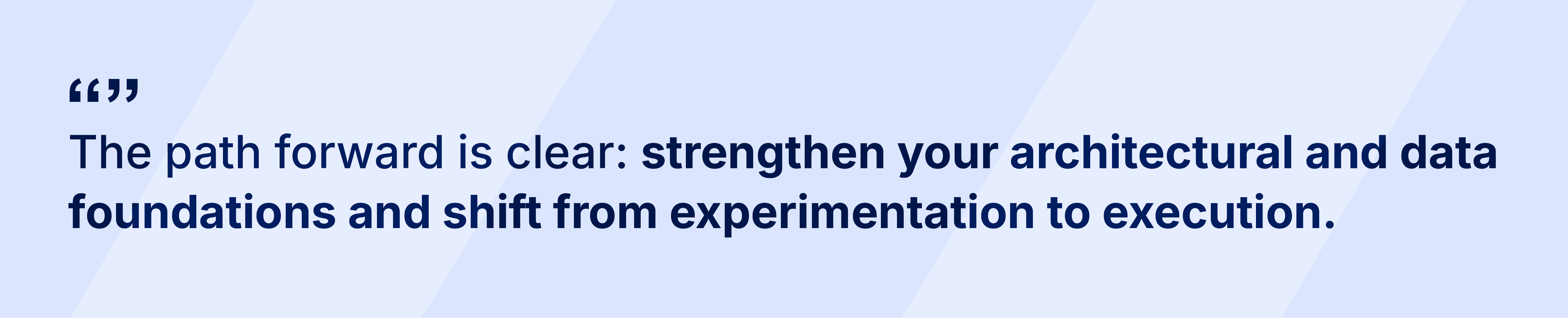
Leaders want measurable ROI across their architecture, operating models, and data. That’s a healthy shift. It moves us beyond the hype, bringing discipline, sharper focus, and a renewed commitment to where AI genuinely moves the needle. For transformation leaders, the path forward is clear: strengthen your architectural and data foundations, shift from pilot-heavy experimentation to production-ready execution, and focus relentlessly on what drives measurable outcomes aligned with business goals. Everything else can wait.
What role will enterprise architecture play in turning strategy into outcomes?
Enterprise architecture is becoming the connective tissue that ties strategy, technology, and execution together. As organizations modernize — whether through hybrid cloud, platform engineering, data fabric/mesh, or AI adoption — they need a connected view of how the enterprise actually operates.
AI doesn’t create value in isolation, and neither do cloud or data investments. They deliver results when there is clarity on how processes, systems, capabilities, and dependencies interact, and where the real risks and opportunities are. That’s why a connected model of the business is essential, and why enterprise architecture's role as a context provider has become critical.
EA provides the coherent semantic model that makes sense of all the moving parts. As AI agents are embedded into operations, that context becomes indispensable. Without it, AI tools produce generic outputs disconnected from business reality. With it, they deliver meaningful, accurate, and enterprise-aware results. By providing the context, governance, and alignment that drive smarter decisions, EA helps organizations navigate complexity and reduce fragmentation. It doesn’t replace core technologies like AI or cloud; it connects them to business realities, so that transformation can flow more smoothly across teams, systems, and outcomes.
We’re also seeing EA take on a new role in operationalizing sustainability. EA teams are now linking carbon and energy-usage data directly into their models, from cloud and edge workloads to supplier ecosystems. This expansion reflects a broader trend: EA is no longer just a planning discipline. It’s becoming a strategic platform that helps organizations balance performance, risk, cost, and sustainability, and ensures that long-term goals are embedded directly into how the enterprise runs.
How do you see enterprise architecture evolving in response to AI in 2026?
Enterprise architecture is entering a new phase. The role is moving from documentation to orchestration, as EA teams shift beyond static inventories to drive real-time alignment, scenario planning, and coordinated execution. AI will accelerate this evolution, not by replacing architects, but by becoming a collaborative partner in shaping enterprise decisions. That marks a meaningful evolution in the profession. It gives EA leaders the visibility, speed, and leverage to drive change at scale.
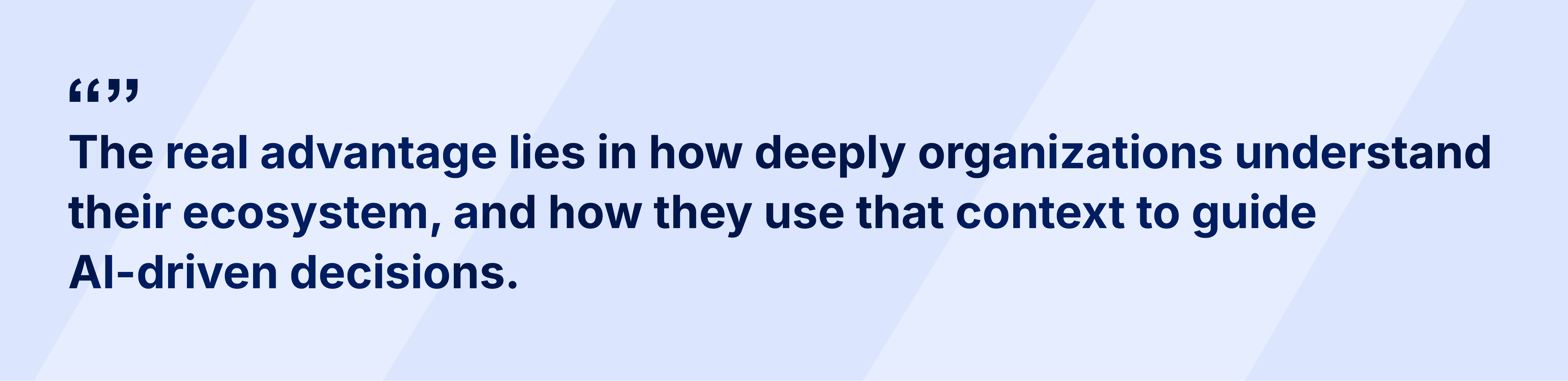
With Model Context Protocol (MCP) and emerging multi-agent capabilities, architects can scale their impact across the business in ways that weren’t possible before. MCP is the mechanism that makes this possible. It exposes enterprise context, semantic models, and architectural dependencies to AI tools, turning generic AI into enterprise-aware intelligence. Architects will be able to support multiple initiatives, identify risks earlier, and test complex design scenarios in real time. In this new phase, MCP will be table stakes. The real advantage will lie in how deeply organizations understand their ecosystem, and how they use that context to guide AI-driven insight, combine it with human expertise and make better, faster decisions.
The future belongs to organizations that combine enterprise context with agentic intelligence. Not just to align decisions with strategy, but to get real, actionable insights instead of generic AI answers.
What will be the biggest competitive differentiators in 2026?
Three differentiators will separate leaders from followers in 2026:
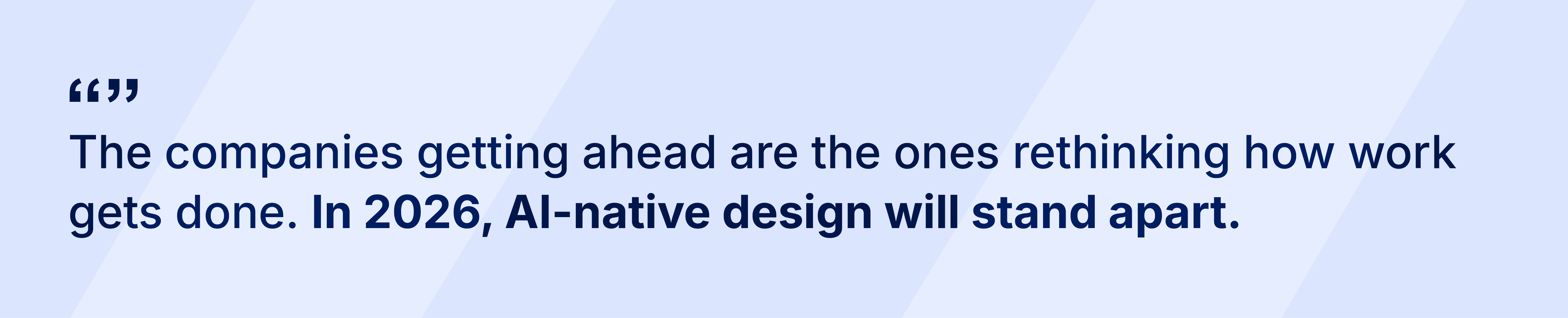
We’re seeing a clear divide emerge between AI-added and AI-native organizations. You can’t just glue a chatbot onto your tech stack and call it AI innovation. The companies getting ahead are the ones rethinking how work gets done — not just adding an AI layer on top, but redesigning the process underneath. In 2026, AI-native will stand apart by delivering faster workflows, better insights, and real value for users.
What does AI-native actually look like? It means treating AI agents as core architectural components, modeling them alongside applications, services, and data flows. Enterprise architecture teams are designing target operating models where intelligent capabilities are embedded into how the business operates from the ground up. This isn't retrofitting. It's reimagining the enterprise around systems that learn, adapt, and act.
A parallel shift is happening in cybersecurity. Analysts warn that as architectures become more distributed and AI-intensive, security cannot be applied after the fact. A secure-by-design approach — with identity, segmentation, and governance built into the architecture from the outset — is becoming a defining differentiator in 2026, much like AI-native design.
Beyond security, data quality will be the next big differentiator. In 2026, clean, well-structured, well-governed data becomes your most strategic asset. It fuels smarter decisions, faster execution, and more consistent results. Organizations need to know their golden sources of record and ensure data is accessible and reliable. Quality data fuels smarter decisions, faster execution, and more consistent results. Fragmented or unreliable data, on the other hand, slows you down, increases risk, and undermines every insight.
How will the EU AI Act and other regulations shape what companies do next year?
The EU AI Act is already shaping how organizations approach AI governance. While the timeline for compliance with high-risk requirements has been extended to late 2027, the core expectations remain. Companies must prepare for risk classification, governance frameworks, and greater oversight of general-purpose systems.
This is not a signal to slow down. It is a call to get ready. Regulation, done right, accelerates maturity. It gives leaders the clarity and confidence to move from experimentation to execution, scaling AI with accountability. The most forward-looking organizations will use this moment to strengthen visibility, embed governance into transformation efforts, and align AI with long-term strategy.
What pressures will CEOs/CIOs/CTOs feel most next year as AI matures?
Move fast. Stay in control. That’s the pressure facing every leader in 2026. Boards, shareholders, and customers expect leaders to accelerate modernization; whether in AI, cloud-native architecture, data platforms, or security. But they also expect accountability, alignment, and clear guardrails as these capabilities scale across the enterprise.
At the same time, the conversation is shifting. These aren’t standalone initiatives anymore; they’re becoming part of the enterprise infrastructure. That raises the bar. Leaders must now coordinate more deeply across IT, data, risk, and strategy, and face sharper scrutiny to show impact where it matters most: P&L, EBITDA, time to value, and long-term resilience. The pressure isn’t entirely new, but the expectations are higher. How leaders manage that tension will determine who moves with real momentum in 2026.
What one piece of advice would you offer transformation leaders preparing their organizations for 2026?
Transformation leaders should treat 2026 as the moment to rethink how the business runs — not just fine-tune legacy processes, but redesign operating models, governance structures, and cross-functional coordination to maintain alignment and absorb innovation at scale.
Stay anchored in clarity. Ensure teams share a connected understanding of how the enterprise works, where the risks lie, and where technologies — from cloud and data platforms to AI — can truly move the needle. Increasingly, this clarity also includes sustainability and ESG considerations, as organizations look to understand the footprint and impact of their architectures.
That foundation is what turns experimentation into execution and pilots into a sustained flow of value. It’s also where enterprise architecture earns its seat at the table by aligning strategy with execution, and transformation with long-term resilience.
Continue the conversation
If you’d like to discuss how these themes apply to your transformation priorities, Bizzdesign is ready to support you.
We will continue sharing guidance and perspectives throughout 2026 to help you strengthen alignment across your strategy, architecture, and execution initiatives.
Stay connected for further insights on how to plan with clarity and move with confidence.