Six Signs Your AI Portfolio Has Outgrown Informal Governance
Most organizations can point to the AI initiatives they've formally approved. What's harder to account for is everything else. The tools adopted by individual teams, the capabilities embedded in applications through vendor updates, the workflows built by employees who didn't need IT's sign-off to get started. When the question of how much AI is running across the enterprise comes up, the honest answer is usually along the lines of: “More than we thought, and less governed than we'd like.”
A McKinsey study found that three times more employees are using generative AI for a third or more of their work than their leaders realize. What organizations don't know about their AI can create some of their greatest exposure, whether through regulatory non-compliance, data quality failures, ungoverned model dependencies, or investments that duplicate rather than compound.
That exposure tends to build over time. An AI portfolio has outgrown informal governance when teams can no longer reliably answer where AI is being used, who owns it, what risks it carries, or whether it's delivering value. At that point, isolated approvals aren't enough. Here are six signs it's happening.
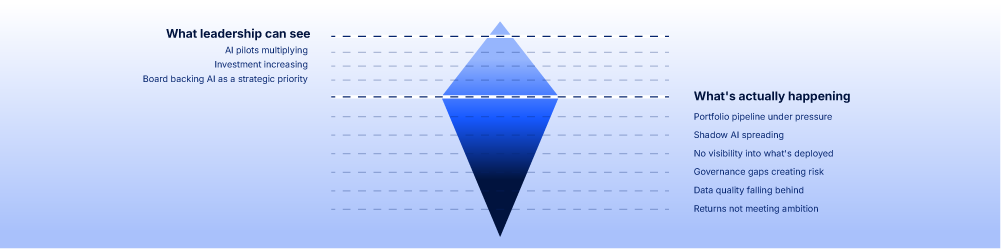
1. The Portfolio Pipeline Is Getting Overwhelmed
Can your team clearly articulate which AI initiatives are in the portfolio, what criteria were used to fund them, and how they rank against each other?
As the call for more AI investments surges, the portfolio demand pipeline fills with competing initiatives, many of which are complex or experimental. Strategic leaders are being asked to assess, prioritize, and fund these investments without clear criteria for doing so, and without a consistent way to evaluate them against each other or against what's already been committed. Without that basis, decisions about which initiatives to fund, scale, pause, or stop lack the context to hold up.
2. Shadow AI Is Spreading
The last time someone in the business deployed an AI tool outside the formal approval process, was it flagged? Governed? Even visible to IT?
AI-powered no-code tools have made it easier for employees to build their own workflows and access data independently, often outside established intake, architecture, data, or risk-review processes. Business stakeholders want to understand what AI makes possible for the capabilities and processes they're responsible for, and they want to act on it. That's a healthy instinct. But when adoption moves faster than the frameworks to manage it, AI accumulates across the organization without IT, EA, or risk functions ever having a chance to assess it.
3. No One Has Full Visibility into Deployed AI
If someone asked you today for a complete list of AI running across the enterprise, how long would it take to produce one you'd stand behind?
If responding to a regulatory question, a model deprecation, or a security incident requires manually piecing together information from multiple teams and systems with no guarantee of completeness, that's a sign the AI inventory doesn't exist in any reliable form. The organizations best placed to respond are the ones that already know which use cases, models, and application capabilities are active across the enterprise, who owns them, and what they depend on.
4. Governance Gaps Are Creating Material Organizational Risk
When did your organization last assess the risk level of its AI use cases against current regulatory requirements, business impact, and data sensitivity?
Without clear standards to assess risk and business impact, along with defined mitigation strategies, organizations face exposure across multiple fronts: data breaches, algorithmic bias, compliance failures, and costly system overhauls. Agentic AI, referring to autonomous AI systems capable of making and acting on decisions independently, raises the stakes further. With EU AI Act obligations already taking effect in phases, and prohibited practices enforceable since February 2025, the regulatory consequences of ungoverned AI are becoming more concrete.
5. AI Systems Are Making Data Harder to Govern and Trust
How confident are you that the data your AI systems are generating, using, or feeding back into business processes is accurate and defensible?
AI integrations can flood systems with unchecked outputs or introduce new data flows that aren’t fully governed, leading to poor decisions, wasted resources, and increased compliance risks. When data foundations aren't in place, even well-designed AI initiatives produce results that are difficult to act on or stand behind. The volume of data generated, used, and moved by AI systems is growing faster than most organizations' ability to govern and quality-control it.
6. AI Returns Are Falling Short of Expectations
If your board asked you to demonstrate the return on your AI investment to date, what would you show them?
Leaders are being asked to deploy capital and guide their organizations toward AI maturity without reliable visibility into what's already running, where investment is duplicating, or where AI can deliver the most value. The result is investment that's difficult to justify and harder still to build on. A governed portfolio is what makes it possible to measure progress, compare initiatives, manage risk, and demonstrate value to stakeholders.
How to Bring Your AI Portfolio Under Governance
Most organizations that reach this point already have teams that understand different parts of the AI landscape. Application owners know their portfolios, enterprise architects understand dependencies, and GRC teams can assess exposure. What's usually missing is a shared framework that connects those capabilities and makes it all visible in one place.
Our guide, AI Portfolio Governance in 7 Steps, is built around closing that gap. It covers what effective AI portfolio governance requires in practice, how AI needs to be managed differently from a conventional application portfolio, which roles need to be involved and how they connect, and a seven-step process for bringing existing AI activity into view and putting it under governance. For teams already feeling the pressure these six patterns create, this is where to start.

FAQs
The most consistent signals are an inability to answer foundational questions about the AI portfolio with confidence: what's in use, who approved it, what it's connected to, and whether it's delivering value. Organizations that have reached this point often find that different functions hold different versions of the AI inventory, that AI has entered through vendor updates or business-led tools without going through a formal process, and that AI investment decisions are being made without visibility into what already exists. If any of these sound familiar, informal governance has likely reached its limits.
Shadow AI refers to AI tools, features, and workflows being used across the organization without the knowledge or oversight of IT, EA, data, or risk functions. It typically spreads through no-code tools that allow employees to build their own workflows and access data independently without going through a formal approval process. The governance risk is the absence of any formal record of what's been deployed, who's accountable for it, what data it's processing, or how it connects to existing applications and business capabilities. What can't be seen can't be assessed for regulatory exposure, data quality risk, or strategic alignment. Bizzdesign Alfabet provides visibility into where AI is being used across the organization, including which applications are providing AI features and whether they've been formally approved.
Discovery tools that flag unauthorized network activity can play the same role for AI: identifying AI service usage across the organization so it can be registered in Bizzdesign Alfabet as an AI Technology object, mapped to a responsible owner, and brought under formal governance instead of operating as Shadow AI.
When AI is deployed without a formal record of what it does, what data it processes, and who approved it, organizations may struggle to demonstrate compliance when regulators ask. Under GDPR, for example, organizations need to understand and document how personal data is processed, for what purpose, and under what legal basis. If an employee uses an unapproved AI tool that processes customer data, the organization may create compliance exposure, even if there was no intent to bypass policy. Under the EU AI Act, which has been phasing in since 2024 with prohibited practices already enforceable and many transparency obligations taking effect in August 2026, certain AI applications require technical documentation, human oversight mechanisms, and formal risk assessments depending on how they are classified and used. Without a governed inventory of what AI is in use, organizations can't identify which systems fall under these requirements, let alone demonstrate they've met them.
AI governance is the broader set of policies, standards, roles, and oversight mechanisms that determine how AI is used, assessed, and controlled across the organization. AI portfolio management is what makes that governance operational. It provides the connected view of AI use cases, features, models, applications, and technologies that governance decisions depend on: what exists, who owns it, what it's connected to, and whether it's been formally approved. Without portfolio management, governance remains a policy document rather than a working system. Bizzdesign Alfabet brings both together, giving enterprise architecture and strategic portfolio management teams the portfolio visibility needed to govern AI consistently at enterprise scale.
The starting point is visibility, specifically understanding which applications across the enterprise are providing AI features, what those features do, and whether they've been formally assessed and approved. From there, organizations can document AI use cases, connect them to business capabilities and strategic priorities, inventory the models in use and the conditions under which they're permitted to operate, and establish the approval workflows that bring AI activity under consistent governance. Bizzdesign’s guide, AI Portfolio Governance in 7 Steps, walks through each of these steps in detail.
One common gap is the absence of a clear connection between AI initiatives and business outcomes. When AI use cases aren't linked to specific business capabilities, priorities, and success criteria from the outset, there's no baseline to measure performance against, no way to identify what's working, and no evidence base to justify continued investment. A governed AI portfolio addresses this by connecting every AI use case to a business capability, a defined investment rationale, and measurable value criteria, making it possible to track adoption, assess performance, and direct resources toward the initiatives with the clearest strategic case.