FedRAMP® Certified Bizzdesign GovCloud Brings Government-Ready Portfolio Management to U.S. Federal Agencies
TL;DR
Federal IT leaders are managing modernization backlogs, cost pressures, shifting mandates, and accelerating AI investment while keeping mission-critical services running. Connected portfolio evidence helps agencies find defensible savings, prioritize modernization, redirect investment as conditions change, and govern AI alongside the existing technology estate. With Bizzdesign GovCloud achieving FedRAMP® Certification on 1 September 2026, agencies now have an authorized route to Bizzdesign Alfabet to support this work.
U.S. Federal technology leaders are making increasingly consequential choices across complex technology estates. Gartner’s Critical Resources for U.S. Government Leaders in 2026 states that “Federal CIOs are tasked with modernizing technology while reducing costs and workforce.”¹ Shifting funding priorities, rapid AI adoption, cybersecurity threats, and technical debt add to these demands. Together, these pressures are forcing harder choices about what to fund, modernize, consolidate, retire, defer or introduce, and which investments need to move when priorities change.
A May 2025 Government Accountability Office (GAO) report found that the Office of Management and Budget (OMB) and 24 federal agencies could save $100 million or more by reducing duplicative IT investments and halting or terminating investments where appropriate. The finding underscores the practical importance of distinguishing mission-critical investment from duplication, underperformance and lower-priority spend.
Making defensible, mission-aligned choices requires leaders to connect mission priorities with trusted context across applications, technologies, risks and dependencies, so decisions about cost, modernization, reprioritization and AI can be made in relation to one another.
Bizzdesign Alfabet has long supported government technology leaders by providing a centralized, up-to-date view for these decisions. With Bizzdesign GovCloud now FedRAMP® Certified and listed in the FedRAMP Marketplace, U.S. federal agencies can access Alfabet through Bizzdesign’s own authorized SaaS environment, with a U.S. Government Accelerator providing a configured starting point tailored to federal structures and requirements.
What U.S. Federal Agencies Can Access Through Bizzdesign GovCloud
FedRAMP, the Federal Risk and Authorization Management Program, is the U.S. government's standardized approach to security assessment and authorization for cloud products and services used by federal agencies.
Through FedRAMP® Certified Bizzdesign GovCloud, federal agencies have an authorized route to access Bizzdesign Alfabet. The platform connects strategic initiatives with information across applications, technologies, costs, risks and dependencies, supporting work across strategic portfolio management, application portfolio management, and enterprise architecture. This gives federal technology leaders connected context to understand what they have, assess what needs to change, and make portfolio decisions grounded in current information.
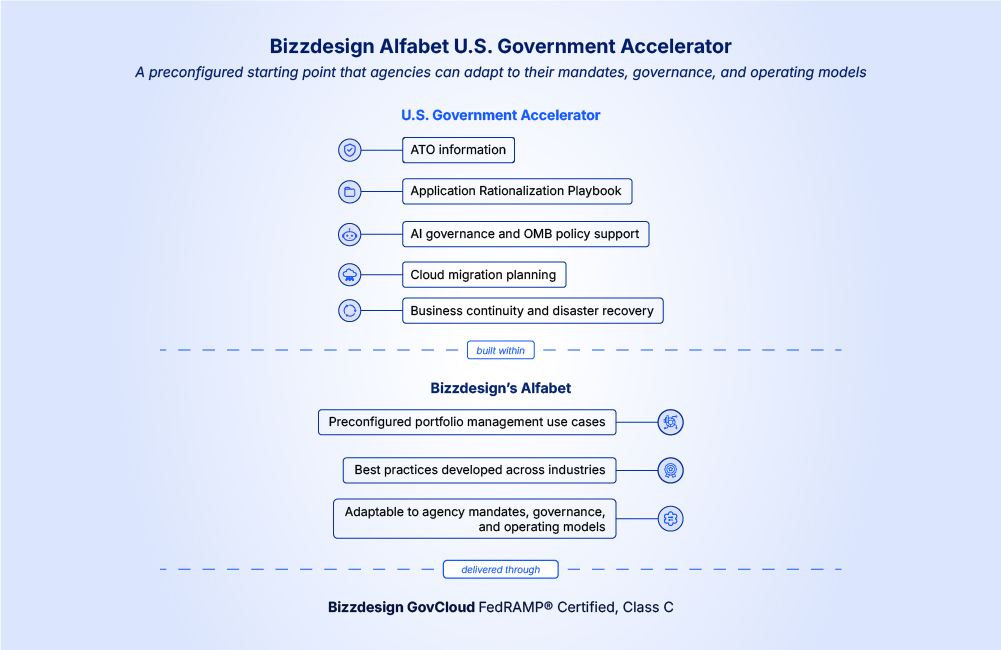
Federal agencies can also use the Bizzdesign Alfabet U.S. Government Accelerator as a preconfigured starting point that they can adapt to their mandates, governance, and operating models. The Accelerator draws on Bizzdesign's global experience and best practices across industries, with government-specific elements and support for portfolio activities including:
- Government-specific application attributes for recording Authority to Operate (ATO) information
- Built-in support for applying the Federal CIO Council Application Rationalization Playbook
- AI portfolio management and governance, including support for OMB AI policies
- Cloud migration planning
- Business continuity and disaster recovery planning
This tailored configuration helps agencies organize portfolio information around structures they already use. Teams can use that information repeatedly as mandates, funding, and priorities change.
Turning portfolio evidence into defensible investment decisions
Effective application portfolio management depends on continuous portfolio visibility, which helps agencies connect changing priorities with the applications, technologies, costs, risks, and dependencies affected by them. This makes decisions easier to revisit as mission requirements, funding, and circumstances change, supporting continuous steering rather than decisions fixed to a single planning cycle.
A change in one area of the technology portfolio can alter the choices available elsewhere. Savings may need to fund modernization, shifting priorities can change which investments should move first, and new AI investment can introduce further costs and dependencies. Leaders therefore need connected context that shows the consequences of these choices across the portfolio.
- Reducing federal IT costs without weakening mission delivery. Federal leaders are being asked to modernize while controlling or reducing spend, but blanket cost-cutting risks eliminating mission-critical technology alongside duplicative or lower-priority systems. Leaders need to distinguish between the two and redirect savings toward higher-priority modernization. Connected evidence across applications, costs, mission relevance, risk, and dependencies helps identify where application rationalization is defensible and what should be protected. The Federal CIO Council's Application Rationalization Playbook gives agencies a structured six-step methodology for this work. Bizzdesign's Essential Guide explains how to apply it in practice, turning portfolio evidence into decisions about what to retain, modernize, consolidate, migrate, or retire.
- Sequencing application modernization around mission impact. Modernization and reducing technical debt remain active government priorities, but agencies cannot modernize everything at once. By showing the technologies, dependencies and risks connected to critical systems, portfolio information can help leaders assess what should move first and where change may have wider operational consequences. This gives leaders a practical basis for sequencing modernization around mission impact, dependencies, and delivery risk.
- Reprioritizing Federal Technology Investments as Conditions Change. Priorities, mandates, and funding can shift quickly within the federal landscape. In its 2026 CIO Agenda for U.S. State and Local Government, Gartner states that “Decision making is shifting from a calendar-based approach to dynamic reprioritization of resources.”² For federal leaders, the relevant implication is that a decision made during annual planning may need to be revisited sooner than expected. Connecting strategic initiatives to applications, technologies, costs, and dependencies gives leaders a clearer basis for redirecting funding and capacity when that happens, allowing priorities to change without losing control of their wider portfolio consequences.
Portfolio discipline in practice at Minnesota IT Services
Minnesota IT Services (MNIT), which provides centralized IT services for 38 state agencies, offers an example of portfolio discipline in a complex, federated government environment. MNIT uses Bizzdesign Alfabet as the authoritative system of record for its application landscape, turning fragmented application lists into a continuously maintained enterprise view of systems, technologies, and vendor relationships. With that visibility in place, the agency has identified redundant contracts, supported more informed cloud and modernization planning, and provided executive leadership with better information for funding and decision-making.
“That’s when you can go to decision-makers and make the case for significant funding, because you can show exactly what you have today and the direction you need to move in.” – Chris Bucksa, Continuity of Operations Lead, MNIT
MNIT operates at the state level, but the portfolio challenge is familiar across government. Its experience shows how a maintained portfolio view can become part of governance, planning, and funding across a distributed organization, and why that view must expand as new categories of technology investment enter the estate.
Preventing AI from becoming the next unmanaged estate
AI is the clearest test of this portfolio discipline. As adoption moves from experimentation toward scaling, informal governance becomes harder to sustain. The resulting investment footprint extends beyond tools and models to contracts, infrastructure, vendors, data, skills, and oversight. When these elements enter through separate procurement and governance paths, they can accumulate as a fragmented technology estate of their own. AI may accelerate change, but agencies still need trusted context to understand where each investment fits, what it affects and how it should be governed.
For federal agencies, AI portfolio management means evaluating AI initiatives alongside existing applications, infrastructure, data, contracts, skills, and mission priorities. This gives leaders a clearer view of where initiatives overlap, what they depend on, which investments they may displace and what new risks they introduce. The opportunity is to apply that portfolio discipline while AI investments are still being selected, funded, and scaled, so agencies can consolidate overlapping initiatives, address dependencies and redirect resources. AI investment should not recreate the duplication, cost and technical debt agencies are working to reduce across the existing estate.
In our view, federal technology leaders are managing one portfolio across two horizons, rationalizing and modernizing the estate they have while shaping the AI investments and other technologies that will enter it next. Keeping those choices connected as mission requirements, funding and priorities change gives leaders the context to steer change continuously, fund the right priorities and prevent short-term decisions from becoming the next layer of duplication and technical debt.
Through Bizzdesign’s own FedRAMP® Certified GovCloud, U.S. federal agencies can access Bizzdesign Alfabet and use trusted, connected portfolio context to support decisions across both horizons.

¹ Gartner, Critical Resources for U.S. Government Leaders in 2026, Michael Brown, Peter Aykens, Irma Fabular, George Sellner, and Farrah Watson, 16 January 2026.
² Gartner, 2026 CIO Agenda for U.S. State and Local Government: Technology Priorities and IT Strategy Shifts, Roland Rivera, Irma Fabular, Mike Shevlin, and Todd Kimbriel, 18 September 2025.
FAQs
A listing in the FedRAMP Marketplace provides an official federal record of a cloud product or service’s current FedRAMP status. The Marketplace includes offerings at different stages of the FedRAMP process, giving agencies a way to find and verify an offering’s status rather than relying on vendor claims alone. Bizzdesign GovCloud’s listing records the offering as FedRAMP Certified as of September 1, 2026. The certification and listing apply to Bizzdesign GovCloud, the dedicated SaaS offering through which Bizzdesign Alfabet is delivered to U.S. federal agencies. Agencies can review the listing directly on the FedRAMP Marketplace and access Bizzdesign Alfabet's portfolio management capabilities through Bizzdesign GovCloud.
Modernizing while reducing costs depends on distinguishing mission-critical technology from duplicative, underperforming, or lower priority investments, rather than cutting spend across the board. A May 2025 Government Accountability Office report found that the Office of Management and Budget and 24 federal agencies could save $100 million or more by fully implementing required IT portfolio and high-risk investment reviews, reducing duplicative IT investments and halting or terminating investments where appropriate. Effective application modernization planning depends on connected evidence across applications, costs, mission relevance, risk, and dependencies. Savings identified in one part of the portfolio can then be redirected toward higher-priority modernization elsewhere, rather than being treated as a separate cost-cutting exercise disconnected from modernization planning. Bizzdesign Alfabet, available to U.S. federal agencies through FedRAMP® Certified Bizzdesign GovCloud, supports this connected view, helping agencies make cost and modernization decisions in relation to one another.
The Federal CIO Council Application Rationalization Playbook is a practical guide that provides federal agencies with a structured, six-step framework for application rationalization, the discipline of evaluating an application portfolio to decide what to retain, modernize, consolidate, migrate, or retire. Beyond the methodology itself, effective application rationalization draws on current, connected, and authoritative portfolio data showing costs, dependencies, risk, and mission relevance. Without an updated view, rationalization risks becoming a one-time exercise rather than an ongoing discipline. Bizzdesign's Essential Guide walks through how to apply the Playbook's six steps, and the Bizzdesign Alfabet U.S. Government Accelerator includes preconfigured support for applying the Playbook.
AI investment should be evaluated within the context of the existing technology estate, not managed separately from it. As AI adoption moves from experimentation to scaling, AI investments often enter the technology estate through procurement and governance processes and vendor relationships separate from those used for existing technology, creating a new layer of fragmented tools, infrastructure, and dependencies if left unmanaged. The opportunity is to apply the same portfolio discipline while AI investments are still being selected and scaled, evaluating where each initiative overlaps, what it depends on, and what new risks it introduces before fragmentation takes hold. Bizzdesign Alfabet supports this kind of connected evaluation, and is available to U.S. federal agencies through FedRAMP® Certified Bizzdesign GovCloud.
"FedRAMP Certified" is the current official name for the status previously called "FedRAMP Authorized". In February 2026 FedRAMP announced that “FedRAMP Certified” would replace “FedRAMP Authorized” as the official term. The change was formalized when the Consolidated Rules for 2026 (CR26) launched in June 2026, aligning the terminology with the FedRAMP Authorization Act’s definition of an authorization as a form of certification. The same update introduced Certification Classes A through D for FedRAMP certification packages. Class B incorporates the former LI-SaaS and Low baselines, Class C corresponds to Moderate, and Class D corresponds to High. Because this change is recent, some existing content, including vendor and industry sources, may still use "Authorized." Bizzdesign GovCloud achieved FedRAMP Certification, Class C (Moderate), on 1 September 2026. The FedRAMP Marketplace lists Bizzdesign GovCloud under this current designation.