
Application Rationalization for Government Agencies
How to operationalize the CIO Council’s Application Rationalization Playbook with a purpose-built platform
A Buyer’s Guide to Platforms Supporting the CIO Council Playbook
When government agencies face simultaneous mandates to reduce IT operating costs, accelerate cloud modernization, and strengthen cybersecurity resilience, all three priorities converge on a single capability: continuous visibility into the application portfolio, knowing precisely which applications are in use, what they cost, what mission services they support, what risk they carry, and whether they remain necessary.
Many agencies still struggle to answer these questions with confidence. Portfolio assessments can take months to complete and may become outdated before leadership can act on them. As a result, rationalization often becomes a periodic cleanup exercise rather than an operational discipline, allowing portfolio complexity to gradually return.
Sustainable application rationalization requires two elements: Proven methodology and the infrastructure to execute it at scale. Many federal, state, and municipal organizations already follow the Application Rationalization Playbook developed by the Federal Chief Information Officers (CIO) Council, a six-step framework that provides standardized processes, common evaluation criteria, and shared terminology. What’s often missing is the operational infrastructure to maintain authoritative application data, run repeatable assessments, and translate analysis into governed decisions within a FedRAMP® Certified SaaS offering. Without that foundation, agencies revert to spreadsheet-based tracking that quickly becomes difficult to manage at scale.
This guide outlines:
- The core capabilities agencies should evaluate in an application rationalization platform,
- How those capabilities operationalize the CIO Council Playbook step by step, and
- The measurable outcomes agencies should expect from a purpose-built solution.
What Is Application Rationalization?
Application rationalization is defined as the structured, repeatable process of evaluating an agency’s application portfolio to determine which systems should be retained, modernized, consolidated, migrated, or retired based on business value, technical health, cost, risk, and dependencies.
In government environments, application rationalization provides visibility into which systems support mission services, where duplicative capabilities exist, how costs are distributed across the portfolio, and where operational or cybersecurity risks accumulate. Establishing an authoritative application inventory and standardized evaluation criteria creates a defensible foundation for investment decisions, modernization planning, and compliance reporting.
Rationalization becomes sustainable when it operates as a continuous discipline supported by authoritative portfolio data and governed decision workflows rather than periodic spreadsheet-based assessments. An authoritative application inventory is a continuously maintained, enterprise-wide record of applications, including ownership, costs, dependencies, mission alignment, and risk posture. It serves as the factual foundation for rationalization decisions and portfolio governance.
Why Application Rationalization Matters for Government Agencies
Government agencies pursue application rationalization to ensure their portfolios remain aligned to mission priorities, cost-efficient to operate, and resilient to changing demands.
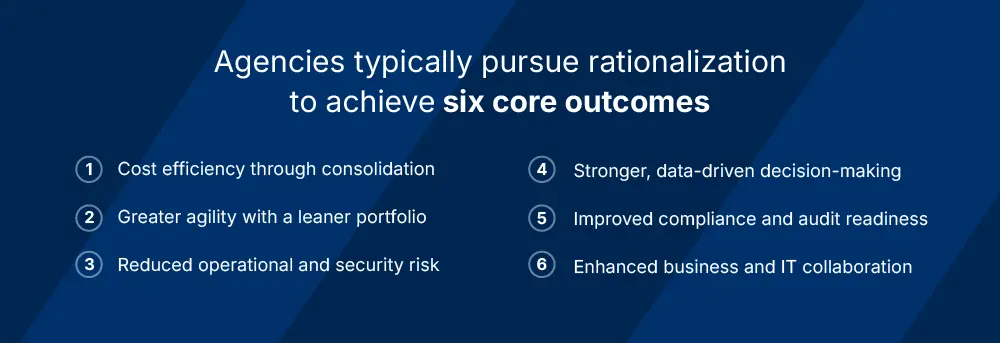
They typically pursue rationalization to achieve six core outcomes:
- Cost efficiency through consolidation
Over time, portfolios accumulate multiple applications performing similar functions across departments or programs. Rationalization identifies these overlaps and enables consolidation, lowering licensing, maintenance, hosting, and support costs while freeing funding for modernization initiatives and priority services. - Greater agility with a leaner portfolio
A streamlined application landscape reduces operational complexity and makes it easier to introduce new capabilities, modernize systems, and respond to policy or operational change. Fewer systems means fewer integration constraints and faster delivery. - Reduced operational and security risk
Each application introduces operational, cybersecurity, and compliance exposure. Reducing unnecessary systems lowers the number of potential vulnerabilities and failure points, strengthening resilience and protecting continuity of critical public services. - Stronger, data-driven decision-making
A structured rationalization process generates reliable data on application usage, cost, technical health, dependencies, and mission value. This enables more defensible decisions on investment, retirement, modernization, and cloud migration while improving transparency for leadership and oversight bodies. - Improved compliance and audit readiness
Understanding which applications support regulated processes, where sensitive data resides, and how systems interconnect simplifies reporting, improves traceability, and reduces the operational burden associated with audits and compliance reviews. - Enhanced collaboration between IT and other functions
Application rationalization creates a shared portfolio view and consistent evaluation criteria across IT, service delivery, finance, security, and other stakeholders. With agreed data and terminology, discussions focus less on reconciling conflicting information and more on prioritizing action and allocating resources.
As the CIO Council's Application Rationalization Playbook notes, "Ultimately, application rationalization is a component of a broader federal strategy to use IT and services in a way that enables agencies to perform their missions faster and more effectively."
Why Application Rationalization Must Be Continuous
Achieving these outcomes once is not sufficient. Government technology environments change constantly as new programs launch, policies evolve, security requirements expand, and digital services grow. Agencies sustain rationalization benefits when the process operates as a continuous discipline rather than a periodic initiative.
Traditional rationalization efforts often rely on time-bound assessments supported by spreadsheets that quickly lose relevance. A continuous approach embeds authoritative portfolio data, standardized evaluation criteria, and governed workflows into ongoing operations. This allows agencies to respond to new mandates without restarting portfolio discovery from scratch.
The Playbook reinforces this principle: "Application rationalization isn’t a one-time exercise but should become part of normal business operations within the agency."
"Application rationalization isn’t a one-time exercise but should become part of normal business operations within the agency." –– CIO Council, Application Rationalization Playbook
Organizational demand for new technologies requires consistent reassessment of the portfolio to prevent duplication, limit technical debt, maintain agility, and control costs.
The Cost of Inaction: What Happens Without Continuous Rationalization
When rationalization is treated as a one-time cleanup effort, portfolio complexity can gradually return. New applications are introduced, legacy systems remain in place, and oversight becomes reactive rather than structured.
Without continuous portfolio infrastructure, four risks commonly emerge:
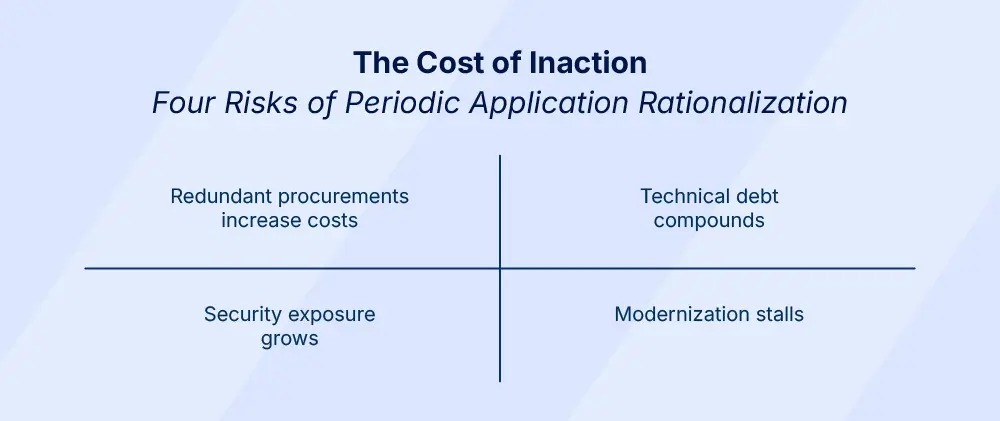
Redundant procurements increase costs
If intake processes don’t require visibility into the existing portfolio, agencies may approve duplicate capabilities. Collaboration tools, analytics platforms, or workflow systems can be purchased without awareness of existing enterprise licenses. Over time, overlapping functionality increases licensing, support, and integration costs.
Technical debt compounds over time
Applications running on unsupported technologies or deprecated infrastructure become harder and more expensive to modernize. Dependencies become less visible, and retirement planning becomes more complex. The longer systems remain unmanaged, the more difficult structured modernization becomes for agencies.
Security and compliance exposure increases
Applications without current ownership, data classification, or documented controls create governance gaps. Agencies may require extended effort to respond to audit requests or security inquiries if portfolio data is incomplete. Incident response can slow when system dependencies and data flows aren’t clearly documented.
Modernization initiatives stall in extended discovery phases
Cloud migration, digital service expansion, and infrastructure consolidation require accurate portfolio baselines. When application data is fragmented or outdated, teams spend significant time reconstructing basic facts (which applications exist, what they cost, which business capabilities they support, and how they interconnect) before planning can proceed. This delays execution and increases the likelihood of avoidable migration errors.
These risks are not unusual. They reflect common portfolio management challenges in complex government environments. The central question is whether the agency has the infrastructure in place to manage portfolio change continuously rather than rebuilding visibility for each new initiative.
The CIO Council Application Rationalization Playbook Explained
Many public sector organizations don’t need to design an application rationalization methodology from scratch. As mentioned earlier, the CIO Council's Application Rationalization Playbook already provides a widely recognized framework that federal, state, and municipal agencies use to structure their rationalization programs. Its six-step approach — identify needs and conduct readiness assessment, inventory applications, assess business value and technical fit, assess total cost of ownership, score applications, and determine application placement — offers a clear path from initial discovery through portfolio decision-making.
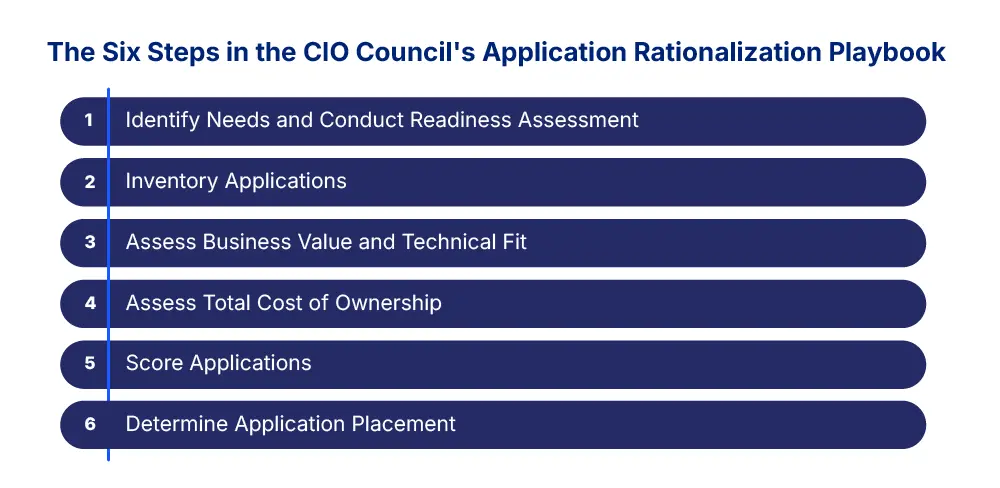
The strength of the Playbook lies in its balance between structure and flexibility. It establishes a common process and shared terminology while allowing agencies to adapt scoring models, prioritization criteria, and decision thresholds to their specific missions and operational contexts. A defense agency assessing mission-critical systems under strict security requirements will weight criteria differently than a health services agency evaluating constituent-facing applications for accessibility and interoperability; yet both can apply the same foundational method while tailoring execution to their own requirements.
Operationalizing this methodology at scale, however, requires infrastructure that spreadsheets and general-purpose tools can’t provide. Spreadsheet-based rationalization can create version control problems, become outdated, and make collaboration across dozens of stakeholders challenging. Modeling solutions capture point-in-time architecture without continuous data management. CMDBs and ITSM platforms lack the business context and mission alignment that rationalization decisions require. Agencies often require a FedRAMP®-Certified SaaS offering that maintains authoritative portfolio data, supports collaborative workflows, and enables governed decision-making aligned to the Playbook.

"Agencies that develop an authoritative application inventory will empower their leaders to make more informed IT strategies, allow procurement offices to buy services more efficiently, and enable users to deliver mission services to customers." –– CIO Council, Application Rationalization Playbook
What to Look for in an Application Rationalization Platform (Supporting the Playbook Step by Step)
The Playbook defines the process. The practical question is how to execute it consistently at scale.
Application rationalization in the public sector requires infrastructure that supports collaboration, maintains reliable portfolio data, and aligns with FedRAMP requirements where applicable. The right platform should enable each Playbook step without relying on disconnected tools or static assessments.
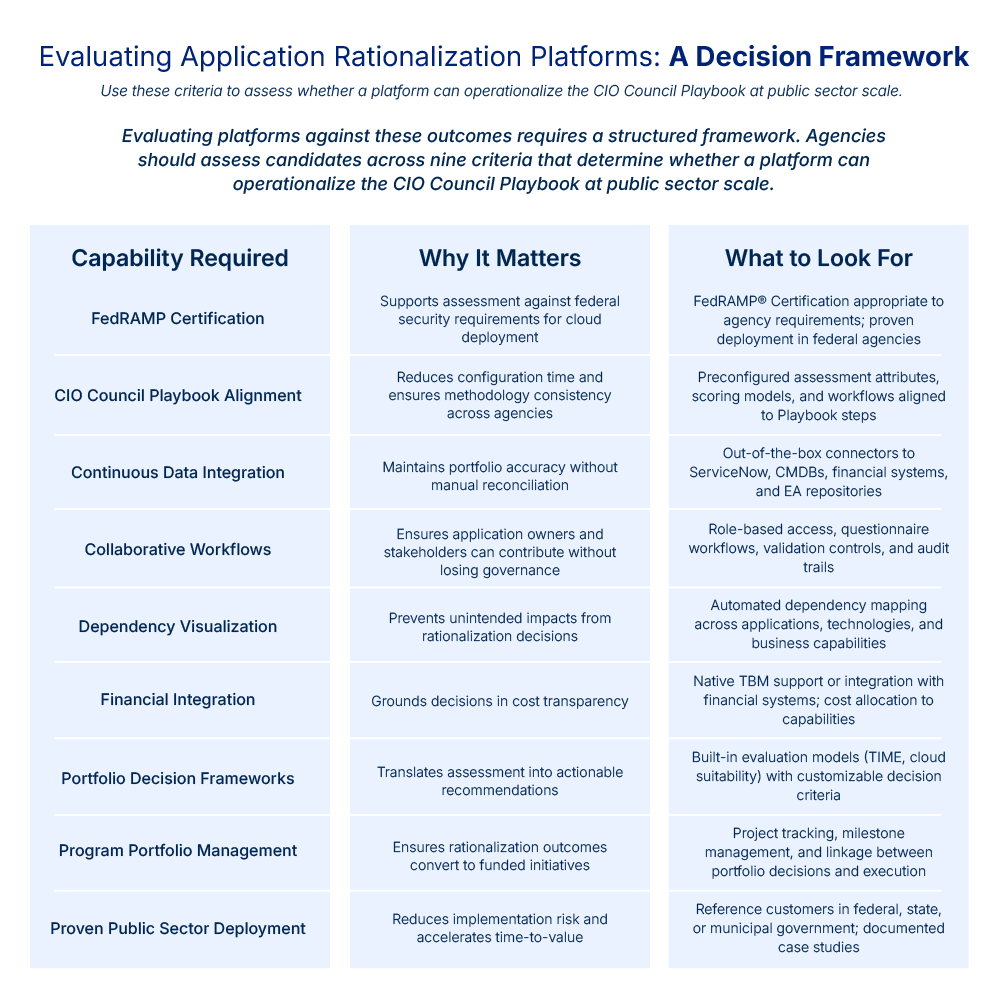
Essential Platform Capabilities for CIO Council Playbook Execution
Agencies evaluating platforms should look for capabilities that support structured execution across the rationalization lifecycle, including:
- A centralized application repository serving as the authoritative source of portfolio information.
- Continuous data synchronization with existing systems (CMDBs, asset inventories, financial systems).
- Workflow-based questionnaires with ownership assignment and validation controls.
- Role-based access ensuring application owners can update systems they manage while maintaining governance.
- Built-in analytics and dependency visualization for multidimensional portfolio analysis.
- Integrated financial views mapping costs to applications, services, and business capabilities.
- Centralized scoring logic ensuring consistent evaluation criteria across departments.
- Portfolio evaluation frameworks (e.g., TIME: Tolerate, Invest, Migrate, Eliminate).
- Program portfolio management linking rationalization decisions to funded initiatives.
The following sections outline how these capabilities align with each Playbook step.
Step 1: Identify Needs and Conduct Readiness Assessment — Centralized Application Intelligence and Data Integration
The first step establishes scope, stakeholders, and the initial portfolio baseline.
Application data often resides across architecture repositories, CMDBs, asset inventories, financial systems, and identity platforms. A suitable platform should consolidate this information into a unified application repository through out-of-the-box integrations and flexible ingestion methods. Ongoing synchronization helps ensure that portfolio decisions reflect current conditions.
Reporting capabilities should highlight ownership gaps, incomplete records, and mission coverage so agencies can prioritize where deeper assessment is required.
Step 2: Inventory Applications — Structured Data Collection and Governance Controls
Creating a reliable inventory requires coordinated input from application owners and operational teams.
Platforms should provide workflow-driven questionnaires, ownership assignment, validation rules, and completeness tracking. Defined roles and approval checkpoints help maintain accountability and data quality over time. Role-based access ensures that stakeholders can update relevant records while preserving oversight.
The objective is not a one-time survey but a maintained portfolio record that supports ongoing assessment.
Step 3: Assess Business Value and Technical Fit — Multidimensional Evaluation and Dependency Insight
This stage evaluates each application against mission relevance, technical health, risk exposure, performance, and lifecycle status.
Platforms should support configurable scoring models, dashboards, and portfolio segmentation views that allow agencies to analyze applications across multiple dimensions simultaneously. Because most systems are interconnected, dependency visualization is essential. Understanding upstream and downstream relationships helps agencies assess the broader impact of retirement, consolidation, or modernization decisions before acting.
Step 4: Assess Total Cost of Ownership — Integrated Financial Mapping
Rationalization decisions must be grounded in cost transparency, including operational expenses, licensing, infrastructure costs, and support requirements.
Platforms should allow costs to be associated with applications, services, and business capabilities. Where agencies use Technology Business Management (TBM), the platform should complement TBM structures by mapping IT spend to portfolio elements in a way that supports rationalization analysis.
This enables cost comparisons, identification of outliers, and more precise evaluation of consolidation or migration scenarios.
Step 5: Score Applications — Centralized and Transparent Scoring Logic
The Playbook recommends developing a consistent scoring methodology.
Platforms should anchor that methodology in a centralized system, so evaluation criteria remain stable across departments and assessment cycles. Transparency into how scores are calculated supports defensibility and auditability. Portfolio managers should be able to trace how business value, risk, cost, and technical health contribute to final placement recommendations.
This reduces inconsistencies that arise when scoring logic exists in disconnected spreadsheets.
Step 6: Determine Application Placement and Plan Actions — Portfolio Evaluation and Execution Tracking
Assessment outcomes must translate into clear decisions and measurable actions.
Platforms should support structured evaluation models such as TIME (Tolerate, Invest, Migrate, Eliminate) or equivalent placement frameworks. These help agencies determine future-state direction based on combined business, cost, and risk inputs.
For cloud migration and modernization initiatives, platforms should support scenario analysis and action tracking. Linking rationalization outcomes to project and program portfolios ensures approved decisions move into funded initiatives, with visibility into milestones, dependencies, and progress.
Building the Business Case for an Application Rationalization Platform
For most agencies, investing in an application rationalization platform requires a clear, measurable value case. Without dedicated infrastructure, teams spend significant time reconstructing portfolio data for each assessment cycle. With purpose-built support, portfolio information remains current and reusable, reducing repetitive discovery work and enabling recurring decision-making.
A strong business case typically quantifies value across six dimensions:
- Direct cost reduction through consolidation
Agencies that identify redundant or underutilized applications can reduce licensing, hosting, and support costs. Consolidation targets vary by portfolio size and complexity, but even modest reductions generate recurring annual savings that accumulate over time. - Cost avoidance through governance
Preventing duplicate procurements often delivers greater value than application retirement. When intake processes require checking the existing portfolio before approving new purchases, agencies avoid redundant investments. In some cases, preventing duplicate procurement may offset a substantial portion of platform investment. Over multi-year periods, governance-driven cost avoidance frequently exceeds consolidation savings. - Operational efficiency gains
Manual rationalization efforts require substantial staff time for data collection, validation, and reporting. Structured platform workflows that embed evaluations into daily work routines shorten assessment timelines, improve data consistency, and allow staff capacity to shift toward modernization planning and architecture work. - Risk reduction and compliance readiness
Although risk reduction isn’t always directly quantifiable, agencies can track proxy indicators such as reductions in unsupported applications, fewer critical vulnerabilities, and improved audit response times. These measures demonstrate strengthened security posture and improved operational resilience. - Faster modernization execution
Clear portfolio visibility accelerates cloud migration and modernization programs. When application data, dependencies, and cost baselines are readily available rather than requiring extended discovery work for each initiative, project planning cycles compress significantly. - Governance maturity and investment quality
Long-term platform value comes from repeatable decision frameworks that improve investment quality over time. Agencies can track metrics such as percentage of new investments aligned to portfolio strategy, reduction in redundant procurements, and improvement in portfolio health scores.
Federal agencies have already demonstrated the value of structured portfolio governance: The PortfolioStat initiative has generated over $2.57 billion in savings and cost avoidance since 2012.
How Bizzdesign Supports Government Application Rationalization at Scale
Bizzdesign Alfabet delivers these capabilities with support from the U.S. Government Accelerator, a preconfigured foundation for portfolio management with built-in support for the CIO Council Playbook. For U.S. federal agencies, Bizzdesign Alfabet and the Accelerator are accessible via FedRAMP® Certified Bizzdesign GovCloud. The Accelerator enables agencies to initiate structured portfolio analysis shortly after implementation, minimizing configuration effort.
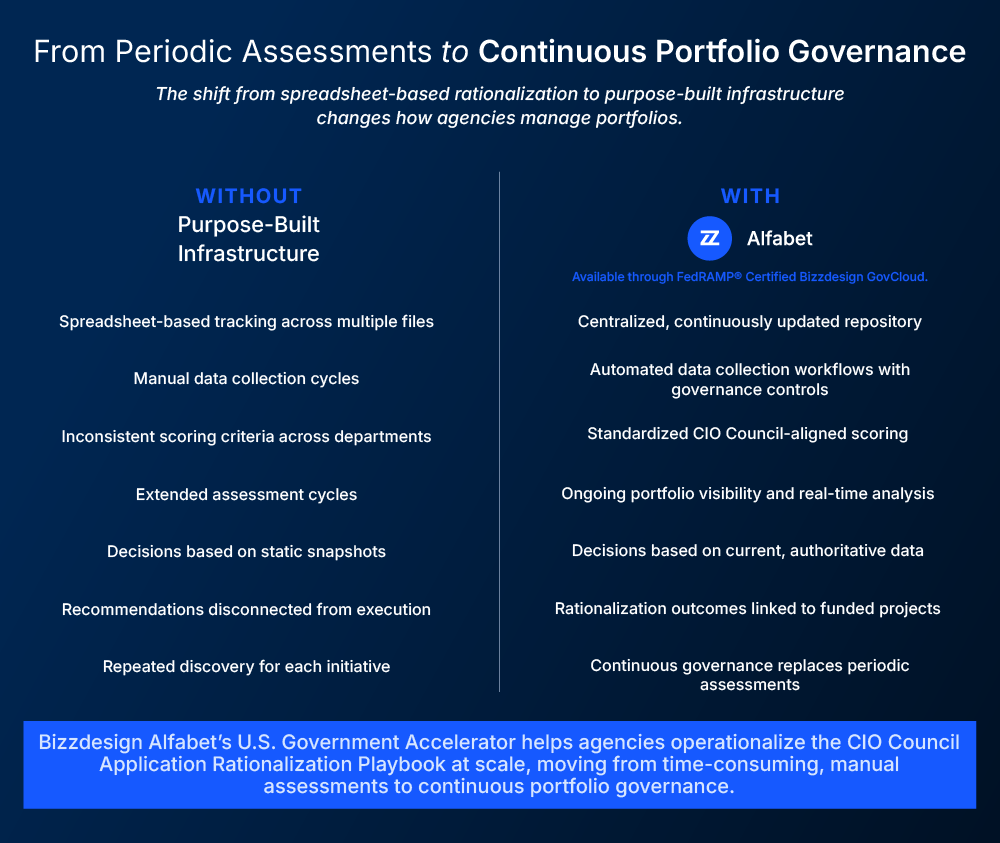
Three factors drive faster time-to-value:
- Preconfigured Playbook alignment: Standardized assessment attributes, scoring logic, and reporting structures reduce the need to build rationalization frameworks from the ground up. Agencies adapt the Accelerator to their environment rather than designing methodology from scratch.
- Out-of-the-box integrations: Direct connections to ServiceNow (CMDB), Flexera ITpedia (technology catalogs), the National Institute of Standards and Technology (NIST) vulnerability database, and enterprise architecture repositories enable continuous data synchronization without custom development. Data quality and risk profile improve while IT staff effort decreases.
- Proven methodology embedded in the platform: The Accelerator reflects years of public sector application rationalization experience, incorporating best practices from dozens of federal, state, and municipal implementations. Agencies benefit from accumulated knowledge rather than learning through trial and error.
When building a business case, agencies should quantify not only application retirement savings but also cost avoidance, operational efficiency gains, risk reduction, and modernization acceleration.
Operationalizing Continuous Rationalization: Minnesota IT Services
Minnesota IT Services (MNIT) supports 38 state agencies and 60 boards and commissions across a highly federated IT landscape. Before implementing Bizzdesign Alfabet, MNIT faced limited portfolio visibility and inconsistent data definitions across agencies, making it difficult to assess risks, identify redundancies, and support sound investment decisions.
By deploying Bizzdesign Alfabet, MNIT established agency-wide transparency and continuous governance:
Agency-wide transparency across federated IT
MNIT built a centralized application repository covering dozens of agencies, some managing hundreds of applications, providing the authoritative portfolio view needed for investment decisions and modernization planning.
Measurable cost savings through contract consolidation
MNIT identified cases where multiple agencies held separate contracts for the same platform. By consolidating redundant vendor contracts, MNIT achieved measurable savings while reducing administrative overhead.
Reduced risk through dependency mapping
MNIT mapped technology dependencies to critical business processes, enabling better understanding of operational risk and more informed modernization planning.
Strengthened governance through EA integration
MNIT aligned Bizzdesign Alfabet with its Enterprise Architecture Review Board, ensuring portfolio decisions align with broader architectural strategy and operate from current, authoritative data.
"This is part of the strategic roadmap. We're now delivering dashboards and baseline reports that let those conversations take place. As outliers appear, it drives better data, which leads to better answers, and ultimately to better questions." — Jen Baltes, APM Lead, Minnesota IT Services
Extending Value Beyond Application Rationalization
Application rationalization is often the starting point for broader portfolio governance. Once agencies establish a centralized application repository, standardized assessment processes, and shared decision frameworks, the same foundation supports additional disciplines that ensure technology investments remain aligned with mission priorities over time.
This is where platform selection becomes strategic rather than tactical. Platforms purpose-built to support the CIO Council methodology deliver standardized processes that agencies can extend into adjacent governance areas, maximizing long-term platform value.
Application Portfolio Management (APM)
Application rationalization is a foundational discipline within Application Portfolio Management (APM), the broader practice of governing applications across their entire lifecycle from acquisition through retirement. While rationalization focuses on evaluating and optimizing the existing portfolio, comprehensive APM extends into adjacent governance areas that ensure technology investments remain aligned with mission priorities over time.
Technology Portfolio Management (TPM)
After rationalizing applications, many agencies turn attention to the underlying technologies that support them. Technology portfolio management enables agencies to identify redundant or unsupported technologies, define standards, and guide modernization roadmaps. Establishing structured technology lifecycle management helps reduce technical debt, lower infrastructure costs, and maintain a more stable and secure technology landscape.
Strategic Portfolio Management (SPM)
Application rationalization creates the visibility needed to improve investment planning. Strategic Portfolio Management connects mission strategy with investment decisions by providing a structured process for evaluating demands, prioritizing initiatives, and ensuring that funded projects align with agency objectives. When application and technology portfolio data integrate with project and investment portfolios, agencies gain clearer understanding of how proposed initiatives affect cost, risk, and operational performance.
AI Portfolio Management
As agencies expand artificial intelligence use, they face growing pressure to maintain transparency into where AI capabilities are deployed, how they interact with existing systems, and whether they align with mission priorities and regulatory requirements. AI portfolio management extends portfolio governance practices to AI models, use cases, and supporting technologies, providing visibility into adoption patterns, dependencies, and associated risks.
Investment Approval and Governance
A platform that integrates application, technology, and project portfolios supports more consistent investment governance across the organization. Standardized intake workflows, evaluation criteria, and approval processes help ensure that proposed initiatives are assessed based on mission alignment, architectural impact, and cost-benefit considerations before funding decisions are made.
From Periodic Reviews to a Sustainable Rationalization Capability
The difference between agencies that sustain rationalization outcomes and those that revert to portfolio complexity comes down to whether rationalization operates as an ongoing discipline or a periodic project. Agencies using the CIO Council Playbook with platform support can maintain portfolio visibility continuously, respond to new mandates without restarting discovery, and make investment decisions based on current data rather than outdated assessments.
When leadership changes, priorities shift, or new requirements emerge, agencies with mature portfolio governance respond with greater clarity and control. The application portfolio becomes a managed strategic asset that supports mission agility instead of an unmanaged layer of complexity that slows progress.
Bizzdesign Alfabet, delivered to U.S. federal agencies via FedRAMP® Certified Bizzdesign GovCloud, provides the operational infrastructure agencies need to operationalize the CIO Council Playbook at scale. The Bizzdesign Alfabet U.S. Government Accelerator combines preconfigured rationalization processes with integrated portfolio governance capabilities, reducing configuration effort and supporting coordinated, organization-wide management aligned to mission priorities.
Ready to put continuous application rationalization into practice? Talk to our team about your government agency’s needs.
FAQs
Agencies without visibility into their application portfolios typically fund duplicate capabilities across departments, accumulate technical debt from underutilized systems, and lack the data needed to challenge new procurement requests. Application rationalization reduces IT operating costs by identifying redundant applications, consolidating overlapping capabilities, retiring underutilized systems, and preventing duplicate procurements before they occur.
Direct savings come from reducing licensing, hosting, maintenance, and support costs for systems that are retired or consolidated. However, cost avoidance through governance controls often exceeds direct savings over multi-year periods. When intake processes require visibility into the existing portfolio before approving new purchases, agencies avoid funding duplicate capabilities, preventing costs that would otherwise accumulate across licensing, integration, and support. Platforms such as Bizzdesign Alfabet enable agencies to connect cost data directly to applications, business capabilities, and mission services, making these savings measurable and defensible.
Application rationalization typically follows a structured evaluation process that assesses applications across business value, technical health, cost, and risk. The CIO Council Application Rationalization Playbook outlines a widely adopted six-step methodology:
- Identify needs and conduct readiness assessment: Define scope, stakeholders, and initial portfolio baseline
- Inventory applications: Collect structured data on applications, ownership, and mission alignment
- Assess business value and technical fit: Evaluate mission relevance, technical health, and risk exposure
- Assess total cost of ownership: Map costs to applications, services, and business capabilities
- Score applications: Apply consistent evaluation criteria to determine relative priority
- Determine application placement: Decide whether systems should be retained, modernized, consolidated, migrated, or retired
These steps provide a repeatable framework that agencies can adapt to their specific missions, compliance requirements, and operational contexts. The Bizzdesign Alfabet U.S. Government Accelerator operationalizes this six-step methodology through preconfigured assessment attributes, scoring logic, and reporting structures aligned to the Playbook.
Agencies attempting rationalization with spreadsheets or general-purpose tools typically encounter version control problems, data quality issues, and collaboration bottlenecks that make portfolio assessments difficult to sustain beyond a single cycle. A purpose-built application rationalization platform should provide the infrastructure needed to execute the CIO Council Application Rationalization Playbook at scale while maintaining authoritative portfolio data as an operational discipline.
Essential platform capabilities include a centralized application repository serving as the authoritative source of portfolio information, continuous data synchronization with existing systems such as CMDBs and financial databases, workflow-based questionnaires with ownership assignment and validation controls, built-in analytics and dependency visualization for multidimensional portfolio analysis, integrated financial views mapping costs to applications and business capabilities, and centralized scoring logic ensuring consistent evaluation criteria across departments. Alongside these capabilities, U.S. federal agencies should consider FedRAMP certification when evaluating SaaS offerings.
The CIO Council Application Rationalization Playbook provides a proven six-step methodology, but executing it at scale requires more than process documentation. Without dedicated infrastructure, teams often build custom spreadsheets for each assessment cycle, leading to inconsistent evaluation criteria, data quality problems, and portfolio baselines that become outdated before leadership can act on them.
Operationalizing the Playbook requires infrastructure that supports each step with minimal custom development: centralized application intelligence and data integration for readiness assessment, workflow-driven questionnaires for inventory collection, configurable scoring models and dependency visualization for business and technical evaluation, integrated financial mapping for total cost of ownership analysis, transparent scoring logic for consistent application scoring, and structured evaluation models that link rationalization outcomes to funded initiatives. Bizzdesign Alfabet's U.S. Government Accelerator provides a preconfigured foundation for portfolio management with built-in support for each step of the Playbook.
Application rationalization is the structured process of evaluating applications to determine whether they should be retained, modernized, consolidated, migrated, or retired. Application Portfolio Management (APM) is the broader discipline of governing applications across their full lifecycle from acquisition through retirement.
Rationalization is a foundational activity within APM, but APM extends beyond periodic assessments to include continuous portfolio visibility, lifecycle governance, investment planning, and alignment with enterprise architecture. When agencies establish authoritative application data and standardized evaluation processes through rationalization, the same foundation supports ongoing APM disciplines such as technology portfolio management, strategic portfolio management, and AI governance. Rationalization provides the baseline; APM sustains it as an operational discipline. Bizzdesign Alfabet functions as a purpose-built APM platform that enables agencies to initiate rationalization and then extend the same repository and governance workflows into continuous portfolio management.
Agencies that treat rationalization as a one-time project typically see portfolio data become outdated within months, forcing them to rebuild inventories from scratch for each oversight cycle or modernization initiative. Application rationalization should function as a continuous governance discipline supported by periodic assessment cycles, not as a one-time cleanup exercise.
Many agencies conduct structured rationalization reviews annually or semi-annually to reassess portfolio health, update placement decisions, and align investments with evolving mission priorities. However, sustaining rationalization outcomes requires maintaining continuously updated portfolio data and governance workflows between review cycles. This allows agencies to respond to new mandates, evaluate modernization opportunities, and prevent duplicate procurements without rebuilding the portfolio baseline from scratch. As the CIO Council Application Rationalization Playbook states, "Application rationalization isn't a one-time exercise but should become part of normal business operations within the agency."
The CIO Council Application Rationalization Playbook provides a standardized six-step methodology covering readiness assessment, application inventory, business and technical evaluation, cost analysis, scoring, and placement decisions. It establishes common terminology, repeatable evaluation processes, and shared decision frameworks so agencies can make consistent, defensible portfolio decisions across departments and programs.
The Playbook balances structure with flexibility. Agencies follow the same foundational process while adapting scoring models, prioritization criteria, and decision thresholds to their specific missions and operational contexts. This makes the Playbook applicable across federal, state, and municipal organizations regardless of portfolio size or complexity. By providing a proven framework, the Playbook reduces the need to design rationalization methodology from scratch and enables agencies to focus on execution rather than process design. Bizzdesign Alfabet's U.S. Government Accelerator provides a preconfigured foundation for portfolio management with built-in support for the Playbook, allowing agencies to begin structured assessments shortly after implementation. For U.S. federal agencies, Bizzdesign Alfabet is available through FedRAMP® Certified Bizzdesign GovCloud.
Spreadsheet-based approaches typically fail because they cannot maintain continuously updated application inventories, enforce governance workflows, or support repeatable assessment and decision processes at enterprise scale. Spreadsheets may capture a snapshot for a specific oversight cycle, but they cannot maintain real-time dependencies, track changes across organizational boundaries, or connect applications to business capabilities, costs, and risks. As portfolios grow and modernization accelerates, spreadsheet-based rationalization becomes unsustainable.
A purpose-built Application Portfolio Management (APM) platform such as Bizzdesign Alfabet centralizes portfolio data, integrates with existing systems (financial databases, CMDBs, cloud management platforms), automates assessments, enables collaboration across stakeholders, and converts analysis into governed portfolio actions. This allows agencies to sustain portfolio visibility as an operational discipline rather than a periodic reporting exercise.
Agencies executing structured, continuous rationalization typically achieve six core outcomes:
- Cost efficiency through consolidation: Identifying and retiring redundant applications reduces licensing, maintenance, hosting, and support costs while freeing budget for modernization.
- Greater agility with a leaner portfolio: A streamlined application landscape reduces operational complexity and enables faster delivery of new capabilities.
- Reduced operational and security risk: Fewer unnecessary systems mean fewer vulnerabilities, failure points, and compliance exposures.
- Stronger, data-driven decision-making: Reliable portfolio data enables more defensible decisions on investment, retirement, and modernization.
- Improved compliance and audit readiness: Understanding which applications support regulated processes and where sensitive data resides simplifies reporting and reduces audit burden.
- Enhanced business and IT collaboration: Shared portfolio views and consistent evaluation criteria align stakeholders around prioritization and resource allocation.
These benefits compound over time when rationalization operates as a continuous discipline rather than a periodic project. Bizzdesign Alfabet supports all six outcomes through centralized portfolio visibility, workflow-driven assessment processes, and integration with enterprise architecture and governance processes.
Agencies that conduct rationalization in isolation without connecting application data to broader architecture and governance processes often find that portfolio insights remain siloed and fail to inform investment decisions, technology standards, or modernization roadmaps. Once agencies establish authoritative application data and standardized evaluation processes through rationalization, the same foundation supports broader portfolio governance disciplines.
Application rationalization provides the baseline inventory and assessment framework that extends into technology portfolio management (identifying redundant or unsupported technologies), strategic portfolio management (aligning investments with mission priorities), AI portfolio management (governing AI use cases and dependencies), and investment approval workflows (evaluating proposed initiatives based on portfolio impact).
This makes rationalization the starting point for continuous, enterprise-wide technology governance rather than a one-time cleanup exercise. Agencies that operationalize rationalization as an ongoing discipline gain the infrastructure needed to govern technology investments across their full lifecycle. Bizzdesign Alfabet's centralized enterprise architecture repository enables agencies to connect application rationalization directly to business capability models, technology standards, strategic initiatives, and compliance requirements.
Without structured portfolio visibility, IT governance decisions often rely on incomplete information, inconsistent evaluation criteria, and fragmented data across departments. This makes it difficult for leadership to assess whether proposed investments duplicate existing capabilities, align with mission priorities, or introduce unnecessary risk. Oversight bodies face extended timelines when requesting portfolio information for audits or compliance reviews.
Application rationalization establishes authoritative portfolio data and standardized evaluation processes that strengthen governance across the investment lifecycle. When intake processes require visibility into the existing portfolio before approving new purchases, agencies prevent duplicate procurements and ensure investments align with architectural standards. Centralized application data improves audit readiness by providing clear visibility into which applications support regulated processes, where sensitive data resides, and how systems interconnect. Consistent scoring criteria and transparent decision frameworks make investment prioritization more defensible to leadership, oversight bodies, and stakeholders.
Agencies that migrate applications to the cloud without structured portfolio visibility risk migrating systems that should be retired, underestimating migration complexity due to hidden dependencies, or selecting migration strategies that don't align with long-term portfolio goals. Cloud migration decisions require understanding which applications support mission services, what they cost to operate, how technically healthy they are, and how they interconnect with other systems.
Application rationalization provides the authoritative data and dependency visibility needed to prioritize applications for migration, modernization, or retirement before cloud investments are made. It enables agencies to model migration scenarios, assess total cost of ownership across cloud and on-premise environments, and identify which applications are suitable for rehosting, refactoring, or replacement. This reduces migration risk, shortens planning cycles, and improves the likelihood that cloud investments deliver expected outcomes.
Cloud modernization requires understanding application dependencies, costs, technical health, and mission alignment before migration decisions are made. Without structured portfolio visibility, agencies risk migrating applications that should be retired, underestimating migration complexity due to hidden dependencies, or selecting migration strategies that don't align with long-term portfolio goals.
Continuous rationalization provides the authoritative data and dependency visibility needed to prioritize applications for migration, modernization, or retirement. It enables agencies to model migration scenarios, assess total cost of ownership across cloud and on-premise environments, and identify which applications are suitable for rehosting, refactoring, or replacement. This reduces migration risk, shortens planning cycles, and improves the likelihood that cloud investments deliver expected outcomes. Bizzdesign Alfabet supports cloud modernization by connecting applications to infrastructure dependencies and enabling agencies to model migration scenarios.
Federal cost-reduction initiatives such as PortfolioStat require agencies to demonstrate measurable progress in reducing IT spending, eliminating redundant systems, and improving portfolio efficiency. Without authoritative portfolio data, agencies struggle to identify consolidation opportunities, quantify savings, or report progress consistently across assessment cycles. The PortfolioStat initiative has generated over $2.57 billion in savings and cost avoidance since 2012, demonstrating the value of structured portfolio governance.
Application rationalization provides the visibility and decision frameworks needed to support these initiatives. By identifying redundant applications, consolidating overlapping capabilities, and retiring underutilized systems, agencies achieve direct cost reductions in licensing, hosting, maintenance, and support. Cost avoidance through governance controls often exceeds direct savings over multi-year periods: when intake processes prevent duplicate procurements before they occur, agencies avoid costs that would otherwise accumulate across licensing, integration, and support. Continuous rationalization enables agencies to report portfolio health metrics, track consolidation progress, and demonstrate measurable outcomes to oversight bodies and leadership.
AI systems don't operate in isolation but depend on existing applications for data inputs, integrate with legacy platforms, rely on shared infrastructure, and introduce new dependencies across the enterprise. Agencies that lack visibility into these dependencies struggle to inventory AI use cases accurately, assess where AI introduces operational or security risk, or prevent fragmented AI investments across departments. Application rationalization supports AI governance by providing authoritative visibility into applications, data dependencies, infrastructure, and risk exposure across the portfolio.
To govern AI responsibly and meet requirements such as OMB M-25-21 (which directs agencies to inventory AI use cases and conduct ongoing reviews), agencies need to understand how AI systems interact with the broader technology landscape. Continuous rationalization provides the architectural context needed to inventory AI systems accurately, evaluate where they introduce operational or security risk, align AI initiatives with modernization priorities, and prevent fragmented AI investments across the organization. Bizzdesign Alfabet enables agencies to extend application rationalization into AI portfolio management by connecting AI use cases to the applications, data sources, and business capabilities they depend on.
Bizzdesign’s Alfabet is an Application Portfolio Management (APM) platform that operationalizes the CIO Council Playbook through the U.S. Government Accelerator, a preconfigured foundation for portfolio management with built-in support for the Playbook's six-step methodology. The Accelerator draws on Bizzdesign’s global experience and proven practices and remains adaptable to agency needs. Beyond application rationalization, it supports AI portfolio management and governance, cloud migration planning, and business continuity and disaster recovery planning. It also includes government-specific application attributes for recording Authority to Operate (ATO) information.
The Accelerator enables agencies to initiate structured portfolio analysis shortly after implementation by providing standardized assessment attributes, scoring logic, and reporting structures. Out-of-the-box integrations with ServiceNow (CMDB), Flexera ITpedia (technology catalogs), and enterprise architecture repositories enable continuous data synchronization without custom development.
Unlike spreadsheets or operational tools, Bizzdesign Alfabet connects applications to mission services, costs, risks, and dependencies within a centralized repository. This allows agencies to sustain rationalization as an ongoing discipline, respond to oversight requirements without rebuilding the portfolio baseline, and extend the same foundation into technology portfolio management, strategic portfolio management, and AI governance. For U.S. federal agencies, Bizzdesign Alfabet is available through FedRAMP® Certified Bizzdesign GovCloud.




Put application rationalization into practice with the Bizzdesign Alfabet U.S. Government Accelerator to support cost avoidance, faster modernization, and stronger mission delivery.