Application Rationalization in Government Agencies: How to Keep IT Portfolios Aligned as Priorities Change
TL;DR:
Application rationalization helps government agencies decide which applications to retain, modernize, consolidate, migrate, or retire. When budgets, mandates, or risks change, teams can build on existing assessments and current portfolio information to identify affected applications, refresh relevant evidence, and revise plans without restarting the entire exercise. Clear ownership, documented reasoning, and updates to funding and roadmaps help translate revised decisions into action while protecting mission delivery.
Your agency needs to cut IT spending, and you have weeks to find savings without disrupting public services. Which applications could you consolidate or retire? Which modernization projects could wait? And where would a cut put mission delivery at risk?
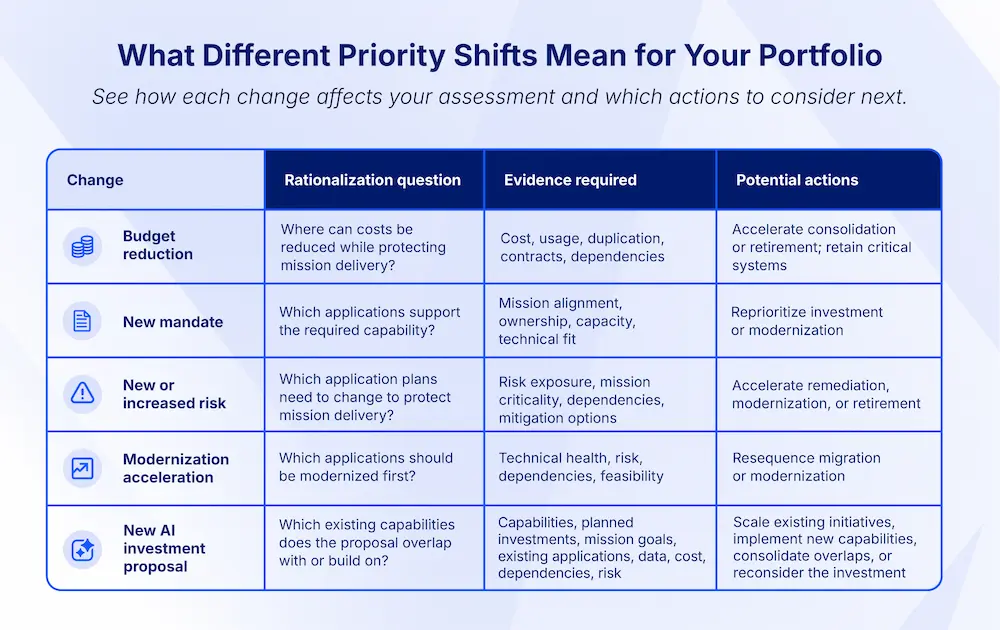
Budget pressure brings these choices into sharp focus, but it is not the only reason to reconsider technology plans. A new mandate may require investment in an application previously scheduled for retirement, while an emerging risk may make a deferred modernization project urgent.
Keeping technology plans aligned as these demands change is an ongoing responsibility for government CIOs. According to Gartner’s 2026 CIO Agenda for U.S. State and Local Government, "U.S. state and local government CIOs must frequently realign their technology investment and deployment plans." The report also notes that "[d]ecision making is shifting from a calendar-based approach to dynamic reprioritization of resources."
Continuous application portfolio management supports dynamic reprioritization by keeping information about applications, dependencies, and mission needs current and connected. The practical challenge for government teams is using that information to keep application rationalization decisions aligned as budgets and mandates change. That means knowing what to reassess and how to carry revised decisions into action while protecting mission delivery, without restarting the entire exercise.
What is application rationalization in government?
Application rationalization is a structured, repeatable process for evaluating an application portfolio and deciding which applications to retain, modernize, consolidate, migrate, or retire. The chosen course of action for an application is known as its disposition. In government, dispositions draw on evidence about:
- mission relevance and business value
- cost
- ownership
- technical health
- operational and cybersecurity risk
- application and technology dependencies
- lifecycle status
- modernization feasibility
Rationalization sits within application portfolio management, the broader discipline of managing applications throughout their lifecycle. This includes maintaining portfolio information, governing choices about applications, and tracking the resulting actions.
For federal agencies, the Federal Chief Information Officers (CIO) Council's Application Rationalization Playbook sets out an established six-step methodology for evaluating applications and determining their future disposition. The Playbook also emphasizes that rationalization should become part of normal agency operations.
If your agency already has an application inventory and previous assessments, you can build on that work, using current portfolio information to reassess plans for the applications affected by a savings target or other new priority. Start by validating the owners, costs, and critical dependencies for the affected service. If material gaps remain, widen the assessment before committing to a change. Agencies starting a rationalization program from the ground up can use the six-step methodology to establish that foundation, tailoring it to their mission and operational needs.
How do changing priorities affect application rationalization decisions?
A rationalization decision reflects your agency's priorities, constraints, and available evidence at the time it was made. When those conditions change, a planned application retirement, consolidation, or modernization may become more urgent, less valuable, or harder to carry out.
Take a new mandate. Your team may have agreed last year to retire an application, with owner sign-off and a decommissioning date in the roadmap. The mandate then makes the capability that application supports a new priority. The application's mission importance rises, and retiring it on the original schedule could put delivery of the mandate at risk. Budget pressure can pull in the opposite direction, making a planned consolidation or retirement more urgent where applications overlap.
Changes in risk, modernization timing, available technology, or critical dependencies can also affect when and how an existing disposition should be carried out.
Agencies often face several of these pressures at once. In Critical Resources for U.S. Government Leaders in 2026, Gartner observes, “Public-sector CIOs are under enormous pressure to modernize while simultaneously navigating volatility, policy changes, and shrinking budgets.”
Responding quickly to these shifts requires agencies to manage their portfolios continuously, keeping application plans visible as they are put into action. Owners and other stakeholders should keep application information, dispositions, and implementation progress up to date through their daily work. This supports decision agility by giving teams a current view of the portfolio and its interdependencies when priorities change.
Decision agility also requires clear ownership, agreed assessment criteria, awareness of the IT policies relevant to the mission, and a way to assess the impact of proposed changes. A clear path from decision to action plan then helps teams carry approved changes into implementation.
How can your team revisit rationalization decisions without starting over?
When a budget, mandate, or mission priority changes, the first task is to establish which existing application plans need review. Within your agency's established rationalization process, you can focus the review on the applications involved, the evidence behind their planned disposition, and any adjustments needed.
Clarify what has changed
Start with the new requirement or constraint itself. What outcome does your agency need to achieve, and how urgently? What funding is available, and what mission or operational constraints apply? The answers frame the rationalization question and show which part of the portfolio needs reassessment. For a savings target, the question might be where costs can come down while mission delivery is protected.
Identify the affected applications
Next, trace the change through the application portfolio. Look at:
- the mission service or capability involved
- the applications that support it
- business and technical owners
- technical and operational dependencies
- existing dispositions
- related modernization or investment initiatives
Include applications affected directly and those connected through shared infrastructure, data, technologies, or operational dependencies. This gives your team a focused scope for the assessment. It also brings to light mission-critical requirements and implementation constraints that may limit the options available.
Refresh the evidence that could affect the decision
Review the information behind the existing application plans and confirm what is still accurate and complete. Focus on the evidence that could change an existing disposition or how it should be implemented:
- costs and contracts
- usage
- lifecycle status
- planned investment
- technical health
- security and operational risk
- modernization feasibility
- capacity to execute
The change you clarified at the start tells you where to look first. For a savings target, for example, start with costs, contracts, and usage. Compare recurring savings with transition and exit costs, and confirm when contract commitments allow the savings to be realized.
Reconsider the existing disposition
With current evidence in hand, test whether each previous decision to retain, modernize, consolidate, migrate, or retire still supports your agency's priorities. Apply your agency's assessment criteria and check the options against relevant IT policies and mandatory mission requirements. For example, an application supporting a required public service may need to remain operational until a suitable replacement is available, even where retirement would reduce costs.
The review may lead to several outcomes:
- an application marked for retention may now need modernization
- a planned migration may need to move forward sooner
- a planned retirement may need to be delayed because of a newly critical dependency
- a consolidation opportunity may become more urgent under budget pressure
- a planned modernization may be deprioritized when a more urgent mission requirement emerges
The disposition may remain appropriate even when its timing, funding, or implementation plan needs to change.
Budget pressure calls for particular care. In Cost Optimization Strategies, Gartner advises organizations to “[a]void indiscriminate cost reductions that can harm essential functions and long-term growth. Instead, prioritize cuts based on strategic importance and potential impact, ensuring that critical areas remain well-supported.” Portfolio evidence lets your team apply that principle to applications, showing where credible savings may exist and which applications remain important to mission delivery.
How can your team turn revised rationalization decisions into governed action?
Once the reassessment identifies a change to an application’s disposition or implementation plan, your team needs to document why it is needed and coordinate how it will be carried out. Some practical steps to consider include:
Record the decision and the reasoning behind it. Document the outcome of the review, the evidence that supports it, and why the disposition or implementation plan changed. This record supports oversight and audit reviews, helps future teams understand the rationale, and provides evidence for subsequent reassessments.
Connect it to plans and funding. Assign clear ownership and link the decision to an operational action or funded initiative. Update the roadmaps, budgets, contracts, and modernization plans it affects, and sequence changes around dependencies so that one application's retirement doesn't disrupt another.
Govern and track it. Set approval and review points, then track implementation and outcomes against what the decision was meant to achieve. Depending on the decision, that might mean net recurring savings realized, less exposure to unsupported technology, or continuity maintained for the services the public relies on.
Many different developments can prompt a reassessment. Your team should agree on which ones will trigger a review in the future. These triggers may include material changes in funding, mandates, mission priorities, risk, modernization programs, technology proposals, or critical dependencies.
Embedding these actions and review triggers into everyday portfolio management helps put the Federal CIO Council's Playbook recommendation into practice, making rationalization part of normal agency operations.
As the number of affected applications and stakeholders grows, keeping the evidence and the approved actions connected becomes harder. Our Essential Guide to Application Rationalization for Government Agencies explores the platform capabilities needed to sustain this approach. When you evaluate platforms, look for support that connects Playbook assessments to approved actions and implementation tracking.
Available to U.S. federal agencies through FedRAMP® Certified Bizzdesign GovCloud, Bizzdesign Alfabet supports ongoing application rationalization by connecting applications with mission capabilities, costs, risks, technologies, dependencies, and planned initiatives. With this trusted, connected portfolio context, business and IT teams can assess the consequences of proposed changes and agree which actions best support current mission priorities. The Bizzdesign Alfabet U.S. Government Accelerator provides preconfigured support for the Playbook, helping agencies establish consistent assessment structures and governed workflows.
Keeping your portfolio aligned as priorities change
The next savings request or mandate may arrive with little warning. Keeping portfolio information and application plans current gives your team a stronger starting point for responding. You can explain which plans need to change, which should hold, and what each choice means for mission delivery. Putting rationalization into everyday practice helps agencies respond with the speed leaders need and the accountability public investment demands. 
FAQs
Government IT teams can keep modernization moving by identifying which work remains essential to mission delivery, what can be deferred, and how existing plans can accommodate new requirements. Some modernization work may need to continue because it enables the new priority or addresses a risk the agency cannot accept. Where modernization work can be deferred or its scope adjusted, teams need to record the trade-offs and agree when to review the revised plans again. Approved changes should be reflected in modernization roadmaps, funding allocations, and delivery schedules, with dependencies accounted for. Using Bizzdesign Alfabet for application portfolio management, teams can assess how new priorities affect modernization plans by reviewing applications alongside their mission role, costs, risks, dependencies, and planned investments. Bizzdesign Alfabet is available to U.S. federal agencies through Bizzdesign GovCloud, a FedRAMP® Certified offering.
Assessing the impact of a new federal mandate starts with identifying the mission capabilities it requires, the applications that support them, and whether existing systems and plans can meet the requirements. The required outcome, deadline, funding, and mission or operational constraints define the scope of the assessment. The review covers:
- the mission service or capability involved
- the applications that support it
- business and technical owners
- technical and operational dependencies
- existing dispositions
- related modernization or investment initiatives
The review includes applications affected directly and those connected through shared infrastructure, data, technologies, or operational dependencies. Each affected application’s mission alignment, capacity, and technical fit help establish whether it can support the new requirement or needs changes. Tracing the mandate this way gives teams a focused assessment scope and can surface conflicts with existing dispositions. For example, an application scheduled for retirement may support the capability the new mandate makes a priority. Retiring it on the original schedule could put delivery of the mandate at risk. Using Bizzdesign Alfabet for application portfolio management, teams can trace the affected mission capabilities to supporting applications, owners, dependencies, and planned initiatives. Bizzdesign Alfabet is available to U.S. federal agencies through FedRAMP® Certified Bizzdesign GovCloud.
Government IT teams can reduce application costs by consolidating overlapping capabilities or retiring underused systems where the change preserves required services. Low usage alone does not mean an application is safe to remove. The assessment needs to connect costs, contracts, usage, and dependencies with the mission services each application supports. Application and service owners help confirm whether another system can meet those needs, what a transition would involve, and when savings could realistically be achieved. Contract commitments, migration costs, and operational dependencies may limit or delay the savings. Using Bizzdesign Alfabet for application portfolio management, teams can compare potential application savings with the risks and dependencies that could affect mission delivery. The platform is available to U.S. federal agencies through FedRAMP® Certified Bizzdesign GovCloud.
Before retiring a legacy system, government IT teams need evidence that required public services can continue, dependencies have been addressed, and any necessary replacement is ready. That assessment covers the system’s mission role, usage, data and technical dependencies, contracts, and relevant agency IT policies. Business and technical owners need to confirm how required capabilities and access to necessary data will be maintained after retirement. Using Bizzdesign Alfabet for application portfolio management, teams can examine an application’s mission role and dependencies alongside its planned retirement. A previous retirement assessment may still be useful, but new mandates, emerging dependencies, or delays to a replacement can change whether the original plan remains workable. The retirement decision can remain appropriate even when its timing or implementation needs to change. For U.S. federal agencies, Bizzdesign Alfabet is available through FedRAMP® Certified Bizzdesign GovCloud.
Government agencies can justify protecting an IT investment by showing its contribution to mission delivery and the consequences of reducing, delaying, or stopping it. The case is stronger when it connects funding to mandatory requirements, operational risk, and dependencies on other applications or initiatives. Current evidence about application costs, technical health, dependencies, lifecycle status, and modernization feasibility supports a comparison of the available options, including a reduced scope or revised timetable. A lower immediate cost may come with greater operational risk or delay a required capability. Making the case requires a documented record of the evidence, assumptions, and trade-offs so leadership and oversight teams can understand why some investments should be protected while others can be deferred or reduced. Bizzdesign Alfabet supports application portfolio management by giving teams a shared view of application costs, risks, mission relevance, and planned investments to inform and substantiate funding recommendations. For U.S. federal agencies, Bizzdesign Alfabet is available through FedRAMP® Certified Bizzdesign GovCloud.