Fresh perspectives on the future of enterprise architecture
TL;DR
Enterprise architecture is evolving as people from broader backgrounds enter the profession, transformation becomes more multidisciplinary, and AI makes architecture knowledge faster and easier to surface. Emerging and experienced architects contribute different strengths, while trusted enterprise context helps transformation teams and AI apply that knowledge effectively.
Conversations about the future of enterprise architecture often begin with AI. The technology promises to reduce manual effort, surface insights faster, and make architecture knowledge more accessible. But AI is only one part of the change. The enterprise architecture profession is also evolving through the people entering it, the growing range of roles involved in transformation, and new expectations for how architecture knowledge should be shared and applied.
These shifts were central to the conversations at Bizzdesign Connect London, where our customer and practitioner community came together to explore the changing role of enterprise architecture.
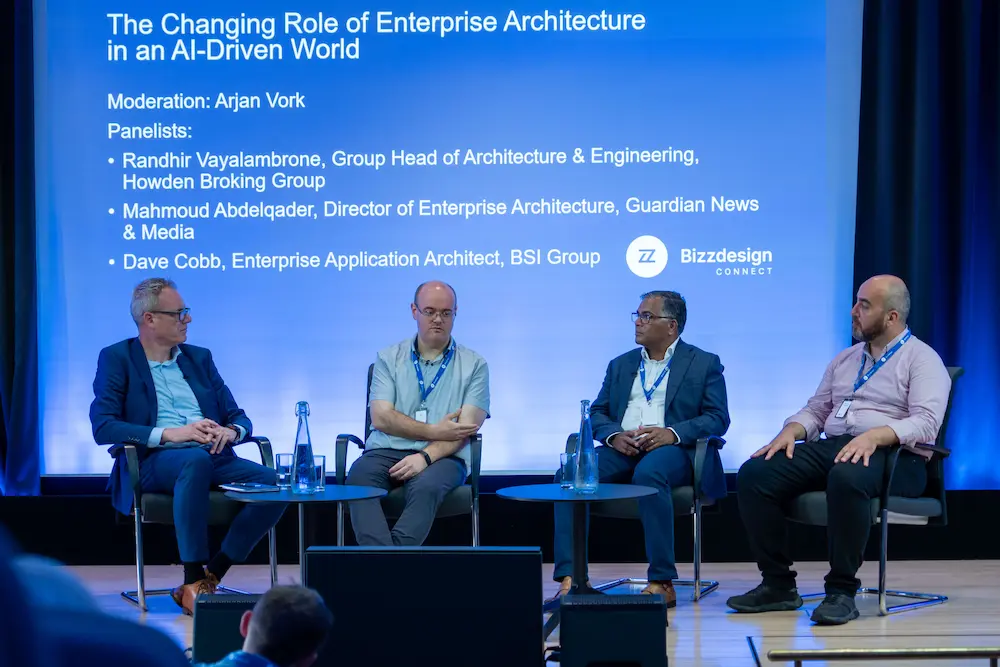
Two sessions highlighted different but closely connected aspects of that evolution. Grace King, an Associate Architect at Leonardo, reflected on her journey from a mathematics degree into enterprise architecture and the value that people from different backgrounds can bring to the profession. In a separate discussion, a panel of enterprise architecture leaders explored how AI is changing the work architects do, the decisions they support, and the way enterprise knowledge can be accessed. The panel brought together Randhir Vayalambrone, Group Head of Architecture and Engineering at Howden Broking Group; Mahmoud Abdelqader, Director of Enterprise Architecture at Guardian News & Media; and Dave Cobb, Enterprise Applications Architect at BSI Group.
Together, the discussions raised a broader question: what skills, perspectives, and ways of working will enterprise architecture need in an agentic future, where humans and AI co-workers increasingly contribute to transformation together?
New career pathways are bringing a wider range of skills into enterprise architecture
Grace King had not heard of enterprise architecture before joining Leonardo’s Digital Solutions graduate scheme. Through placements spanning project delivery, cloud operations, information security, and architecture, she was able to explore the breadth of the profession before choosing enterprise architecture as her substantive role. The combination of analytical thinking, structured problem-solving, and business engagement was a natural fit with the strengths she had developed through her mathematics background.
Her route into the profession was one of several across Leonardo’s associate architect cohort. Others brought experience from engineering, data, security, delivery, and automation, reflecting the wider range of backgrounds from which future enterprise architects can emerge. Grace’s presentation also made clear that these different skills are becoming increasingly relevant as architecture practices evolve.
As Grace described it, newer architects bring “fresh pairs of eyes.” They ask why established processes work as they do, bring conversations back to the business question being answered, and identify opportunities to apply their own strengths. At Leonardo, newer members of the team have introduced scripting and automation, more structured ways of working, and experience drawn from disciplines such as project delivery.
“We’re sort of asking 'why' all the time. And that leads people to have to look and think: actually, what is the answer here? What business question is this answering?” — Grace King, Associate Architect at Leonardo
The benefit also flows in both directions. Emerging architects gain from the knowledge, frameworks, and experience of established colleagues, while their questions and perspectives can prompt the wider team to reconsider assumptions and see the bigger picture. That combination of established expertise and new thinking shows why broader career pathways can strengthen the enterprise architecture profession.
Grace King, Associate Architect at Leonardo, reflects on her journey from mathematics into enterprise architecture and the value fresh perspectives can bring to the profession.
Enterprise transformation is now a multidisciplinary activity
Those different perspectives also influence how enterprise architecture works with the wider teams involved in transformation. At Leonardo, colleagues entering architecture from adjacent disciplines have brought expertise that supports work across different functions. Security expertise, for example, has supported the integration of cyber and disaster recovery considerations into architecture design from the outset. The practice also works across engineering, data and AI governance, information security, cyber, and disaster recovery.
This reflects a broader shift in how enterprise transformation is delivered. Transformation collaboration increasingly spans strategy, architecture, technology, operations, portfolio management, delivery, and the business. A 2025 study of digital transformation found that 80% of leading organizations involved the right mix of business and IT stakeholders during planning, compared with 47% of those falling behind.
Working across that range of roles can create its own challenges. Across Bizzdesign’s work with transformation teams, we often see people operating in separate tools across ideation, workshopping, planning, and execution. They may use different terminology and work from fragmented sources of information, making it difficult to form a shared, trusted view for decision-making. Atlassian’s 2025 State of Teams research, for example, found that knowledge workers and executives spend around a quarter of their time searching for answers, illustrating the wider challenge of finding the context needed to work and make decisions effectively.
For multidisciplinary teams to work effectively, enterprise knowledge needs to remain connected, accessible, and trusted as decisions move from early ideas into planning and execution. That same foundation also determines how far AI can extend the reach and impact of enterprise architecture.
AI can multiply the impact of enterprise architects
As transformation draws on more disciplines, AI can help enterprise architects extend their reach across the organization. By reducing manual review, accelerating repetitive analysis, and making architecture knowledge easier to find, it can free architects to spend more time on interpretation, stakeholder engagement, and decisions that require professional judgment.
At Bizzdesign Connect London, our customer panel explored this potential from three complementary perspectives: moving beyond individual productivity toward measurable business value, managing adoption carefully in trust-based environments, and establishing clear policies and guardrails around how AI is used.
“The real test for enterprise AI is whether it moves beyond individual productivity and delivers measurable value for the business.” — Randhir Vayalambrone, Group Head of Architecture and Engineering, Howden Broking Group
The discussion also focused on where AI can create meaningful value, how quickly it should be introduced, and what controls need to remain in place.
The panellists emphasized reliable data, clear governance, and human oversight, particularly where decisions carry regulatory, operational, or financial consequences. AI may make enterprise knowledge faster to access, but the value of its output depends on the quality and control of the information beneath it.
“AI creates real opportunities to accelerate work, but in a trust-based organization, adoption has to be managed carefully and human accountability must remain.” — Dave Cobb, Enterprise Applications Architect, BSI Group
This aligns with Bizzdesign’s view that AI needs live, governed enterprise context, including the relationships between business capabilities, applications, data, risks, and change initiatives. Bringing that context into the flow of transformation work allows AI to provide more relevant support and helps a wider range of stakeholders engage with architectural insight.
“AI can be a valuable assistant for finding information and accelerating work, provided it operates within clear policies, principles, and guardrails.” — Mahmoud Abdelqader, Director of Enterprise Architecture, Guardian News & Media
Shared, trusted enterprise context serves several needs at once:
- New architects can learn from accessible institutional knowledge and established patterns.
- Experienced architects can make their knowledge available more widely.
- Multidisciplinary teams can work from a common view of transformation initiatives and their dependencies.
- AI can draw on governed, enterprise-specific context.
Leonardo provides a practical example of how this kind of foundation supports people entering the profession. Grace was able to contribute quickly because Leonardo had established architecture, strong governance, and a shared metamodel in place. That foundation helped her learn the language, draw on proven patterns, and understand how her work connected to the wider enterprise.
Evolving enterprise architecture for an agentic future
Leonardo’s approach also shows how organizations can develop the next generation of enterprise architects more deliberately. Grace was given meaningful responsibility early, access to experienced colleagues, and exposure to real business stakeholders. Together, those experiences helped her build professional judgment and see the impact of the role firsthand.
“I would really recommend that enterprise architecture teams try to attract graduates by showing them the breadth of the work that can be done and how impactful it can be.” — Grace King, Associate Architect at Leonardo
As the profession evolves, graduate programs, mentoring, and meaningful exposure to the breadth of enterprise architecture will remain essential to building the talent organizations need. So will the foundations that allow knowledge to move across generations, disciplines, and technologies. Trusted enterprise context and strong governance help new architects learn from established knowledge, enable experienced architects to share their expertise more widely, and support transformation collaboration by giving multidisciplinary teams a common basis for decisions. They also give AI the enterprise-specific grounding it needs to provide useful, relevant support rather than generic output.
In a future shaped by agentic AI, where human and AI co-workers contribute to transformation together, those foundations will determine how effectively the profession can adapt. The conversations at Bizzdesign Connect London showed that the next chapter of enterprise architecture will be shaped by how well organizations connect broader talent, trusted enterprise context, and AI that can multiply the impact of architects while keeping human judgment at the center.
What fresh perspectives is your organization bringing to enterprise architecture? Let’s continue the conversation.
FAQs
AI is changing the role of enterprise architects by reducing manual work and expanding their impact across transformation. It can help automate repetitive tasks such as translating whiteboards into models, cleaning metadata, and assembling reports, giving architects more time for scenario planning, stakeholder engagement, and decisions that require professional judgment. As a result, enterprise architecture is moving from documentation to orchestration. Architects are also increasingly shaping AI-native target operating models in which AI agents and intelligent workflows are designed alongside applications, services, data flows, governance, and business capabilities rather than added later as isolated tools. This allows AI to multiply the impact of enterprise architects further while keeping human judgment, governance, and accountability at the center.
Enterprise architects will need a balanced combination of architectural expertise, business understanding, analytical thinking, communication, multidisciplinary collaboration, and governance capabilities. They must connect business capabilities, applications, data, risks, and change initiatives, then translate those relationships into decisions that people and AI can use. Architects will increasingly curate enterprise semantics, ensuring that enterprise concepts, relationships, ownership, lifecycle states, and controls are clearly defined. The ability to guide how AI accesses and applies enterprise knowledge will become essential, ensuring that outputs remain enterprise-specific and grounded in business reality rather than generic or disconnected.
Yes. Enterprise architects can come from a wide range of professional backgrounds, in other business and technology disciplines. The profession depends on analytical thinking, structured problem-solving, curiosity, business engagement, and the ability to connect technical detail with business priorities, all of which can be developed in different disciplines. People entering from adjacent fields may also bring fresh perspectives, adjacent skills, and new ways of working, while experienced architects contribute institutional knowledge, proven frameworks, and understanding of the enterprise. Bringing these strengths together helps the profession evolve by combining established expertise with new thinking that challenges assumptions and broadens the team's capability.
Organizations can attract and develop the next generation of enterprise architects by giving emerging talent meaningful responsibility early, access to experienced colleagues and mentoring, and exposure to real business stakeholders and decisions. Development also depends on strong enterprise architecture foundations. Shared metamodels, governance frameworks, reusable patterns, clear definitions, and accessible institutional knowledge help new architects understand how the enterprise fits together and contribute without having to rebuild established knowledge from scratch. AI can accelerate this learning by making architecture knowledge easier to find and apply, but experienced architects remain essential for providing judgment, context, and guidance.
Enterprise architecture helps multidisciplinary transformation teams work together through Transformation Collaboration, giving teams across strategy, technology, operations, portfolio management, delivery, risk, and the business a shared, trusted view of how the enterprise works. In practice, enterprise architecture connects capabilities, applications, data, processes, risks, and change initiatives so teams can identify dependencies, evaluate trade-offs, and test scenarios while decisions are still taking shape. This reduces fragmented decision-making and late-stage rework, while carrying context and rationale from early ideas through planning and execution. The result is stronger alignment between strategy and execution, with fewer decisions having to be revisited once delivery is already underway.
AI needs trusted enterprise data and context because reliable AI adoption depends on more than technically accurate data. Enterprise architecture helps make data ready for AI by defining which sources are authoritative, what enterprise concepts mean, how they relate, who owns them, and what lifecycle and governance rules apply. This gives AI a consistent foundation for understanding capabilities, applications, processes, risks, and change initiatives, so it can surface dependencies, assess impacts, and support decisions using the realities of the organization. Without that foundation, AI can amplify inconsistency and fragmentation rather than resolve it.