Transformation Collaboration: How Enterprise Leaders Are Turning AI Ambition into Execution
AI is changing how quickly organizations have to move, and how early the important decisions get made. Budgets, pilots, and direction are being set sooner than ever, often before teams share a clear view of what'll create value and what won't.
At Bizzdesign Connect 2026, our cross-industry panel brought together five senior enterprise architecture leaders from KPMG, FMO (The Dutch Entrepreneurial Development Bank), IT Syntrix, VivaNova Consulting, and the Chief Architect Network, to talk through what AI is really demanding of enterprise transformation, and a common thread ran through the conversation.
The challenge is broader than AI itself. What matters is whether architecture, governance, and enterprise context are in the room early enough to shape decisions, while there's still room to move before strategic choices get expensive to reverse. That's the gap Transformation Collaboration is built to close.
Here's what the panel told us.
Why AI Investment Needs Enterprise Clarity First
Leonardo Vivas, Founder of VivaNova Consulting and formerly Senior Director of the enterprise acceleration office at Target, opened with an observation that set the tone for the rest of the discussion: too many organizations measure AI progress by how many licenses they've deployed or how many pilots are running, rather than asking which business capabilities have the highest value and what's driving underperformance in them.
He isn't alone in seeing this. In Gartner research published in April 2026, only 28% of AI use cases in infrastructure and operations were judged to fully succeed and meet ROI expectations, with a further 20% failing outright. The rest is where most AI programs start to drift.
At one of his former employers, applying AI to demand forecasting was one of the biggest opportunities the business had, and it became a proof point in a way that thousands of scattered ChatGPT licenses weren’t.
What made the difference was clarity about the problem before the investment: which capability needed to improve, and why. That kind of clarity depends on upstream work:
- Which capabilities matter most to the business?
- What's driving underperformance in them?
- Is AI the right lever, given what we know?
That upstream work is what too often gets skipped, as the pressure to show momentum drowns out the pressure to show rigor.
Grant Ecker, Vice President of Enterprise Architecture at Ecolab and Founder and Chairman of the Chief Architect Network, a network of approximately six hundred chief architects, brought a different angle to this. His concern was less about what organizations are measuring and more about whether they're oriented toward the right outcome in the first place. For Ecker, architecture leaders have a responsibility to help the organization define the right puzzle before teams begin piecing it together. That means being present when strategic direction is being set, not brought in once it's been decided.
The signal, Ecker argued, comes from conversations with peers across different organizations and industries. Architecture leaders who stay close to those networks are the ones who can distinguish genuine direction from noise.
For leaders making AI investment decisions, the message is practical. Activity needs to connect back to business capabilities, enterprise priorities, and decisions the organization is ready to act on. Otherwise, momentum can look strong while value remains difficult to prove.
Why Most AI Pilots Don't Make It to Production
A pilot that works is one thing. Getting it into production, and then scaling it, is where the difficulty starts.
John Blyth, Managing Director at IT Syntrix and formerly at Rolls Royce Small Modular Reactors, has spent time on the front line of AI adoption in highly regulated environments, starting in nuclear and now across regulated industries in the UK. The core problem he described is one most regulated organizations are still working through. You can train an AI agent on a representative dataset in a development environment where experimentation is encouraged and constraints are loose. That environment looks nothing like the production environment it needs to move into, which is more secure, more restrictive, and governed by data sovereignty requirements.
He also posed a question to the panel that few have fully answered yet: how do you preserve the learning from a development pilot and shift it into a locked-down production environment without retraining the model from scratch?
Ecker built on this with a point about scale. Pilot purgatory, as he described it, happens when an organization succeeds in optimizing an AI solution for one context, whether that is a single manufacturing plant, a single line of business, or a single customer. The results are there. But because the underlying data models and logic were built for that context rather than designed to travel, expanding into the next context means starting again. The problem compounds each time scope widens.
The way out is making the implicit explicit. The decisions organizations have been making for years, the logic embedded in processes, assumptions, and institutional knowledge, need to be codified before a machine can reason across them. What's generic across the business? What's specific to a particular context? That, Ecker argued, is the work of enterprise architecture, and it’s the work that’s commonly underestimated.
Not every AI problem requires that level of custom work. Some solutions, a product recommender for instance, already exist off the shelf. Part of what enterprise architecture brings is the ability to tell the difference.
That distinction matters more as AI investment accelerates. Scaling well means making deliberate calls about what to scale, what to adapt, what to reuse, and what to leave alone. Enterprise architecture gives organizations the context to make those calls with discipline, so they adopt what already works and build only what genuinely needs building.
“You can train an AI agent on a representative dataset in a development environment where experimentation is encouraged and constraints are loose. That environment looks nothing like the production environment it needs to move into, which is more secure, more restrictive, and governed by data sovereignty requirements.”
How Governance and Trust Shape Enterprise AI Adoption
Rearchitecting permission and trust was the phrase Ecker brought back from a recent Chief Architect Network event in London, and it reframed how the panel thought about trust in AI. Performance isn't the whole story. An agent that reasons and decides but isn't entrusted to follow through won't deliver value regardless of how well it's built. As Ecker put it, you have to build the autonomous car and rearchitect the roads at the same time.
Shikha Ranjan, Lead Enterprise Architect at FMO, added that even when AI produces better outcomes than current processes, organizations may still resist adopting it. The guardrails must come first, she argued, before trust can follow. At FMO, the workforce is focused on impact; speaking in the language of efficiency, risk reduction, and customer experience is what lands. Shikha used value stream mapping to make the case visually: showing where rekeying data fifteen times was costing the organization, and what removing that friction would mean in practice.
Kimberly Schreiber, Head of Enterprise Architecture at KPMG UK, built on this with a point about traceability. As AI adoption accelerates and model releases move faster than traditional governance cycles, organizations need a live understanding of how applications, agents, models, platforms, and controls connect. That means maintaining a live chain of traceability from applications to agents, agents to models, models to platforms, platforms to approved controls.
Done that way, it's what allows enterprise architecture support innovation, by making the guardrails visible, the dependencies easy to follow, and the risks no longer buried in disconnected documents. Everyone who needs to act has the boundaries clear, not just the architects who designed them.
What Enterprise Leaders Can Do to Improve Transformation Decisions
Many of the decisions that shape transformation outcomes are made before architecture practices are involved. They happen in workshops, strategy sessions, investment discussions, and early business case development. If enterprise context arrives only after direction has been set, architecture is forced into correction mode. The cost of change rises, momentum slows, and teams lose the opportunity to make better decisions earlier.
The practitioners on this panel described what closing that gap looks like from their own work:
- Engage earlier, not later. Move architecture into intake, ideation, and early planning so guardrails are set before teams are already committed.
- Keep traceability live. Connect applications, agents, models, platforms, and controls so governance can keep pace with AI change.
- Start with business capabilities. Identify where AI can create the most value before committing investment, effort, or executive attention.
- Codify what the organization already knows. Make process logic, assumptions, and institutional knowledge explicit so they can scale across teams and use cases.
- Pressure-test direction before execution. Help teams understand whether they are solving the right problem before they start building.
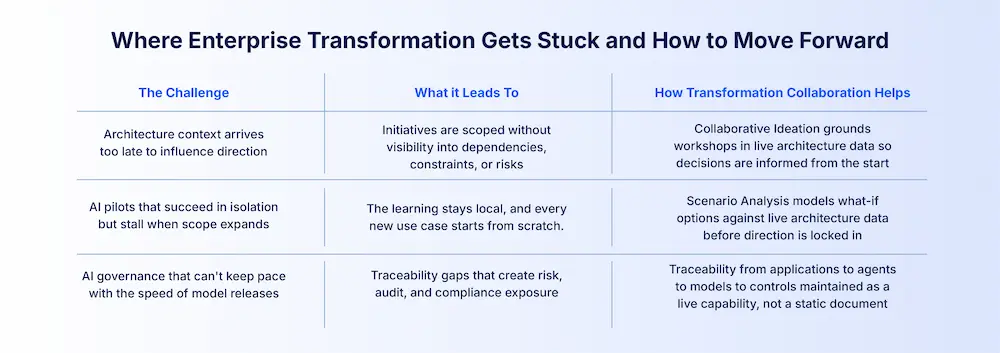
These are the approaches that practitioners in some of the world's most complex organizations are using right now, because the old ways of working no longer move fast enough. Sitting where I do, I'd add that one of the hardest problems in enterprise AI is that the narrative has outpaced the architecture. A lot of organizations can describe an AI ambition; far fewer can show the enterprise reality that ambition has to survive. Closing that gap is the work, and it's why a conversation like this one matters.
John Blyth was our first Bizzdesign Unify customer, having used it at Rolls Royce Small Modular Reactors. He described it as an intelligent whiteboard where stakeholders query the organization's architecture in natural language, explore ideas together, and the environment does the grounding work in real time.
"It almost marks your homework," Blyth said. "It'll say, that doesn't work, that does work, we've already got that process, you should use this one instead." The governance isn't a separate process. It's built into the conversation.
That's Transformation Collaboration in practice. Ideation grounded in enterprise reality from the first session. Scenario analysis against live architecture data so trade-offs are visible before direction is locked in. Workshop outputs that move directly into structured, traceable plans without the rework that comes from discovering dependencies too late.
If any of this resonates, try putting it into practice.
Start your free 14-day trial of Bizzdesign Unify and bring enterprise intelligence into your next transformation conversation.
Already a Bizzdesign customer? Connect with your account team to explore how Bizzdesign Unify can extend the value you're already getting from your Bizzdesign platform.

FAQs
Transformation Collaboration is Bizzdesign’s solution for bringing visual collaboration, enterprise context, and AI-driven insight together during enterprise change. It is delivered through Bizzdesign Unify, Bizzdesign’s new SaaS product within the Enterprise Transformation Suite.
Transformation Collaboration is designed to bring people, plans, enterprise intelligence, and AI-driven insights together while decisions are still taking shape. In practice, that means teams can work from the same enterprise picture earlier, assess trade-offs with more context, and carry decisions forward with less rework. In Bizzdesign Unify, Transformation Collaboration takes shape through three connected use cases: Collaborative Ideation, Scenario Analysis, and Initiative Mobilization.
Bizzdesign Unify is the collaborative layer of the Bizzdesign Enterprise Transformation Suite. It gives cross-functional teams, including business leaders, architects, strategy, and delivery teams, a shared workspace to explore ideas, model scenarios, and align on initiatives, all connected to live enterprise architecture data.
Where tools like Miro or Mural support ideation and collaboration, Bizzdesign Unify adds the enterprise context those tools aren’t designed to provide dependencies, constraints, and structured data from architecture, portfolio, and system-of-record sources your organization already maintains. Teams work in a familiar canvas environment without needing deep technical expertise. The enterprise context surfaces in the flow of work. Decisions made in collaborative sessions hold up in execution because the trade-offs were visible when the decisions were being made.
Pilot purgatory is the pattern where an AI initiative delivers results in one context but can’t be scaled because the underlying data models and logic were built for that specific context rather than designed to travel. When scope expands, teams rebuild rather than scale, and the learning stays local. Enterprise architecture addresses this by making the implicit explicit: codifying the organizational reasoning, data structures, and decision logic that currently exist in processes and institutional knowledge, so AI solutions can operate consistently across business units and contexts. Distinguishing what is generic across the organization from what is specific to a given context is the foundational work that separates AI projects that scale from those that stall.
Enterprise architecture enables AI governance by maintaining the traceability chain that connects AI systems to the controls and oversight structures governing them. This chain runs from business applications to AI agents, from agents to the models they use, from models to the platforms hosting them, and from platforms to the approved controls and guardrails in place.
As AI adoption accelerates and new models are released faster than traditional governance cycles can absorb, this traceability becomes the foundation for governance, risk management, and audit. Without it, organizations can’t demonstrate active oversight of their AI systems, which is increasingly required under frameworks such as the EU AI Act. Enterprise architecture teams that maintain this chain as a live capability, rather than periodic documentation, are the ones best positioned to enable AI innovation without creating governance gaps.
Enterprise architects identify where AI will create the most business value by applying capability decomposition: mapping the highest-value business capabilities, identifying the root causes of underperformance in them, and then assessing whether AI is the right solution to those root causes.
This approach avoids the common failure mode of measuring AI progress by license counts or use case volume, which can show activity without proving value. When organizations skip capability decomposition and move directly into experimentation, they generate AI investment that is difficult to govern, scale, or connect to business outcomes. When they apply it, they produce proof points that both senior executives and engineering teams can act on, as well as a clear definition of what success looks like before commitment is made.
Enterprise transformation typically stalls between strategy and execution because the decisions that shape an initiative's success are made before the enterprise intelligence needed to validate them is present. Workshops and strategy sessions happen in collaborative tools; architecture data lives in separate platforms consulted at a different stage. By the time architecture is involved, investment has been committed and direction set. The dependencies, constraints, and risks that would have changed the decision surface later, when the cost of changing course is higher.
Closing this gap requires bringing enterprise architecture data into the collaborative sessions where transformation decisions are being made, not as a review step after the fact. This is the core design principle behind Bizzdesign’s solution Transformation Collaboration.