
Bizzdesign Unify: An AI-native platform for faster, better transformation decisions.
Transformation Collaboration: A Practical Guide to Aligning Strategy, Enterprise Architecture, and Delivery
Most transformation decisions are made twice: Once in the workshop, and again later, when teams uncover the dependencies, constraints, and trade-offs that weren't visible during brainstorming.
If you’ve led or supported transformation work, the pattern is familiar. A workshop creates momentum. Stakeholders align around a direction. The whiteboard looks clear, the energy is high, and the pressure to keep moving is intense. But most people in that conversation are working from partial visibility. Architecture input often isn’t there yet, downstream operational implications aren’tvisible, and delivery constraints tend to emerge only once plans are already moving.
This coordination gap runs through many transformation efforts. Teams are often making decisions before they have enough shared context to understand what’s feasible, what’s affected, and what trade-offs will surface later in execution. That context typically lives in different tools, different teams, and different stages of the process, siloed in ways that make it difficult to build a shared, trusted picture where direction is being set.
The cost shows up downstream. When missing dependencies, conflicting requirements, or feasibility issues surface after budgets are committed, organizations can face 30–40% budget overruns, 20–30% schedule delays, and 20–30% effort lost in the early phases of transformation. For a €10 million initiative, that translates into €3-4 million lost before execution is fully underway. At enterprise scale, the financial impact can quickly reach tens of millions. More broadly, inefficiency linked to coordination gaps can cost businesses up to 25% of annual revenue.
This challenge is getting harder to absorb. As AI accelerates the pace and scale of change, organizations are expected to move faster across more initiatives, more dependencies, and more complex trade-offs. Without shared context, faster decisions simply bring rework forward.
Transformation Collaboration is designed to close that gap. It connects visual, cross-functional collaboration with the enterprise context teams need to make well-informed decisions early, before budgets are committed, before execution work begins, and before rework getsexpensive. It creates a more connected path from workshop momentum to execution reality, so teams make decisions with clearer understanding of what’ll hold up.
This guide explains why Transformation Collaboration matters, how it works in practice, and what organizations need in place to make it operational.
Introducing Transformation Collaboration
Transformation Collaboration is Bizzdesign’s solution for closing that coordination gap in enterprise change. It sits at the core of Bizzdesign Unify, an AI-native platform in the Enterprise Transformation Suite, and brings people, plans, and enterprise intelligence together while decisions are still taking shape. It connects collaborative work with trusted enterprise context, so teams can explore ideas, assess trade-offs, and move toward execution with stronger alignment.
This matters because the longstanding split between whiteboarding and enterprise architecture or strategic portfolio management is creating more friction than organizations can afford.
Visual collaboration tools make it easy for cross-functional teams to ideate and workshop together, but they don’t carry the enterprise context those decisions depend on. Enterprise architecture and strategic portfolio management platforms hold that critical context, but they’re typically built for specialists and rarely part of early conversations. Transformation Collaboration connects these worlds.
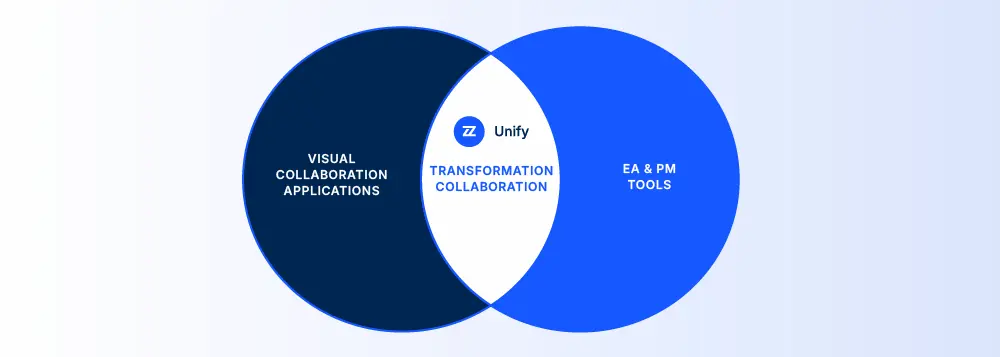
It's also built for the AI era, which means AI co-workers are part of the collaboration story from the start. They sit alongside human teams, answering questions in plain language, summarizing designs, recommending improvements, and surfacing data-driven insights, making enterprise context accessible to everyone shaping transformation. That frees architects and technical teams from repetitive documentation work, so they can focus on more strategic contributions: influencing direction, evaluating trade-offs, and ensuring transformation aligns with enterprise reality.
Human teams bring judgment, creativity, strategic intent, and domain expertise. AI co-workers bring speed and accessibility. Together, with enterprise intelligence available from the start, they can align earlier and move forward with less rework.
In this model, teams can engage with enterprise context through conversational queries in plain language and get grounded, data-driven answers in real time. For example:
- "Which systems are affected by this change?"
- "What are the dependencies for this capability?"
- "Are there any conflicts with initiatives already in flight?"
- "Which applications support this business process?"
- “What are effective transformation scenarios to implement our new strategy?”
That dramatically improves how the value of enterprise context is realized in transformation. Instead of sitting with specialists and being translated later, it's usable in the moment collaboration happens. A broader set of transformation stakeholders can work from a shared picture that reflects enterprise reality, and architects can shift their focus from interpretation to strategic guidance.
The result:
- Risks surface earlier
- Decisions are made with better context while options are still open
- Teams spend less time on “work about work” and more time moving change forward
In summary: Transformation Collaboration is a model for enterprise change that brings visual collaboration, enterprise context, and AI-assisted insight together early enough to improve decision quality and reduce rework as work moves into execution.
How Transformation Collaboration Works in Practice
To understand the model in practice, it helps to look at where it changes the transformation process itself.
Three practical applications of Transformation Collaboration across the transformation lifecycle demonstrate that shift especially well: Collaborative Ideation, Scenario Analysis, and Initiative Mobilization.
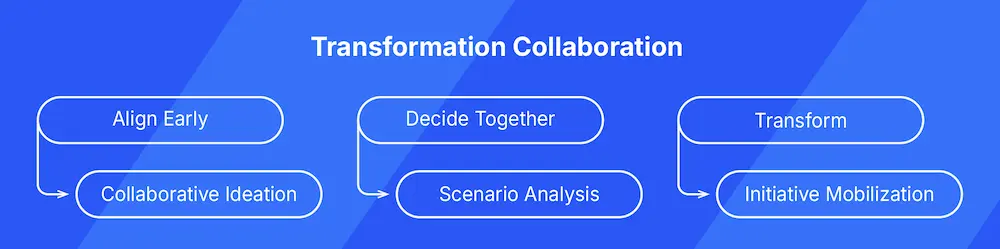
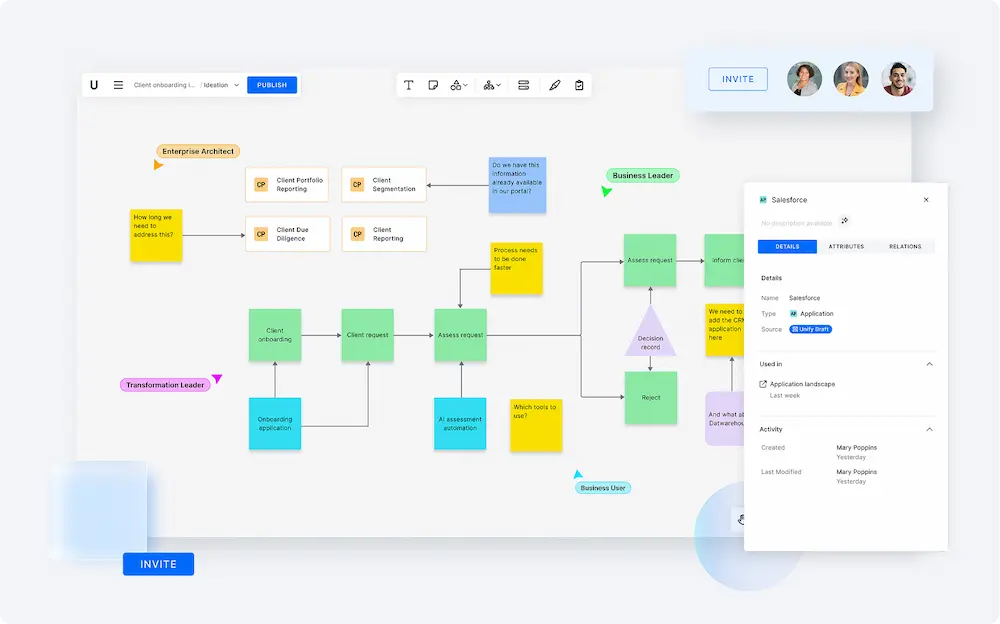
Collaborative Ideation | Early Alignment with Shared Enterprise Context
Transformation Collaboration enables Collaborative Ideation by giving teams the shared context they need to co-create visually, explore ideas, and shape direction before decisions are locked in.
What changes at this stage is the quality of early alignment. As concepts evolve, teams can drag, sketch, or map ideas visually while connecting them to capabilities, processes, and systems. They can co-create with context, grounding workshop conversations in architecture data before resources are committed, with dependencies, constraints, and risks surfacing while the conversation is still open.
Teams leave with direction that's grounded in enterprise reality, going beyond energy and assumptions, and that's far more likely to hold once execution begins.
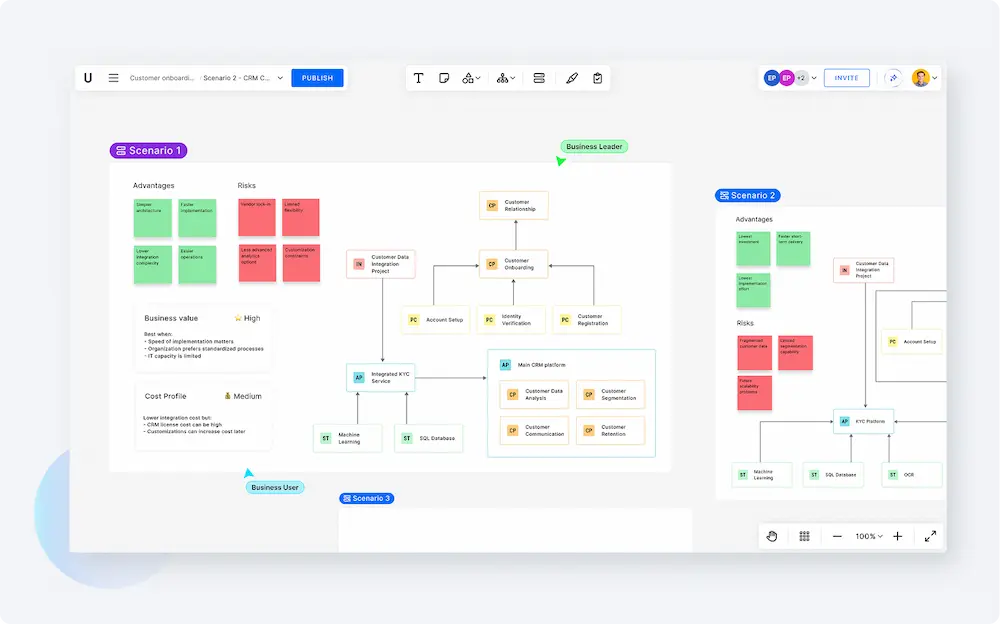
Scenario Analysis | Evaluating Options Together Before Commitment
Transformation Collaboration supports better decision-making once a direction starts to take shape through Scenario Analysis.
Teams can model what-if scenarios, compare trade-offs, and evaluate impact across business and technology using live architecture data, AI-generated insights, and shared enterprise intelligence. That gives everyone involved a clearer view of dependencies, risks, relationships, performance, maturity, and technical fit, with options assessed faster through simple, natural language interactions. Instead of validatingdecisions later, teams can pressure-test them while choices are still open.
Enterprise architecture and governance input comes in earlier, trade-offs become clearer, and teams are much less likely to reopen decisions once execution is in motion.
Initiative Mobilization | Moving Decisions into Execution
Transformation Collaboration keeps collaborative work connected as it becomes formalized and traceable, so teams can move faster from discussion into execution.
What changes here is continuity. The logic behind the decision doesn't need to be rebuilt once execution begins. Collaborative outputs can be formalized into structured, traceable artifacts, with scope, dependencies, and context carried forward. Supported by governed architecture data, impact analysis, and pre-populated workspaces, teams can move from discussion into action without losing the reasoning that shaped decision-making.
Teams start execution with clearer scope, fewer surprises, and a more reliable link between the original discussion and the initiative that follows.
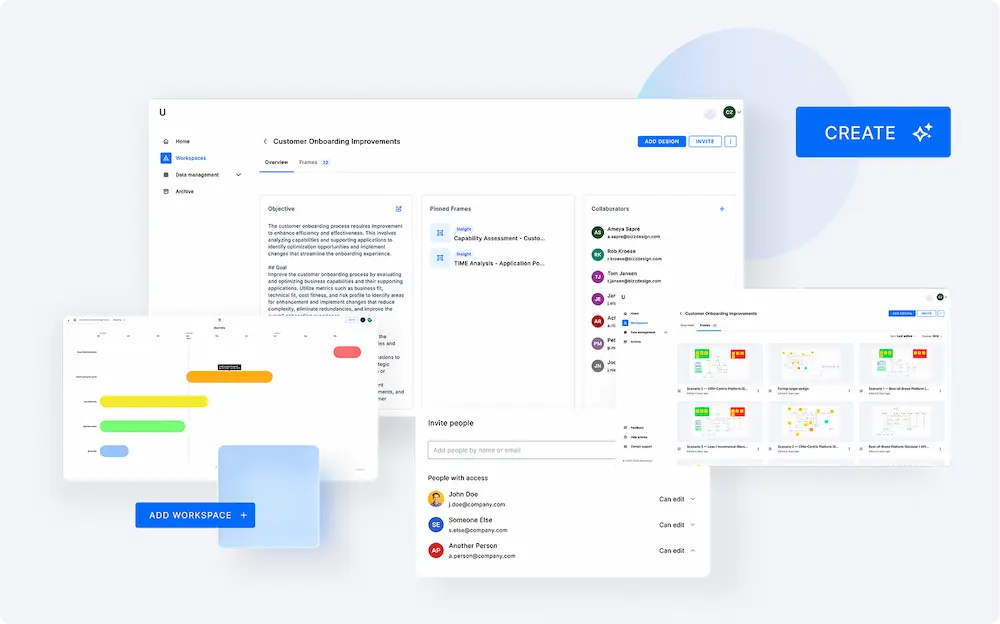
What Transformation Collaboration Changes Across the Transformation Process
Across these three applications, Transformation Collaboration shifts how transformation moves forward. Early alignment becomes more grounded. Decisions are easier to test before commitment. Execution starts with more continuity and less reconstruction.
That's the practical value of the model: Transformation moves from idea to action with stronger alignment and less rework along the way.
In summary: Transformation Collaboration works by bringing enterprise context into the moments where teams ideate, evaluate options, and mobilize for execution, helping teams align earlier, reduce rework, and carry decisions forward with greater clarity.
How Different Teams Benefit from Transformation Collaboration
Transformation Collaboration changes how different parts of the organization contribute to change. Here's what that means for each role:
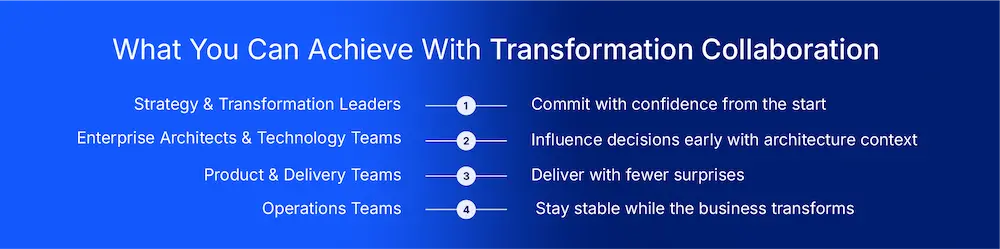
Strategy & Transformation Leaders
You’re responsible for setting direction, aligning stakeholders, and accelerating time to value.
Transformation Collaboration enables you to:
- Align stakeholders around transformation choices with full visibility into enterprise dependencies and constraints.
- Move from exploration to roadmap in one shared workspace, without losing context across tools.
- Validate decisions against enterprise reality early, before commitment locks in direction.
Enterprise Architects & Technology Teams
You need to have the right context at your fingertips so you can advise stakeholders early and shape decisions before they're locked in.
Transformation Collaboration enables you to:
- Surface architecture insights in real time during collaborative sessions.
- Show system impacts and constraints as options are explored, while choices are still flexible.
- Ensure decisions align with downstream implementation reality, reducing the rework that comes from late-stage architecture input.
Product & Delivery Teams
You prioritize what delivers value within actual business constraints and need visibility into enterprise context to make trade-offs stick.
Transformation Collaboration enables you to:
- Evaluate options against enterprise constraints before committing resources.
- See cross-team dependencies before they become mid-sprint surprises.
- Deliver continuously with clarity on what will and won't scale, grounded in architecture reality.
Operations Teams
You strive for operational excellence and resilience, so you need to anticipate what's changing and why.
Transformation Collaboration enables you to:
- Provide input on feasibility before decisions are locked, ensuring operational realities shape direction.
- See what's being planned and how it affects your operations, with full context on dependencies and constraints.
- Track changes with the reasoning intact, so nothing comes as a surprise when implementation begins.
In summary: Transformation Collaboration gives strategy, architecture, delivery, and operations teams the shared enterprise context they need to commit with confidence, influence decisions early, deliver with fewer surprises, and stay stable through change.
Is Your Organization Ready for Transformation Collaboration?
Organizations need Transformation Collaboration when enterprise architecture exists but is underutilized, early cross-team alignment is costly, and teams make high-value decisions in informal environments that disconnect from execution.
These organizations feel the pain of late discovery, rework, and delay, and want to intervene earlier in the decision process instead of absorbing those costs later.
You're likely ready if several of these patterns sound familiar:
- Your organization is undergoing continuous transformation, with AI accelerating the pace and scale of change.
- Architecture data exists but remains locked in specialist tools, rarely influencing early decisions.
- Cross-team alignment happens too late. After direction has formed and momentum has built.
- High-value decisions are made in workshops, slides, and informal conversations that don't connect to enterprise context.
- Dependencies, constraints, and risks surface during delivery, not during planning.
- Teams spend significant time rebuilding context that was lost across handoffs.
- You're motivated to intervene earlier in the decision process rather than absorbing the cost of rework later.
You may also be ready if your organization is already investing in the foundations that support Transformation Collaboration:
- You’re adopting structured change methodologies, such as Domain-Driven Design, OKRs, Design Thinking, Team Topologies, or AI-first transformation initiatives.
- You’re bringing together multidisciplinary teams across strategy, architecture, PMO, delivery, and operations.
- You’re actively working to reduce silos and improve alignment across functions.
- You want enterprise context to play a more active role in shaping priorities and decisions.
- You’re looking for better ways to connect collaborative work with governed systems and execution.
In summary: Organizations are ready for Transformation Collaboration when enterprise architecture exists but is underused, decisions are made in disconnected environments, and teams need a more shared, trusted view of context before work moves into delivery.
How to Get Started: A Practical Roadmap
If several of these patterns sound familiar, the most practical next step is to put the right foundations in place so collaborative work and enterprise intelligence can operate together, without requiring a full transformation overhaul from the outset.
Making Transformation Collaboration operational requires aligning stakeholders, establishing (or building) the enterprise context, and creating new workflows that connect collaborative work with enterprise intelligence. Here's a practical approach based on how organizations are successfully adopting Transformation Collaboration today through Bizzdesign Unify.
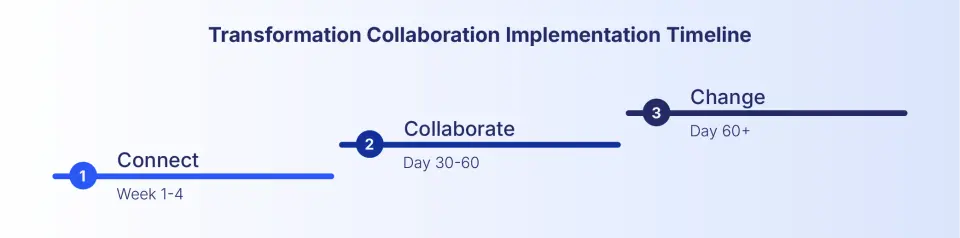
Phase 1: Connect (Week 1-4)
Objective: Connect your data, invite your team, and run your first collaborative session with enterprise context embedded.
What happens:
- Connect your enterprise data: Bizzdesign Unify integrates with your existing enterprise architecture (EA) and strategic portfolio management platforms to enable Transformation Collaboration. If you don't have those systems yet, the platform accepts data and diagrams from virtually any source and works with the AI tools your teams already use.
- Bring together the team around a defined transformation priority: Bring together the stakeholders who need to shape and assess a specific business or technology initiative with a clear objective, ownership, and timeline, such as strategy leaders, architects, delivery teams, and operations.
- Run your first session: Start collaborating in workspaces that offer a familiar canvas environment. Your AI co-worker begins surfacing connections, dependencies, and enterprise context from your first session.
What to watch for:
- Are dependencies and constraints surfacing during the conversation, not afterward?
- Are architects able to contribute insights in real time during collaborative sessions, while options are still open?
- Does the reasoning behind decisions feel clearer and more grounded than in traditional workshops?
- Are all the right stakeholders able to contribute and capture their ideas clearly?
- Are ideas mapped against enterprise context?
Phase 2: Collaborate (Days 30–60)
Objective: Get 3-5 initiatives live, with teams working from one shared picture and risks surfacing before they reach delivery.
What happens:
- Formalize collaborative sessions into execution-ready initiatives: Turn workshop outputs into execution-ready initiatives with context, dependencies, and scope already in place.
- Scale across multiple transformation efforts: Apply the model to 3-5 high-impact initiatives where cross-team coordination risk is highest.
- Build the workflow: Establish how Collaborative Ideation, Scenario Analysis, and Initiative Mobilization connect in your organization's transformation process.
What to watch for:
- Are decisions made during collaborative sessions holding once work moves into delivery?
- Are teams spending less time rebuilding context across handoffs?
- Are governance and architecture reviews becoming faster because the context is already in place?
Phase 3: Change (Day 60+)
Objective: Enterprise knowledge accumulates, and architecture models auto-populate from collaborative sessions.
What happens:
- Enterprise intelligence builds over time: As teams collaborate, the shared picture of your enterprise becomes richer and more complete. Dependencies, constraints, and relationships accumulate naturally.
- Architecture emerges from transformation work: Even if you didn't start with a formal enterprise architecture (EA) practice, enterprise context develops as a byproduct of collaborative decision-making.
- Scale Transformation Collaboration across the organization: Expand beyond the initial sessions to more transformation initiatives, embedding the model into how your organization coordinates change.
What to watch for:
- Is enterprise context becoming more complete and more reliable over time?
- Are new transformation initiatives starting with better context than earlier ones?
- Are teams across the organization beginning to rely on the shared enterprise picture for decision-making?
- Are transformation workflows moving faster over time?
In summary: Getting started with Transformation Collaboration means putting the right foundations in place so collaborative work, enterprise context, and AI-assisted insight can operate together from the start.
Measuring Success with Transformation Collaboration
Organizations adopting Transformation Collaboration can track whether it is reducing rework and improving decision quality across several leading indicators:
- Reduction in workshop preparation time: Early adopters report 30–40% reductions in workshop preparation time, as enterprise data becomes immediately available rather than requiring manual gathering and formatting. Baseline building that previously took weeks now takes days, with data collection time shifting to high-value insights.
- Dependencies identified during solution design and planning versus delivery: Organizations can track how many dependencies, constraints, and risks surface during Collaborative Ideation sessions compared to those discovered later during execution. A higher percentage identified during planning and design reduces late-stage surprises that drive budget overruns and schedule delays.
- Compression of alignment cycles: Early adopters report significant reductions in the time needed to move from collaborative sessions to execution-ready initiatives. Multi-week strategy and architecture mapping has compressed into focused sessions, with alignment cycles shortening as enterprise context becomes accessible during collaboration rather than afterward.
- Time from decision to execution-ready initiative: Organizations can track how quickly teams move from collaborative sessions into mobilizing initiatives. When collaborative outputs are formalized into structured, traceable artifacts with context, dependencies, and scope already in place, teams can move from discussion into action without losing the reasoning that shaped the work. Organizations cantrack the time needed to launch initiatives after collaborative sessions, as manual setup and context reconstruction are reduced.
- Reduction in post-commitment scope changes: Organizations can measure rework time after decisions are committed, as decisions validated against enterprise reality during Scenario Analysis may require fewer adjustments once execution begins. Reducing rework hours directly impacts project costs and delivery timelines against critical business needs and requirements.
"As we scale transformation across a complex environment, it's critical that we can move quickly while keeping decisions grounded in real architectural data. Bizzdesign Unify helps us connect collaboration directly to that data, so decisions can be made faster and still hold up beyond the workshop." — Matthew Beech, Rolls-Royce SMR
Beyond these measurable indicators, organizations adopting Transformation Collaboration can also experience qualitative shifts in how transformation work gets done:
- Stakeholder satisfaction with decision quality and alignment: As enterprise context becomes visible during collaboration rather than introduced afterward, cross-functional teams tend to express higher confidence in the decisions they're making. When teams can collaborate in plain language while staying connected to the architecture behind it, decisions are more likely to hold once work moves into delivery.
- Architect and analyst capacity redirected to strategic advisory: Early adopters report that architect and analyst time has shifted from manual data transcription to strategic advisory, as enterprise context flows directly into collaborative sessions.
- Democratization of enterprise knowledge: Early adopters also report that enterprise knowledge has been democratized beyond architecture teams, enabling faster decisions on transformation priorities as a broader set of stakeholders gain direct access to context.
“Bizzdesign Unify helps non-technical stakeholders understand impacts and trade-offs easily, without going into architecture tools.” — Partha Mukherjee, Kappahl Group
Experience the Shift Transformation Requires
For decades, the discourse around transformation has been the same: Too many efforts fail to deliver what they set out to achieve. We believe a large share of that failure stems from decisions being made before the full enterprise picture is available to the people shaping them.
Transformation Collaboration was created to address exactly that. It brings people, plans, enterprise intelligence, and AI-driven insights into the hands of the teams shaping transformation while decisions are still taking shape. With built-in AI capabilities that help cross-functional teams work from the same picture, teams can assess trade-offs earlier, align with more confidence, and move forward before rework starts to build.
That's what makes it a fundamentally different way to move transformation forward. It gives teams a way to work visually, decide with enterprise context, and carry that logic into execution before rework has a chance to accumulate. Not faster workshops. Not better tools in isolation. A more connected path from strategy to execution, with the context needed for decisions to hold from the start.
Book a demo to see how Transformation Collaboration can empower all teams shaping change.
FAQs
Transformation Collaboration is Bizzdesign’s solution for bringing visual collaboration, enterprise context, and AI-driven insight together during enterprise change. It is delivered through Bizzdesign Unify, Bizzdesign’s new SaaS product within the Enterprise Transformation Suite.
Transformation Collaboration is designed to bring people, plans, enterprise intelligence, and AI-driven insights together while decisions are still taking shape. In practice, that means teams can work from the same enterprise picture earlier, assess trade-offs with more context, and carry decisions forward with less rework. In Bizzdesign Unify, Transformation Collaboration takes shape through three connected use cases: Collaborative Ideation, Scenario Analysis, and Initiative Mobilization.
Enterprise context describes how an organization works by capturing its goals, capabilities, processes, teams, data, technologies, and their interdependencies. It provides the foundational knowledge needed to understand what will be affected when change happens, what depends on what, and where constraints exist. In Transformation Collaboration, enterprise context becomes accessible during collaborative sessions through Bizzdesign Unify, so teams can ground decisions in organizational reality rather than assumptions or incomplete information.
Enterprise intelligence emerges when architecture data is combined with operational enterprise data and enhanced by AI for analytical purposes. It enables stakeholders to answer questions like "Which business processes are at risk due to outdated technologies?" or "What is the total cost of ownership for our end-to-end order-to-cash process?" through natural language queries. Bizzdesign Unify brings that enterprise intelligence into Transformation Collaboration by combining architecture data with operational data from enterprise systems and using AI to surface insights in real time.
Transformation Collaboration is built for the cross functional teams shaping enterprise change. That includes strategy and transformation leaders, enterprise architects and technology teams, product and delivery teams, and operations teams. It enables these teams to work from the same picture earlier, rather than waiting for enterprise context to be interpreted and passed along later.
Transformation Collaboration solves a specific coordination problem in enterprise transformation: decisions are often shaped in collaborative settings, while the enterprise context needed to support those decisions lives somewhere else. That gap leads to late discovery, rework, and delay. Transformation Collaboration brings those two worlds together while decisions are still taking shape.
Transformation initiatives require better coordination because decisions are increasingly made across disconnected tools, fragmented teams, and accelerating timelines driven by AI. When enterprise context is not available during decision-making, teams discover dependencies, constraints, and risks too late, leading to budget overruns, schedule delays, and rework. Transformation Collaboration addresses this by making enterprise intelligence accessible earlier in the process.
Transformation Collaboration works by making enterprise context accessible during decision-making, rather than introducing it afterward. Common applications include Collaborative Ideation, where teams ground early ideas in enterprise reality; Scenario Analysis, where teams validate options against live architecture data before commitment; and Initiative Mobilization, where collaborative outputs become execution-ready initiatives with context intact. Bizzdesign Unify enables these workflows by connecting visual collaboration with enterprise architecture and portfolio data.
Transformation Collaboration gives teams earlier visibility into dependencies, constraints, trade-offs, and downstream impact. Instead of making decisions with only part of the picture and validating them later, teams can work with enterprise intelligence during the act of choosing. That makes decisions easier to test, easier to align around, and more likely to hold once execution begins.
Visual collaboration tools are strong for brainstorming and exploration. Transformation Collaboration adds enterprise context to that work, including dependencies, constraints, and data, so decisions made in collaborative sessions are more likely to hold once execution begins. Bizzdesign Unify delivers this by connecting visual collaboration with enterprise architecture and portfolio data. Teams get the familiarity of a canvas with the substance of organizational insight.
Enterprise architecture and portfolio management platforms provide structure and governance but are typically built for specialists and rarely influence early-stage decision-making. Transformation Collaboration makes that enterprise context accessible during collaborative sessions, so cross-functional teams can use it while shaping ideas and evaluating options. Bizzdesign Unify connects these worlds by bringing architecture and portfolio data into visual collaboration.
Transformation Collaboration depends on enterprise architecture and portfolio management to provide the structure, relationships, and context that inform decision-making. It makes that intelligence accessible earlier and to more stakeholders, so enterprise context shapes decisions during collaboration rather than validatingthem afterward. Bizzdesign Unify integrates with Bizzdesign Alfabet, Bizzdesign Horizzon, and Bizzdesign Hopex to enable this.
No. Transformation Collaboration depends on enterprise architecture. Enterprise architecture and strategic portfolio management provide the context that Transformation Collaboration brings into the decision-makingprocess. The shift is that more stakeholders can work with that intelligence earlier, rather than leaving it inside specialist tools and specialist teams.
Transformation Collaboration makes enterprise context accessible through conversational queries in plain language, allowing non-technical stakeholders to ask questions and get grounded answers without navigating specialist tools. AI co-workers surface dependencies, constraints, and trade-offs in real time, so enterprise intelligence becomes usable during collaboration. Bizzdesign Unify enables this through an AI-native interface designed for cross-functional teams.
AI helps teams interact with enterprise context through natural language, surface insights faster, and automate repetitive work like summarizing designs or recommending improvements. In Bizzdesign Unify, AI co-workers sit alongside human teams, making enterprise intelligence accessible to non-technical stakeholders, enabling them to work from the same picture while decisions are still open, and freeing architects to focus on strategic advisory rather than data preparation.
The enterprise context comes from architecture, portfolio, and system-of-record data the organization already maintains. Transformation Collaboration brings that context into the flow of decision-making earlier, so teams can use it while they're shaping direction, comparing options, and defining initiatives. Bizzdesign Unify integrates with Bizzdesign Alfabet, Bizzdesign Horizzon, and Bizzdesign Hopex to enable this.
Organizations should adopt Transformation Collaboration when architecture exists but remains underutilized in early decision-making, when cross-team alignment is costly and happens too late, or when high-value decisions are made in informal settings that disconnect from execution. It is particularly valuable when AI is accelerating the pace of change and coordination gaps are becoming harder to absorb.
Organizations can expect reductions in workshop preparation time, faster alignment cycles, earlier identification of dependencies and risks, and decisions that hold up better once execution begins. Early adopters report 30–40% reductions in workshop preparation time, compressed multi-week alignment cycles, and architect capacity redirected from manual data preparation to strategic advisory.
Bizzdesign Unify is an AI-native platform that operationalizes Transformation Collaboration by connecting visual collaboration with enterprise architecture and portfolio data. It enables teams to work in a shared workspace where enterprise context is accessible through conversational queries, AI co-workers surface insights in real time, and collaborative outputs formalize into execution-ready initiatives. Bizzdesign Unify integrates with Bizzdesign Alfabet, Bizzdesign Horizzon, and Bizzdesign Hopex to enable this.
More on this



You Can’t See the Full Picture in a Dozen Disconnected Tools
Give teams one place to shape transformation with the context that actually matters.