Why is Model Context Protocol Suddenly Everywhere in Enterprise AI?
TL;DR:
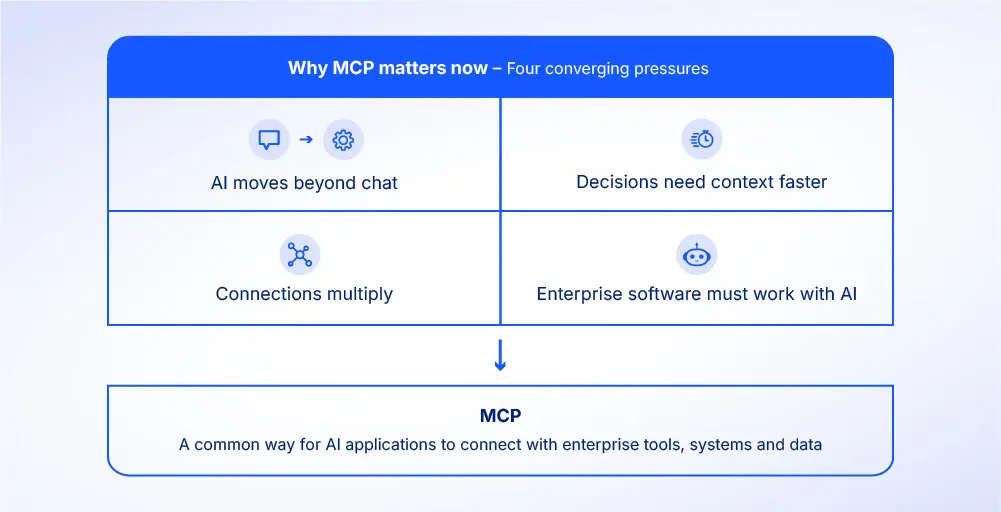
Model Context Protocol is gaining attention as AI moves beyond chat and into agentic workflows. Leaders are under pressure to make better-informed decisions faster, connections across enterprise systems are becoming harder to scale, and customers expect business software to work with the AI tools they adopt. MCP provides a common way for AI applications to connect with enterprise tools, systems, and data. The value of the result still depends on the quality and governance of the enterprise context behind the connection.
Model Context Protocol (MCP) has quickly moved from a topic of interest in developer circles into the wider enterprise AI conversation. It now appears across product launches, platform roadmaps, and architecture discussions, often before leaders have had a chance to understand what it changes in practice.
MCP is an open standard that gives AI applications a consistent way to connect to external tools, systems, and data. Its relevance is growing as organizations look to use AI across the enterprise and make better-informed decisions faster.
MCP Connects AI Agents to Enterprise Context
For many businesses, AI has until recently been used much like a better search engine. You asked a question, it generated an answer, and the conversation ended there. The answer stayed within the conversation. Ask. Answer. Move on.
That’s changing. Organizations are exploring agents that can retrieve enterprise context, query the systems where relevant information resides, and support decisions within existing workflows.
The need for this is clear. Deloitte’s 2026 Chief Strategy Officer Survey found that more than half of CSOs are managing too many priorities with too little time. In a separate Confluent survey of 200 UK CEOs, managing directors, and C-level executives, 82% said they felt forced to choose between making a fast decision and an informed one.
Enterprise architects create and maintain enterprise architecture (EA) repositories that capture how the enterprise is structured, including the capabilities an application supports, its dependencies, ownership, lifecycle, and risk. AI agents could help extend the reach of that architecture knowledge, but a prompt alone can’t give an agent access to the enterprise model behind the question. Without that connection, the relevant context still has to be found and supplied manually.
Consider a request that architecture teams handle regularly. A developer or project manager wants to know whether they’re permitted to use a particular technology for a specific purpose given in their role. In a mature EA practice, that answer exists, captured in Architecture Decision Records (ADRs). But finding it still typically means a manual lookup, a message to the architecture team, and a wait while someone with the right context reviews and responds. It takes time, and it may leave room for error.
This is where Model Context Protocol (MCP) comes in. MCP provides a standardized way for agents to reach enterprise context. By connecting agents with the enterprise systems and knowledge they need, MCP can help bring the speed of AI together with the context required for better-informed decisions.
With an AI agent connected via MCP to a well-structured EA repository, that same question becomes a conversation. The developer asks in plain language. The agent queries the governed architecture model and surfaces the answer directly: Which technologies are approved, for which purposes, and for which roles. No queue. No delay.
For architecture teams, this creates an opportunity to extend the reach of governed architecture knowledge beyond the architecture function, giving more people faster access to the context they need without separating it from the structure, governance, and expertise behind it.
Enterprise AI Needs a Common Connection Model
At scale, AI applications may need to connect with many enterprise systems and data sources, and the problem compounds when several applications need access to the same systems. Each bespoke integration has to be built, maintained, and managed separately, creating more work for both the organizations using AI and the vendors providing the underlying software.
That integration challenge reflects a broader pattern. In Contentstack’s 2026 Agentic Enterprise Report, 37% of enterprise leaders identified difficulty integrating agentic AI into existing processes and technology as a significant adoption challenge, making it the most commonly cited barrier in the study. Governance and security concerns ranked closely behind. Both challenges point to the same underlying need: AI that can access the right information, in the right context, with the right controls in place, and deliver meaningful action through the processes and technologies the enterprises already rely on. MCP provides the foundation for both.
The pressure to solve the integration challenge isn't only coming from inside businesses. Customers increasingly expect the enterprise software they already use to work with the AI applications like ChatGPT, Copilot, or Claude. Vendors whose systems can't be reached by these tools leaves customers to bridge the gap themselves, adding exactly the integration friction they’re trying to reduce.
MCP helps address this by providing a common protocol through which enterprise systems can expose data, tools, and capabilities to AI applications. MCP servers can be provided by vendors or built internally. Once in place, any MCP-compatible AI application can connect to them without a bespoke integration. This is what makes those connections reusable and easier to extend as the AI ecosystem grows.
MCP Makes the Connection. Enterprise Context Creates the Value.
Whether an agent can produce something useful and trustworthy still depends on the quality, structure, and governance of the enterprise knowledge it finds on the other side, and whether the agent has appropriate access to it.
MCP can carry a request and response in a standardized way, but it doesn’t determine what information an MCP server exposes or the quality of the repository behind it. A server connected to an outdated or incomplete repository can still return a response. Only a response grounded in reliable, up-to-date enterprise knowledge is worth acting on.
Ask two implementations the same question: Which applications are affected by a new regulation?
A thin implementation:
- Wraps a database or document store and exposes it close to as-is.
- Returns a list of applications tagged against the regulation.
- Doesn't show why those applications are affected, which obligations apply, or who's responsible for acting on them.
- Gives you the same list someone could have pulled from a spreadsheet, only faster.
A schema-aware implementation:
- Exposes a model of the business, including the relationships and context that give individual records meaning.
- Identifies the regulatory requirements that apply, the applications and processes affected, and the owners accountable for each.
- Can also surface where coverage is missing.
The difference is not only depth. Thin implementations often struggle to answer efficiently, or at all. Without a model to constrain the query, an agent retrieves too much, reasons over the wrong things, and returns something plausible that nobody can verify. The failure is quiet, which is what makes it expensive.
The depth of the context exposed through the implementation determines whether an agent merely retrieves information or can also surface the relationships and business context needed to understand what that information means.
What MCP Means for Architecture and Transformation Teams
Enterprise architects already create the models, relationships, and governance context that make this kind of analysis possible. MCP doesn’t replace that work. The opportunity MCP brings is to make that knowledge available more widely, so people across the business can ask questions in plain language and get answers drawn from the enterprise model, along with the reasoning behind them.
The modeling work architects have already done, including ownership records, dependency maps, and risk data, can inform a wider range of decisions without requiring the architecture team to gather and explain that context each time.
That frees up capacity. Fewer hours spent answering one-off questions means more time spent on strategic initiatives.
At the same time, broader access raises the stakes for the quality of the repository. An agent pulling from a well-maintained model is more likely to give a business leader relevant, decision-ready context that can be reviewed and acted on immediately. An agent pulling from a repository that hasn’t been maintained means outdated or incomplete information now moves at the speed of AI instead of the speed of a spreadsheet. Keeping that repository current becomes a critical factor in whether AI agents help the business or mislead it.
AI assistants could often operate within the boundaries of a prompt. AI agents need connected, trusted enterprise context. MCP helps them reach it, and enterprise architecture helps ensure that context is worth trusting.
FAQs
Model Context Protocol (MCP) is an open standard that defines a structured interface through which AI applications can interact with enterprise systems and data sources, as exposed by MCP servers.
In the context of enterprise architecture, MCP allows authorized users to ask questions in natural language through AI tools such as ChatGPT, Microsoft Copilot, and Claude. The AI tool calls the MCP server, which resolves the request against governed enterprise architecture (EA) models. This makes it possible for business and technology stakeholders to explore applications, processes, capabilities, risks, and dependencies directly from the architecture repository, without needing deep architectural expertise.
MCP differs from a typical API integration by providing a shared standard for how AI applications connect to external systems, tools, and data. Traditionally, each AI tool is wired to each system through a purpose-built integration, and that work is repeated for every new tool-system pairing. This is the M×N problem: M AI tools multiplied by N systems results in the number of integrations a business ends up building and maintaining. MCP replaces that with a shared standard. With MCP, a system exposes its data, tools, and capabilities once through an MCP server, and any MCP-compatible AI agent can connect through the same standard. This reduces the need for bespoke connections and shifts the integration model from M×N toward M+N.
MCP is getting attention now because businesses are moving from AI assistants that answer questions to agents that retrieve information and act within existing workflows. Those agents need a consistent way to reach the systems where enterprise knowledge lives.
Anthropic released MCP as an open standard in November 2024. For the first few months, MCP stayed largely confined to developers building AI tools. Adoption broadened quickly after that. In March 2025, OpenAI adopted MCP across its products, which put the two largest AI labs behind the same integration standard. In May 2025, Microsoft announced native MCP support in Windows 11, moving MCP from an AI tooling concern to an enterprise platform one. In December 2025, Anthropic donated MCP to the Agentic AI Foundation under the Linux Foundation, with OpenAI and Block as co-founders, making its stewardship vendor-neutral.
By 2026, attention has shifted from whether MCP will gain broad industry support to what each organization should expose through it and how those connections should be governed.
MCP doesn't replace or bypass enterprise security, access control, or governance. Instead, MCP defines a standardized way for AI to interact with systems that already enforce those controls, with MCP servers implementing that interaction at runtime.
When connected to an enterprise architecture platform, an MCP server can govern access to architecture data through the platform’s identity, role-based access controls, and authorization policies. A properly configured server limits the data returned to what the authenticated user or system is authorized to access.
At runtime, a well-implemented server can act as a controlled execution layer, evaluating each request against governance rules, lifecycle states, and approval status defined in the EA repository. Where the platform supports these controls and the underlying rules and data are properly maintained, agents can receive architecture data that is trusted, current, and approved.
No. MCP standardizes how an AI agent connects to a system, but it has no influence over what that system contains. A thin implementation exposes flat, disconnected records. A schema-aware implementation exposes a governed model of ownership, capability, and risk. Both are valid MCP implementations. Enterprise architecture is what determines which kind of implementation a business ends up with, and that work doesn't change because MCP exists.
MCP is most effective when deployed on top of a mature enterprise architecture foundation. Organizations that see the strongest results typically have:
- A well-defined metamodel with clear business and technology concepts
- Governed ownership across applications, processes, and capabilities
- Lifecycle management embedded into architecture workflows
- Strong integration between portfolios, roadmaps, and delivery
In these environments, MCP exposes a living enterprise model that AI can reason over immediately.