
What Is Technical Debt? Types and Causes

TL;DR:
Technical debt arises when past technology decisions or deferred improvements make applications harder to maintain, change, or extend. It can take many forms, from outdated platforms to complex architecture and undocumented systems. For organizations managing large application portfolios, understanding where technical debt sits and how it affects business priorities is essential to making sound investment decisions. Bizzdesign's AI-driven application portfolio management capabilities help teams explore their data, uncover potential issues, and develop transformation scenarios to inform the next steps.
Technical debt is the additional work and cost an organization faces when past technology decisions or deferred improvements make systems harder or more costly to maintain, change, or extend in the future. Like financial debt, it can involve a trade-off: An organization gains something in the short term but takes on an obligation that may require more effort or investment later.
A team might take a shortcut to meet a delivery deadline, for example, knowing that the implementation will need improvement. If the benefit of delivering sooner outweighs the cost of addressing the issue later, that trade-off may be reasonable. Problems arise when the work is repeatedly deferred or the surrounding technology changes, making the original decision increasingly difficult or expensive to live with.
Technical debt isn't limited to code. It can arise in software design, architecture, technology choices, data structures, and the knowledge needed to maintain systems. Gaps in skills, outdated processes, and unclear ownership can also allow that debt to accumulate. Across an enterprise, these constraints can affect how much it costs to run the application estate and how readily the organization can adapt it to new business needs.
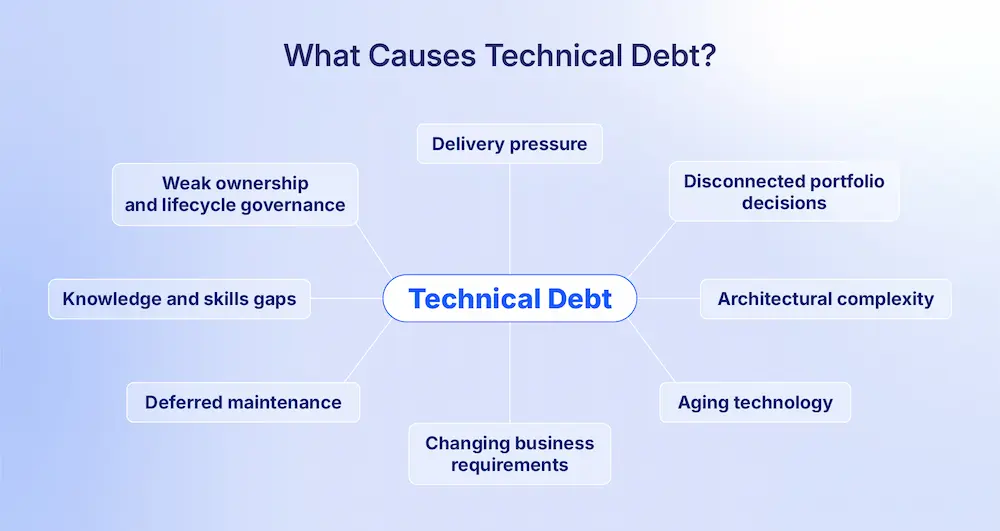
What Causes Technical Debt?
Technical debt can be introduced by a single decision or accumulate over time as delivery pressures, deferred improvements, and changing business requirements shape the systems organizations rely on. Its impact often grows when constraints persist, dependencies increase, or the cost of addressing them rises.
The concern is widespread. As Forrester reports in The State of Tech Debt, 2026, “[a]mong enterprise digital and IT professionals, 73% said their organization hears about technical debt as a significant digital or IT concern at least monthly or more frequently, including 39% who hear about it at least weekly or daily.”
Several factors contribute to its accumulation:
- Delivery pressure: Teams prioritize features, deadlines, and releases, leaving refactoring, testing, documentation, and architectural improvements for later. The immediate work gets delivered, but the technical improvements remain outstanding.
- Deferred maintenance: Upgrades, security remediation, and routine maintenance are repeatedly postponed to make room for more urgent work. As the backlog grows, addressing it can become increasingly difficult and expensive.
- Aging technology: Applications continue to rely on unsupported platforms or components, which can increase maintenance effort and limit future options.
- Architectural complexity: Acquisitions and fragmented application landscapes can introduce duplicated functionality and complex integrations. Dependencies between applications make changes harder to isolate, test, and deliver independently.
- Changing business requirements: Systems designed around earlier business needs become harder to adapt as those needs evolve, sometimes requiring increasingly complex modifications or workarounds.
- Knowledge and skills gaps: Missing documentation, limited knowledge transfer, and reliance on specialist expertise can leave teams struggling to understand and maintain existing systems.
- Weak ownership and lifecycle governance: When accountability is unclear or application lifecycles aren't reviewed consistently, necessary maintenance and improvements can go unresolved.
- Disconnected portfolio decisions: Investment decisions made without a clear view of application condition, dependencies, and business priorities can leave underlying technical constraints unaddressed. New initiatives move forward while the improvements needed to support them remain unfunded.
These factors often reinforce one another. Complex integrations, for example, can make an application harder to upgrade, particularly when documentation is incomplete or knowledge of its dependencies sits with a few individuals. The additional effort makes maintenance harder to prioritize alongside new delivery commitments, increasing the likelihood of further delays.
However, an older application or postponed upgrade doesn't automatically represent technical debt. An application may be old but well maintained, and delaying an upgrade can be a reasonable decision when the risks are understood. Technical debt becomes a concern when earlier decisions or deferred improvements leave teams with constraints that make future maintenance and change more difficult.
Understanding these causes across an enterprise requires visibility into the applications, technologies, and dependencies involved, alongside the business priorities shaping investment. Application portfolio management (APM) helps organizations assess application condition and business relevance, including overlapping functionality, while technology portfolio management (TPM) provides insight into technology lifecycles and dependencies. Combined, this information can support strategic portfolio management (SPM), helping organizations prioritize initiatives with a clearer understanding of the technical landscape they depend on.
Types of Technical Debt
However it arises, technical debt takes several forms, from code and architectural decisions to aging technology, data issues, and gaps in documentation or specialist knowledge.
Forrester’s research reflects this breadth: “According to Forrester’s Modern Tech Operations Survey, 2025, 39% of enterprise digital and IT professionals said that tech debt means systems that cannot be easily adapted or enhanced, 38% cited obsolete/unsupported vendor or open-source software components or frameworks, and 37% cited out-of-date IT skills, processes, policies, and management frameworks.”
The categories below offer a way to distinguish between them, although in practice several types can exist within the same application or portfolio.
Code and software design debt
Code and software design debt arises when implementation or design decisions make software harder to maintain, test, or extend. Duplicated logic, unnecessary complexity, fragile workarounds, and insufficient test coverage can increase the effort required to make changes safely.
For example, a team might duplicate a block of code to deliver a feature before a deadline. When the underlying business rule changes, developers must update each implementation. Missing one can leave the application behaving inconsistently, creating further investigation and rework.
Architecture and integration debt
Architectural debt develops when a system's structure constrains future development. Tightly coupled components and dependencies between applications can make changes harder to isolate, test, and deploy independently.
Imagine two applications that rely on the same database schema. A change to that schema for one application's needs also requires modifications to the other. The teams must coordinate work that would otherwise be independent, increasing the effort involved in delivering the change.
Technology debt
Technology debt arises when dependencies on aging or unsupported platforms, infrastructure, or software components create a material maintenance burden or constrain future options. Older technology isn't automatically debt; the concern is its condition and the implications for continued operation or change.
For example, an application depends on a software platform that has reached end of support. Moving to a supported version requires changes to the application and testing of dependent components. If the upgrade is deferred, the organization may need to pay for extended support or operate without standard vendor support and security updates while the migration remains outstanding. When several applications depend on the same platform, that support deadline can require coordinated changes across the portfolio.
Data debt
Data debt develops when shortcomings in data structures or the arrangements used to manage data create persistent work or constrain its use. Inconsistent formats, duplicated records, and fragile data pipelines can require ongoing workarounds.
Consider customer records held across several applications with different identifiers and formats. Consolidating them for reporting requires mapping and reconciliation rules to resolve inconsistencies. Maintaining those rules adds complexity and can affect the reliability of the resulting data.
Documentation and knowledge debt
Documentation and knowledge debt accumulates when essential information about a system is missing or concentrated among a few specialists. This makes it harder for other team members to understand the application and assess the effects of a proposed change.
For example, a specialist leaves after maintaining a legacy application for several years. Important dependencies and operational workarounds were never documented, so the remaining team must investigate how the application behaves before making changes safely. The knowledge gap increases the effort involved and makes future maintenance more difficult.
How Application Portfolio Management Helps Address Technical Debt
Several forms of technical debt can compound within one application. An aging platform, fragile integrations, and undocumented workarounds may together make a business-critical system harder to maintain or change. Understanding their combined impact requires looking at the application’s dependencies and the business activities it supports.
Application portfolio management (APM) connects this technical picture with business importance, costs, risks, and planned investments. That shared context helps business and technology teams compare options before committing resources and decide whether an application warrants improvement, replacement, consolidation, or retirement, or whether its technical debt can be tolerated for now.
Bizzdesign accelerates the exploration of these options through natural-language search and automated transformation scenario creation in a workspace. Architects and business stakeholders can ask questions about the portfolio, generate scenarios for proposed changes, and evaluate them using the application and business context. This helps teams move from understanding technical debt to shaping a response with greater speed and confidence.
To recognize how technical debt shows up in everyday operations, read Signs of Technical Debt Across Your Application Portfolio.
FAQs
Technical debt isn’t always bad. Accepting it can be reasonable when the immediate business benefit outweighs the expected future cost and risk. With limited IT resources, that can mean prioritizing a pressing business need over addressing every technical issue immediately. A team might therefore defer an upgrade or accept a workaround to meet a more pressing business need. Making that trade-off responsibly requires understanding the implications and revisiting the decision as circumstances change. An issue that's manageable today could become more significant if the application's role changes or its dependencies grow.
Legacy technology refers to older systems, platforms, or components that remain in use, while technical debt is the additional work and cost created when past technology decisions or deferred improvements make systems harder to maintain or change. The two often overlap, but age alone doesn't determine an application's condition. A legacy application may still be reliable and fit for purpose, while a newer application may already be difficult to maintain or adapt. Technology portfolio management (TPM) helps teams assess support status, technology risks, and usage. Application portfolio management (APM) connects those findings to the affected applications, their business importance, and future requirements. Together, these perspectives help teams decide whether modernization is warranted rather than treating age alone as a reason to replace a system.
Technical debt extends beyond software code to architecture, technology platforms, integrations, data, and the knowledge needed to maintain systems. For example, an application may depend on an unsupported database, fragile integrations, or undocumented workarounds. These constraints can interact, increasing maintenance effort and making business changes harder to deliver. Application portfolio management (APM) helps teams understand the combined impact on applications and the business activities they support, without replacing the specialist work needed to assess each technical issue.
Responsibility for managing technical debt is shared by technical teams, application owners, and the leaders who set priorities and approve funding. Engineering and operations teams identify and address technical issues, while architects assess dependencies and explain the wider business impact. Application portfolio owners use that evidence to agree on the response with business stakeholders. Each agreed action needs a named owner, resources, and a review date to ensure it is carried through.
AI can help teams explore application portfolio information and develop options for addressing technical constraints. Bizzdesign combines natural-language search with automated transformation scenario creation in a workspace, helping architects and business stakeholders move from questions about the application estate to possible modernization approaches, where these capabilities are available and approved for their setup.
Before using these scenarios to inform investment decisions, teams should validate the underlying data, dependencies and assumptions. AI-assisted planning can help identify where action may deliver the most value, but it doesn't reduce technical debt by itself. Debt is reduced when teams implement and verify the selected changes.