
Signs of Technical Debt Across Your Application Portfolio

TL;DR:
Technical debt can become visible through rising maintenance costs, difficult application changes, unsupported technology, unpredictable dependencies, and reliance on specialist knowledge. These warning signs can affect IT spending and limit an organization's ability to deliver business initiatives. Application portfolio management helps teams assess their significance in the context of business priorities, while Bizzdesign's AI-driven capabilities help investigate potential issues and generate transformation scenarios to inform decisions about how to respond.
Rising maintenance costs, slow application changes, unsupported technology, fragile dependencies, and reliance on scarce expertise can all be signs of technical debt. Across an application portfolio, these constraints can consume delivery capacity and make business plans harder to execute.
Technical debt is the additional work and cost created when past technology decisions or deferred improvements make systems harder to maintain, change, or extend. It isn't always immediately visible. An application might continue to operate reliably while teams spend more time working around its limitations or preparing for even relatively small changes. Recognizing technical debt means looking beyond individual technical issues to patterns in how applications operate and evolve.
If you'd like to understand how technical debt accumulates and the different forms it takes, read What Is Technical Debt? Types and Causes.
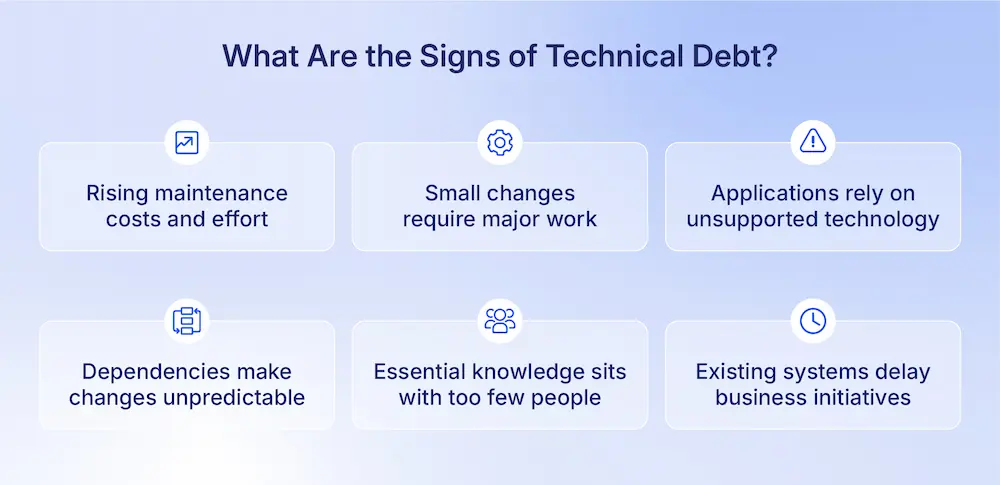
What Are the Signs of Technical Debt?
The following six signs can help organizations identify where technical debt may be affecting their application portfolio. Each warrants investigation, rather than automatically establishing that an application needs modernization or replacement.
1. Maintenance consumes more funding and capacity
Repeated fixes, manual workarounds, and growing support demands can indicate that applications are becoming harder to sustain. Teams may spend increasing amounts of time keeping existing services running, leaving less capacity for planned improvements.
When that effort repeatedly goes toward compensating for the same technical limitations, resolving individual incidents may leave the underlying debt untouched. Comparing recurring support issues with application maintenance costs helps teams understand whether they are addressing the cause or repeatedly managing its effects.
2. Small changes require disproportionate effort
Applications with fragile integrations or outdated technology often require more work before a change can be delivered safely. A seemingly straightforward update can become a wider undertaking if connected applications also need to be modified and tested.
Repeated delays to modest changes can signal that technical constraints are increasing delivery effort. Comparing the work required for similar changes over time can help teams distinguish a persistent problem from an unusually complex request.
3. Applications depend on unsupported technology
Unsupported technology can leave organizations without vendor support or security updates. The level of exposure depends on the technology, available support arrangements, system design, and controls. Some vendors offer extended support at an additional cost, allowing organizations more time to migrate while increasing the expense of keeping the existing technology in use.
The implications can extend across several applications that share a database, runtime, or operating system. Understanding that wider exposure requires knowing which applications depend on the affected technology. Technology portfolio management (TPM) connects those dependencies with lifecycle and support information, helping teams identify where action is needed before support ends.
4. Dependencies make changes unpredictable
Poorly understood dependencies introduce uncertainty when teams need to investigate a problem or change a system. A change that appears straightforward in one application can have consequences elsewhere in the portfolio, particularly when integrations and shared components aren't well documented.
If teams repeatedly discover downstream effects during testing or deployment, gaps in integration design or system knowledge may be increasing the cost and risk of change. A failure in one application can also become harder to diagnose when its connections to other systems are unclear.
5. Essential knowledge sits with too few people
Routine maintenance or changes may depend on a small number of specialists who understand undocumented configurations, integrations, or workarounds. When those people are unavailable, work slows while others reconstruct how the application behaves.
This is a form of documentation and knowledge debt when gaps in accessible system knowledge increase the effort or risk involved in understanding or changing an application. It can also make an otherwise manageable application increasingly expensive to support as the relevant skills become harder to find.
6. Existing systems delay new business initiatives
When maintaining existing applications absorbs a significant share of available resources, new initiatives have to compete for what's left. Modernization can also take longer when the systems being replaced or improved carry technical constraints of their own.
A recurring warning sign is that business initiatives need unexpected preparatory work before they can proceed. A new service, acquisition integration, or AI initiative may depend on applications that can’t readily support the required changes. Identifying those constraints during planning gives teams a chance to include the necessary work in the scope and budget. Strategic portfolio management (SPM) helps teams weigh that preparatory work alongside competing initiatives, so funding and sequencing decisions reflect what successful delivery requires.
How Does Technical Debt Affect Business Performance
The individual signs of technical debt often have wider consequences across an application portfolio. More effort goes into maintaining existing systems, while fragile dependencies and unsupported technology increase the cost and risk of change. Over time, this can leave less capacity for modernization and new business initiatives.
Forrester's The State of Tech Debt, 2026 reports, “[a]mong enterprise digital and IT professionals, the mean share of their organization’s IT investment devoted to repaying technical debt is 33%. In addition, 59% said their organization spends more than 20% of its IT investment on debt repayment.”1
These effects can compound. Difficult changes consume capacity, limited capacity encourages further deferral, and unresolved dependencies make the next change harder. The business consequence may be higher operating costs, greater exposure to disruption, or slower delivery of new capabilities.
Why Technical Debt Needs to Be Assessed in Business Context
Technical debt doesn't tell you, on its own, which applications need attention first. An application with significant technical issues might still be essential to business operations, while another with similar problems could be a candidate for retirement.
The wider context helps determine what those issues mean for the business. An application's importance influences the consequences of it becoming harder to maintain or change. Cost and risk help establish whether continued operation remains viable, while lifecycle plans and dependencies shape the options available. Planned investment matters too. An application's technical condition needs to be considered alongside what the organization expects it to support in the future.
Application portfolio management (APM) brings these factors together, helping teams compare where to improve, replace, consolidate, or retire applications and where technical debt can be tolerated for now. Technical debt is one part of application health, and understanding it in that broader context helps connect technical concerns to the decisions that shape the portfolio.
Bizzdesign brings AI into this decision-making process through natural-language search and automated transformation scenario creation in a workspace. Teams can explore the application and business information behind a warning sign, then generate scenarios for possible responses. Evaluating those scenarios against dependencies, costs, risks, and planned investments helps architects and business stakeholders move from recognizing a constraint to deciding how to address it.
To put this assessment into practice, read our five-step approach to using application-health evidence to prioritize investment.
1 Forrester’s Modern Tech Operations Survey, 2025, as published in The State Of Tech Debt, 2026, Forrester Research, Inc., August 10, 2026.
FAQs
Rising IT costs may indicate technical debt when the increase comes from repeated fixes, workarounds, extended support, or additional effort to change existing systems. Costs can also rise because of business growth, supplier pricing, or new requirements, so spending alone is not enough to establish the cause. Application portfolio management (APM) helps connect application costs with technical condition and lifecycle information. Comparing that picture with incident records and maintenance effort helps teams identify where recurring technical problems contribute to rising costs.
Organizations should prioritize technical debt according to its business impact, the consequences of delaying action, and the cost and feasibility of addressing it. The application’s business importance, operating costs, risks, lifecycle, dependencies, and planned investment all influence how much attention its technical debt deserves. An issue affecting a critical application with a major transformation ahead may warrant more urgency than a similar issue in an application approaching retirement. Assessing these factors together helps organizations compare competing demands and direct investment where it will make the greatest difference. For a practical approach to assembling and using this evidence, read our blog article on bringing application-health evidence into investment prioritization.
Technical debt adds another dimension to application portfolio management (APM) decisions about which applications to maintain, invest in, modernize, replace, or retire. An application might be technically weak but still support an important business capability. Another might be relatively healthy but offer limited business value at a high operating cost. Looking at technical debt alongside business value, cost, risk, and lifecycle gives portfolio managers a more complete basis for evaluating applications and deciding where investment is justified.
The choice between fixing technical debt and replacing an application depends on its future business role, the feasibility of remediation, and the cost and risk of each option. Remediation may be worthwhile when an application remains important to the business and its technical issues can be addressed at a reasonable cost. Replacement or retirement may make more sense when the application no longer meets business needs or the investment required to keep it viable is difficult to justify. Dependencies matter, too, because changing one application can affect others. Application portfolio management (APM) brings application condition, costs, dependencies, and business priorities together so teams can compare these options and avoid investing in technical improvements that don't support their longer-term plans.
AI can help teams investigate potential technical debt by making relevant application portfolio information accessible through natural-language questions. With Bizzdesign, architects and business stakeholders can explore an application’s technology dependencies and business role to understand where technical constraints could affect planned change. Once those issues are validated, automated transformation scenario creation helps teams develop possible responses in a workspace. This connects the investigation to action, giving teams scenarios they can evaluate against the enterprise context before committing to a change.