
Reducing IT Spend in 2026 Through Smarter Application Rationalization: Why Cost Decisions Fail Without Portfolio Context
Cost pressure hasn't gone away in 2026 –– it's become relentless. AI-driven workloads, overprovisioned cloud environments, and mounting technical complexity continue to squeeze CIO budgets. Meanwhile, boards and CFOs still expect IT to reduce run costs while accelerating delivery. Do more. Spend less. Move faster. And somehow, don't break anything critical in the process.
That pressure often drives reactive cost-cutting decisions, and Forrester’s Business and Technology Services Survey 2025 shows why these approaches rarely deliver sustainable savings. While 76% of organizations have renegotiated vendor contracts, 22% still report insufficient budget for critical in-house work. This gap suggests that one-off cuts often shift cost and risk rather than freeing capacity for more pressing issues.
Portfolio optimization remains one of the strongest levers for cost reduction, but only when decisions are made with a complete view of the application portfolio. The goal isn’t simply to spend less, but to allocate spend where it supports strategy. Every redundant application carries opportunity cost: budget and maintenance capacity tied up in systems that do not advance the business, while AI adoption, digital transformation, and innovation initiatives compete for funding.
Identifying which applications to retire, however, is rarely straightforward. Without full portfolio visibility, even well-intentioned cost decisions can produce unintended consequences.
When Cost Reduction Decisions Lack Context
As organizations try to move faster while cutting costs, trade-offs become almost inevitable. KPMG’s Global Tech Report 2026 found that 71% of organizations compromise on areas like security, scalability, and data standardization as they balance speed with budget constraints. These compromises often surface later, after rationalization decisions are made without full portfolio context.
Here's how it typically unfolds.
Finance reviews an application and sees high annual licensing costs relative to its user base. IT Operations sees a stable system with low incident rates, no operational red flags. The business sees a system they use occasionally, nothing mission critical. Enterprise Architecture sees a legacy integration point that could be retired as part of a broader modernization effort.
Each team evaluates the application through its own lens, and each conclusion makes sense locally. The application gets flagged for retirement. Leadership approves the cost saving. The decision moves forward.
A few months later, a critical month-end process fails. The application, it turns out, handled a small but essential data transformation step buried in a chain of integrations. Visible in the architecture diagrams, but its business criticality wasn't documented anywhere. The organization discovers the dependency too late. Leadership brings in a consulting firm to rebuild the integration — a project that takes months and costs multiple times what the original annual license fee was. What looked like an annual saving became an unplanned expense, plus months of workarounds.
Unfortunately, this is the predictable outcome when quarterly budget pressure collides with portfolio complexity that no single team can see in full.
Why this pattern persists:
- Fragmented evaluation across finance, IT, architecture, and business teams, each working from different data.
- Pressure for fast cost wins overriding long-term portfolio health.
- Lack of shared portfolio visibility to evaluate trade-offs holistically before decisions are made.
Sustainable cost reduction depends on breaking this cycle.
Why Application Portfolio Management Matters in 2026
Gartner’s 2026 CIO Agenda Preview shows that many CIOs enter 2026 with little or no budget growth. When cost pressure persists year over year, the impact of individual cost decisions compounds.
Application Portfolio Management provides the visibility needed to make those decisions with confidence. It gives leaders a clear view of cost, risk, and dependency across the application estate, turning rationalization from a periodic clean-up into a continuous discipline. It’s about spending less and spending better –– identifying where budget is trapped in redundant systems and redirecting it to strategic initiatives like AI adoption and digital transformation.
So, what does a sharp portfolio actually look like?
Investment flows to what matters most. Systems that no longer support strategy are retired. The applications that underpin future change stay protected. And it evolves as strategy evolves. When leadership discusses entering a new market, it surfaces which applications support that move and which create friction. When the CFO asks where savings exist, IT can show where redundancy sits and what the trade-offs are. When disruptive events hit, the team quickly identifies which systems are affected and what the remediation path looks like.
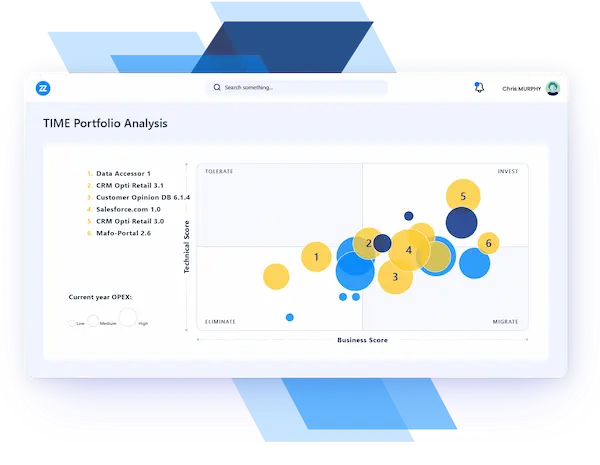
This level of clarity requires treating the application portfolio as a strategic asset with the same rigor applied to financial planning or workforce management. That means:
- Continuous visibility into the portfolio as it changes.
- Shared accountability across IT, finance, and business stakeholders.
- The discipline to revisit decisions as conditions shift.
But sharpening the portfolio — and maintaining that sharpness over time — requires a structured approach to evaluation. It requires context.
The Four-Dimension Framework for Context-Driven Application Rationalization
What separates successful rationalization from the kind that creates more problems than it solves? It comes down to whether decisions are made with a full view of business value and technical reality.
Portfolio optimization delivers lasting value when applications are evaluated across four dimensions simultaneously:
- Business fit: Does this application support current strategy or future priorities?
- Technical health: Does it introduce risk or carry a growing maintenance burden?
- Cost: What does it cost to run, maintain, and integrate?
- Value: What would it cost to lose, replace, or work around?
Together, these four dimensions provide a practical way to evaluate application rationalization decisions while mitigating downstream risk.
Here’s what changes when decisions are grounded in this context:
- Visibility. Every stakeholder works from the same data (application cost, business value, technical health, strategic fit) across the entire portfolio. No more siloed assessments. No more conflicting conclusions.
- Clarity. Decision-makers can model scenarios and compare trade-offs before making decisions, surfacing hidden risks while they can still be managed. Dependencies become visible. Impact becomes quantifiable. Teams can identify which legacy systems block AI adoption and which modernization efforts deliver the highest return.
- Alignment. IT, finance, and business stakeholders share a common understanding of what to keep, retire, consolidate, or invest in. Portfolio optimization becomes a shared discipline, which is critical when deciding which systems to sunset to fund AI infrastructure.
This approach enables CIOs to identify redundant or low-value applications understanding the full impact across business operations. It helps protect systems that underpin transformation efforts from unintended disruption and frees operating expense trapped in unnecessary applications, creating capacity to fund AI infrastructure, digital innovation, and broader transformation initiatives. At the same time, it provides a clear line of sight for CFOs and boards, showing that IT spend is deliberate and tied to measurable business outcomes.
Over time, portfolios become more modular and adaptable, making it easier to support AI-driven use cases without being constrained by legacy systems that should have been retired earlier.
What Happens When Rationalization Is Grounded in Context
This approach has shown measurable results across organizations that have embedded it as a strategic capability.
One example comes from Athora Insurance, a Netherlands-based insurance and asset management company with a long history of mergers, acquisitions, and strategic shifts.
Following years of mergers and acquisitions, IT costs had risen sharply, becoming unsustainable. The enterprise architecture team knew they needed to rationalize the application landscape, yet existing models lacked the business data required to make confident decisions on what to retire, consolidate, or protect.
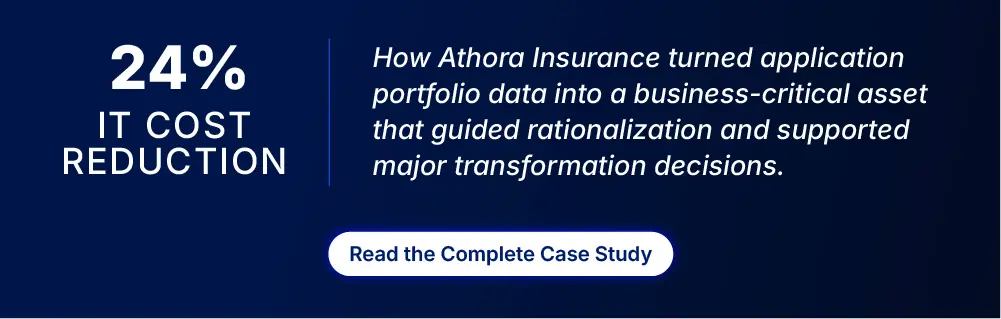
By centralizing application lifecycle and financial data into a single repository, Athora created visibility across its entire estate. The team could evaluate business impact alongside cost, model trade-offs, and deliver interactive roadmaps that guided rationalization efforts.
The result: An estimated 24% reduction in IT costs and a repository that became a business-critical body of knowledge, trusted by leadership during major transformation initiatives, including a significant acquisition.
Athora's success illustrates what's possible when rationalization is grounded in full portfolio visibility. When that context is missing the pattern plays out differently.
Cost Reduction Requires Ongoing Discipline
One-off rationalization cycles can reduce spend in the short term, but they rarely create lasting control. The savings show up for a quarter or two, then the portfolio drifts again. Teams add new applications without clear ownership. Legacy systems linger. The cycle repeats.
The stronger approach treats portfolio optimization as an ongoing discipline. When application decisions are grounded in full visibility across business impact, technical health, cost, and value, leaders can track how the portfolio evolves, revisit decisions as priorities shift, and reduce cost while protecting the systems that support future change.
Organizations that embed application rationalization as a strategic capability can reduce cost while protecting the systems that drive future value. More importantly, they can do it continuously, adjusting as AI strategy matures, as new workloads emerge, and as the competitive landscape evolves.
This is the shift from rationalization as an event to rationalization as a capability — one where the portfolio stays aligned with strategy, the organization stays agile, and cost reduction becomes something you do continuously, with confidence, rather than something you brace for every budget cycle.
FAQs
Application rationalization is the process of evaluating an organization's application portfolio to identify which systems to keep, retire, consolidate, or invest in based on business value, technical health, cost, and strategic fit. Application rationalization matters for IT cost reduction because it helps organizations eliminate redundant or low-value applications while protecting systems that support business strategy and transformation initiatives. Structured application rationalization programs can deliver cost reductions of 20 to 30 percent when decisions are made with full visibility into dependencies and strategic priorities.
Application Portfolio Management (APM) helps CIOs reduce costs without creating technical debt by providing visibility into application cost, business value, technical health, and strategic fit across the entire application estate. It enables leaders to model scenarios, compare trade-offs, and understand dependencies before making rationalization decisions. This approach allows organizations to identify redundant or low-value applications with confidence while protecting systems that underpin transformation efforts and demonstrating to CFOs that IT spending is strategic.
The key dimensions to evaluate when rationalizing an application portfolio are business fit, technical health, cost, and value. Business fit evaluates whether an application supports current strategy or future priorities. Technical health assesses whether an application introduces operational risk or carries a growing maintenance burden. Cost examines what an application costs to run, maintain, and integrate. Value considers what it would cost to lose, replace, or work around an application if it were retired.
Application rationalization should be treated as an ongoing discipline rather than a one-time project because cost pressure remains constant and business priorities shift continuously. One-time rationalization cycles can reduce spending in the short term but rarely create lasting control because portfolios drift as new applications get added and strategies evolve. When rationalization is treated as an ongoing discipline connected to strategy and architecture, leaders can track how the portfolio evolves, revisit decisions as priorities shift, and reduce costs while protecting systems that support future change.


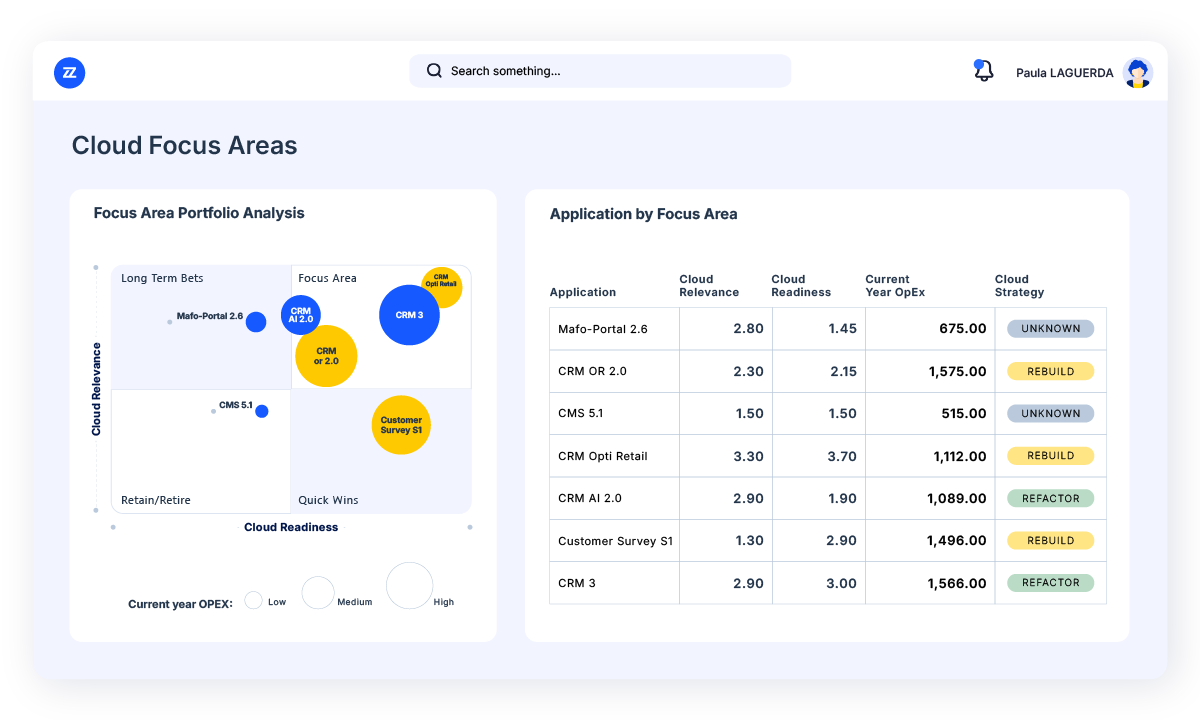

Rationalize your applications, reduce costs, and create a streamlined portfolio that accelerates change.