How the ArchiMate® Modeling Language Became a Global Standard and What Comes Next
TL;DR:
Marc Lankhorst, Managing Consultant & Chief Technology Evangelist at Bizzdesign, managed the original ArchiMate® R&D project and has remained involved with the language ever since. He traces its journey from a Dutch applied R&D project in 2002 to its adoption as a standard by The Open Group® and the publication of the ArchiMate® 4 Specification, explaining how it has evolved with enterprise architecture practice and why future development should preserve its usefulness and clarity rather than add a concept for every new development, particularly as AI changes how architecture models are created and interpreted.
When the ArchiMate project began in the Netherlands in 2002, our goal was practical: to give enterprise architects a better way to describe, analyze, and communicate architectures. More than two decades later, what began as an applied R&D project has become an international standard for enterprise architecture modeling.
In my previous blog article in this series, What ArchiMate® 4 Really Changes and What It Does Not, I outlined the main changes in the language. This time, I want to place those changes within the wider journey of the ArchiMate modeling language and consider what that history tells us about where the language should go next.
A practical need for a common architecture language
Once upon a time, long ago, in a galaxy far, far away, I worked for what was then the Telematica Instituut (later called Novay), a Dutch applied R&D institute in the ICT domain. This was a public-private partnership of knowledge institutes and companies aimed at strengthening the competitiveness and innovative capacity of the Dutch business community. Over the course of its existence (1991–2014), several spin-off companies emerged from its work. One of them was Bizzdesign, founded in 2000 from a collaborative project on business process management.
This history should also recognize Professor Chris Vissers, the Institute’s director, who recently passed away. His seminal contributions to ‘service thinking’ in ICT profoundly influenced both Bizzdesign and the ArchiMate modeling language.
I didn’t join Bizzdesign at that time but stayed at the Institute, which took the initiative for a similar R&D project on enterprise architecture modeling in 2001. Enterprise architecture was still an emerging discipline at that time, but the toolbox of the enterprise architect wasn’t very well-filled: there were no standards yet for modeling enterprise architectures, the Unified Modeling Language (UML) was (and is) focused mainly on software development, and the Business Process Model and Notation (BPMN) didn’t even exist yet.
We aimed to help architects with better ways of describing, analyzing, and communicating architectures, and some of the first ideas were about animating architectures to create better insights, which is also how first the ArchiMate project and then the modeling language got their names.
In 2001, we first did a pre-study with the organizations that were interested in joining the project to see if there were enough similarities between their architecture approaches for a viable project. After that, all of them decided to join and the ArchiMate project kicked off in the summer of 2002. I became the manager of that project and have been involved with the ArchiMate modeling language ever since.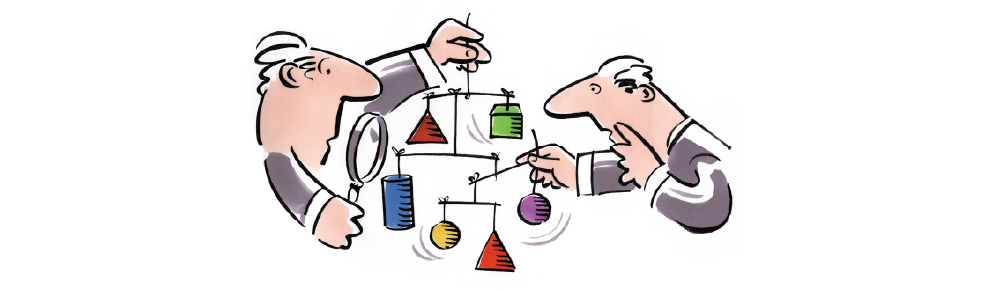
The original ArchiMate® project logo, created during the early development of the enterprise architecture modeling language.
From research project to international standard
The project produced various kinds of results, ranging from scientific papers to tool prototypes, and its most prominent outcome was the book Enterprise Architecture at Work, first published in 2005, describing the foundations and use of the ArchiMate modeling language. Already during the project, which concluded in 2004, the partners stressed that the results should be disseminated and implemented broadly, ideally turning the ArchiMate modeling language into an international standard.
One of the first things we did was to establish a ‘Tool Vendor Forum’ with some six different vendors who were interested in adopting the ArchiMate modeling language in their products. Bizzdesign, building on its shared roots with the Institute and literally just around the corner, was among them. Shortly after the end of the project, it launched its first enterprise architecture tool with ArchiMate support.
When the project ended, we started a foundation under Dutch law to promote the growth of the ArchiMate community, and the use of the ArchiMate language picked up very rapidly. This coincided with a wave of interest in enterprise architecture within the Dutch government, which initiated the creation of various reference architectures for different branches of government around the same time.
As adoption grew, we also explored whether the Object Management Group, the organization behind UML, or The Open Group, the organization behind the TOGAF® standard, could adopt the ArchiMate language. After some back and forth, The Open Group recognized that the ArchiMate language would be complementary to the TOGAF standard, which didn’t provide (but sorely needed) a standardized notation for describing architectures. Thus, in 2008 the intellectual property in the ArchiMate modeling language was transferred to The Open Group, which published Version 1.0 of the ArchiMate Specification in 2009. The transfer gave the language an international home and helped it grow beyond its original Dutch community.
Evolving with enterprise architecture practice
From there, the language evolved through several major releases, with some smaller updates in between:
- Version 1 (2009) was essentially the language developed by the original R&D project, with some adjustments to its terminology and definitions. This first version basically consisted of the Business, Application, and Technology layers that you see below.
- Over the years, the language has evolved further. Version 2 (2012) was the first major release after version 1. It added important concepts for modeling the motivation behind the architecture, such as Stakeholder, Goal, and Requirement, as well as its implementation and planned migration.
- Version 3 (2016) introduced concepts for modeling at a more strategic level, such as Capability, as well as concepts for modeling physical technology. Until then, ArchiMate concepts could only describe information technology. This opened it up for use in many other domains, from manufacturing and healthcare to logistics and defense. NATO’s adoption of the ArchiMate metamodel and notation is one result of this broader applicability.
- That brings us to the ArchiMate 4 Specification. It quite radically redesigns and simplifies parts of the language, making it easier to learn and more flexible to use without abandoning its underlying foundations. It also comes with a new depiction of the language structure, the ‘hexagonion’.
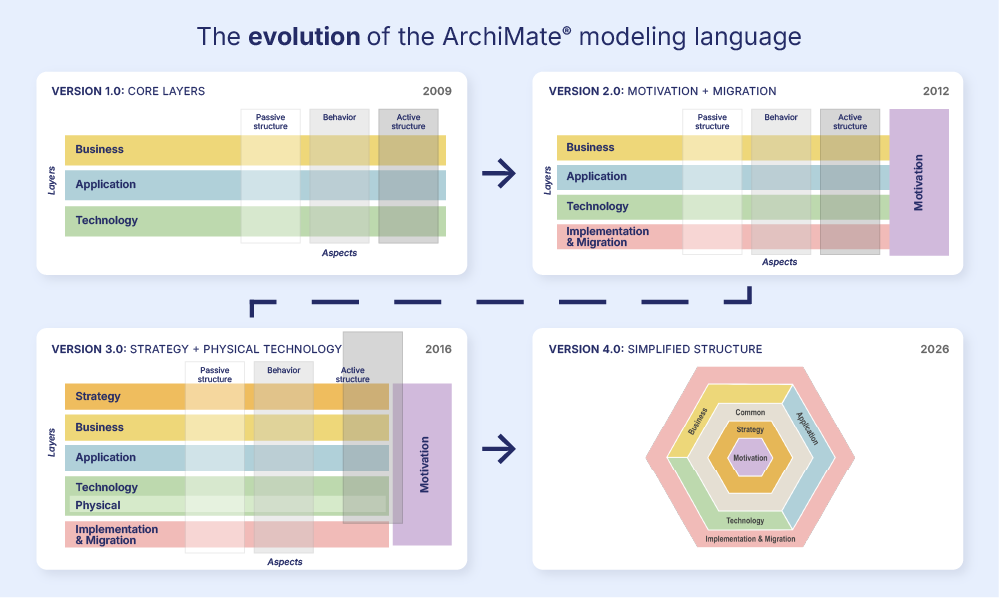
This marks an important change in the language’s evolution. Earlier major versions largely expanded the ArchiMate concepts to cover more of the architect’s world. Version 4 shows that evolution can also mean reducing complexity and making the language easier to understand, apply, and communicate.
What comes next for the ArchiMate® modeling language?
So where do we go from here? The ArchiMate language will probably not change again in the very near future, but it will undoubtedly need to evolve as enterprise architecture itself changes. AI and other rapidly developing technologies are changing the domains we describe, while AI is also becoming an increasingly important tool for architects themselves.
One consequence is that architects increasingly need to describe how people and AI work together. The ArchiMate 4 Specification makes this much easier by allowing you to model collaboration between people and technology more fluidly.
At the same time, AI is changing architecture modeling itself in two related ways. It can help generate models from natural-language descriptions, and it can interpret natural-language information alongside formalized data structures in models created by architects. For example, AI can interpret a textual description of what an application does or what a data object means without requiring the architect to formalize every property or attribute in advance.
Still, it remains important to distinguish between the different kinds of things and relationships being described. Because human language can be ambiguous, architecture models need a formalized ‘skeleton’ of concepts and relationships to ensure clarity of meaning.
This is where the ArchiMate modeling language provides key benefits. Your favorite AI agent can use the conceptual structure of ArchiMate models together with the natural-language information they contain to draw well-founded conclusions about how your enterprise is structured, connected, and evolving, without the guesswork involved in deriving this knowledge from textual documents alone. Moreover, whatever an AI co-worker comes up with, human oversight and judgment are still required. The understanding fostered by architecture models and views therefore remains a core benefit of using the ArchiMate language and may become even more important as AI generates more of the models that architects need to understand and assess.
In my view, future development should focus on keeping the language useful and understandable as architecture practice evolves, rather than trying to represent every new concept directly.
A later article in our series on the ArchiMate 4 Specification will look more closely at how AI may change architecture modeling in practice. Stay tuned!
ArchiMate, The Open Group, and TOGAF are registered trademarks of The Open Group.
FAQs
The ArchiMate modeling language was created between 2002 and 2004 through an applied research and development project led by the Telematica Instituut in the Netherlands, working with partners from government, industry, and academia. Marc Lankhorst managed the original ArchiMate project and has remained involved with the ArchiMate modeling language ever since. He is now Managing Consultant & Chief Technology Evangelist at Bizzdesign.
The ArchiMate modeling language was created to give enterprise architects a common language for describing, analyzing, and communicating enterprise architectures. At the time, no standard modeling language covered enterprise architecture across the business, application, and technology domains. The Unified Modeling Language (UML) focused mainly on software development, while the Business Process Model and Notation (BPMN) did not yet exist.
After the original project concluded in 2004, the ArchiMate Foundation was established to grow the community and encourage adoption. A Tool Vendor Forum brought together vendors interested in supporting the language, including Bizzdesign, which shared its roots with the Telematica Instituut and launched an early enterprise architecture tool with ArchiMate support. In 2008, the intellectual property in the ArchiMate modeling language was transferred to The Open Group, which published Version 1.0 of the ArchiMate Specification in 2009.
The ArchiMate language evolved through four major versions, with a few minor updates in between. It initially expanded in scope as enterprise architecture practice evolved, while Version 4 took a different direction by simplifying parts of the language.
- Version 1 (2009) established the Business, Application, and Technology layers.
- Version 2 (2012) added concepts for motivation, implementation, and migration.
- Version 3 (2016) introduced strategic concepts and support for modeling physical technology.
- Version 4 (2026) redesigned and simplified parts of the language to make it easier to learn and more flexible to use.
The ArchiMate modeling language and the TOGAF standard are complementary standards from The Open Group. The TOGAF standard provides a method and framework for developing and managing enterprise architecture, while the ArchiMate language is used to describe, analyze, and communicate architectures. Organizations can use the TOGAF standard to guide their architecture process and the ArchiMate language to represent and communicate its results.