
How Bizzdesign Unify Helps Teams Make Better Transformation Decisions Earlier
TL;DR:
Bizzdesign Unify was built around three deliberate choices: bring architecture into transformation conversations earlier, ground AI in connected enterprise context, and make architecture intelligence accessible to more people. An independent assessment by enterprise architecture (EA) analyst Stéphane Vanrechem evaluated Bizzdesign Unify against 16 EA criteria and awarded six 5/5 scores across all four AI-related criteria, including EA democratization, plus Integration Ecosystem and Architecture Decision Records.
The most important transformation conversations don't always have the information they need in the room.
Should we pursue this opportunity? What would it take to make it work? What else would this change affect? Those conversations often happen in workshops and planning sessions, yet the enterprise information needed to test those ideas, understand their implications, and carry the thinking through to execution often sits elsewhere, across architecture repositories, portfolios, operational systems, presentations, and individual teams.
That tension was an important part of the thinking behind Bizzdesign Unify. The product was designed to bring people, enterprise context, and AI-supported analysis into the same conversation, early enough for that context to influence the direction being taken. The aim was to help reduce the cost, delay, and delivery risk that can follow when important dependencies and trade-offs are discovered only after investment decisions have been made.
Achieving that meant making some very deliberate product choices. Recently, we had the opportunity to see how those choices stood up in an assessment by Stéphane Vanrechem, an independent analyst with extensive experience in enterprise architecture (EA) research, advisory work, and practice. Here’s more about the thinking behind Bizzdesign Unify, and how it’s reflected in Stéphane’s findings.
Bring Enterprise Architecture into the Conversation Earlier
Through our research with customers and conversations with our experts, we saw a consistent need to bring architecture into the process earlier. Teams were shaping transformation in collaborative settings while the architecture context they needed was often brought in later. When we started defining Bizzdesign Unify, bringing that context into the process earlier became a priority.
That need shaped the Bizzdesign Unify Workspace. We wanted to bring together the best of both worlds: The freedom to collaborate visually, with the trusted context and rigor of enterprise architecture.
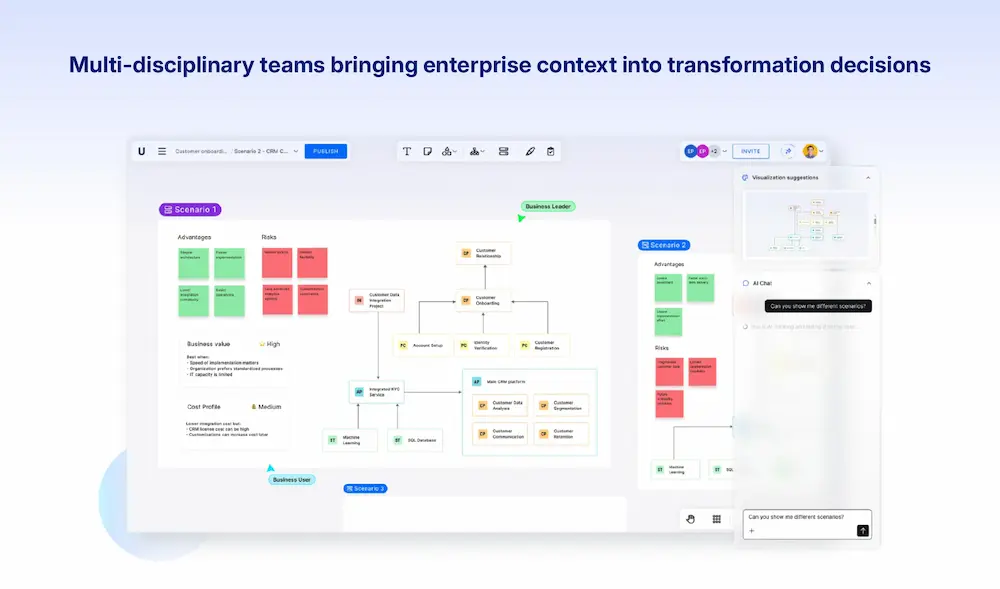
For a transformation leader, that means teams can shape an idea and test it against enterprise reality in the same place. Instead of moving between a collaboration tool where the context is missing and an architecture tool that requires specialist knowledge, teams can bring relevant capabilities, applications and initiatives into the discussion, compare scenarios, and understand dependencies, constraints and trade-offs before significant commitments are made.
The important part is that this work doesn't have to be recreated afterwards. Ideas explored in the Workspace can move into more structured architecture, carrying the context and reasoning behind them into the next stages of delivery. Teams can build on what they've already explored rather than reconstructing decisions from workshop notes and diagrams.
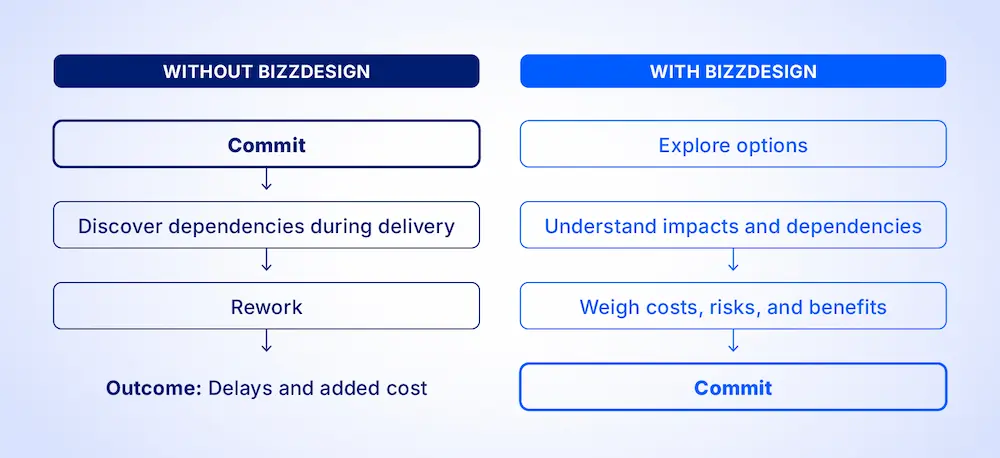
This matters because the decisions made during planning can have a long tail into execution. The Project Management Institute’s December 2025 research found that 35% of senior executives identified a disconnect between planning and execution as the biggest barrier to reinvention.
When Stéphane assessed Bizzdesign Unify using the product materials and demonstrations we provided, he described it as a “collaborative intelligence layer” that complements existing EA platforms and connects to virtually any system to enhance decision-making. His assessment found that Bizzdesign Unify delivers its strongest value in the early stages of transformation, identifying the potential to reduce alignment time by 30–40% and recover four to five weeks during a 12-week mobilization.
Ground AI in Connected Enterprise Context
Our second choice was to take that connected foundation a step further with AI. We knew we had a unique opportunity to bring decades of enterprise architecture expertise into an AI-native platform. We wanted AI to work with the same enterprise context as the teams using it, so they could assess ideas in relation to the wider organization rather than working from isolated documents.
For example, a product leader considering a change to a business capability could ask the Bizzdesign Unify Co-worker what applications, dependencies, and constraints could be affected. Instead of gathering that information from several systems and relying on an architect to translate the implications, they can use the Co-worker to work across connected enterprise information, interpret relevant diagrams, generate insights, manipulate objects, and surface the relationships that matter to the decision. They can then bring those findings into the conversation with colleagues, while architects can step in where deeper interpretation or judgement is needed.
“AI has already begun to redefine how architecture work is performed but Bizzdesign Unify goes further. It embeds AI natively as a first-class Co-worker, not an add-on, and elevates the EA function by delivering measurable business outcomes rather than incremental productivity gains.” – Stéphane Vanrechem, Enterprise Architecture Analyst
For that to work, the AI needs access to the wider enterprise context that supports the decisions teams are making. Bizzdesign Unify uses the Model Context Protocol (MCP) to give AI a standard way to interact with connected enterprise systems. Its integration-first architecture also allows teams to work with established platforms and information sources, across both structured and unstructured data. Architecture Decision Records preserve the reasoning behind decisions, giving teams, and the Co-worker more context to work with as decisions develop.
Stéphane’s assessment awarded 5/5 for Integration Ecosystem and Architecture Decision Records, alongside 5/5 for AI Automatic Suggestions, AI Ecosystem Flexibility and AI-Assisted Diagnosis.
Make Architecture Intelligence Accessible to More People
The first choice brought architecture into earlier conversations. We then grounded collaboration and AI-supported analysis in connected enterprise context, giving teams a way to explore the implications of their decisions as they considered different options. From there, we wanted to make that architecture intelligence accessible to a much broader group of people shaping transformation.
Transformation decisions span business, product, technology, and operations, while architecture expertise remains specialised. We wanted to lower the barrier to engaging with that expertise, so product teams, business analysts, transformation leaders, delivery teams, and operations teams could join those conversations in the shared Workspace. They could work with relevant architecture context themselves, ask questions in natural language, and explore how their decisions could affect the wider enterprise.
That means more people can get involved earlier and contribute to the conversation without needing to know how to navigate an architecture repository or wait for an architect to translate the information for them. Architects remain essential, curating trusted context and using their judgement to help teams interpret complexity and challenge assumptions. With less time spent on repeated translation and handoffs, architects have more capacity for complex analysis and strategic advice.
Stéphane described this as “enterprise-wide participation rather than a specialists’ tool”, awarding 5/5 for EA Democratization with AI.
Looking Ahead: How Enterprise Architecture Is Evolving
Enterprise architecture has spent decades helping organizations make sense of complexity. What’s changing now is how close that intelligence can get to the work of transformation. As AI, connected enterprise information, and collaborative ways of working develop, architecture can move beyond being something people consult at particular points in a process and become part of how organizations explore possibilities and actively shape decisions.
That shift also creates more room for architects to do the work that depends on their judgement. Curating trusted context, interpreting complexity, facilitating difficult conversations, and helping leaders understand the consequences of their choices become increasingly valuable as more people can engage directly with architecture intelligence.
For us, this is what makes the opportunity with Bizzdesign Unify bigger than building a new kind of EA product. It’s about rethinking where architecture can contribute, and what becomes possible when its expertise is part of transformation from the outset.
That’s the direction we’re continuing to build towards. As the technology evolves, so does the opportunity to bring more intelligence into transformation decisions and put the context and expertise organizations already have to work before those decisions become costly to change. 
FAQs
Teams can assess whether existing systems can support a proposed business change by comparing what the change requires with the capabilities and constraints of those systems. Bizzdesign Unify brings the enterprise information needed for that comparison into the conversation while teams are still exploring transformation options. In shared Workspaces, teams can bring capabilities, applications, and initiatives into the discussion, then explore dependencies, constraints, and trade-offs before significant commitments are made. They can also compare scenarios to understand which approach could work within existing systems and which would require changes or additional investment.
Business teams can contribute more effectively when technical options are explained in terms of business goals, operational impacts, and trade-offs. Designed for the wider group of people involved in transformation, including transformation leaders, business analysts, product teams, delivery teams, and operations teams, Bizzdesign Unify supports that discussion through shared Workspaces, where business and technology teams can explore proposed changes visually and ask questions in natural language to explore that information through shared Workspaces and natural-language questions. Business participants can explore ideas, compare scenarios, and work with relevant enterprise context themselves, while enterprise architects remain essential for interpreting complexity, maintaining trusted enterprise context and advising on decisions that require deeper expertise.
Enterprise architecture and portfolio management tools provide structured enterprise data, while visual collaboration tools support workshops and ideation. Bizzdesign Unify connects these two areas by bringing relevant enterprise context into collaborative Workspaces. Through its integration capabilities, Bizzdesign Unify can connect with existing architecture repositories, portfolio platforms and operational systems, allowing those systems to remain authoritative sources while teams use their information in collaborative decision-making.
Former Forrester senior analyst Stéphane Vanrechem found that Bizzdesign Unify delivers its strongest value in the early stages of transformation, helping teams explore options and align before resources are committed. His assessment evaluated the product against 16 enterprise architecture criteria and awarded six 5/5 scores, including Integration Ecosystem, Architecture Decision Records, AI Automatic Suggestions, AI Ecosystem Flexibility, AI-Assisted Diagnosis, and EA Democratization with AI. The assessment also highlighted the potential to reduce alignment time by 30–40% and recover four to five weeks during a 12-week mobilization.
Business and IT teams can compare transformation options by considering the expected business benefits alongside the system changes, costs, and delivery risks each option involves. Examining these factors together makes the trade-offs clear. For example, an option that promises faster growth may also require more extensive changes to existing applications. Bizzdesign Unify brings relevant capabilities, applications, and initiatives into shared Workspaces, where teams can explore scenarios and assess those trade-offs together before choosing a direction.
Teams can turn transformation workshop ideas into a starting point for delivery by structuring proposed initiatives and linking them to the business goals, capabilities, and applications involved. Bizzdesign Unify supports this transition by allowing free-form workshop content to become structured architecture, so teams can build on the ideas already explored. Stéphane Vanrechem’s assessment describes this as initiative mobilization, where workshop outputs become structured artifacts linked to enterprise context, helping teams prepare for delivery and reduce rework.