From Enterprise Model to Decision Engine
A Practical Guide to Building a Digital Twin of Your Organization
Summary
What you'll learn in this guide:
- How a Digital Twin of the Organization (DTO) connects strategic intent, enterprise design, and operational evidence to support continuously informed decisions.
- The five capability foundations required to build and run a DTO, and how to assess your organization's readiness across each one.
- The five-step lifecycle from design-time foundation to closed-loop improvement, with objectives, methods, outputs, readiness indicators, and common pitfalls for each step.
- How to start with one focused decision, outcome, or business problem and expand the DTO progressively as its value is demonstrated.
Imagine if you could maintain a coherent view of how your organization works at any given moment. The capabilities, the processes, the resources, the applications, the risks, the controls, and the relationships between all of them. Continuously, not periodically.
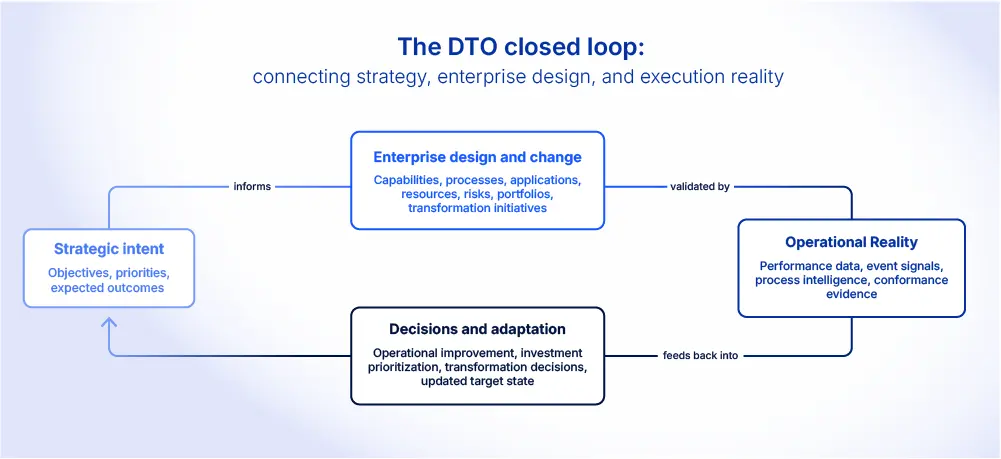
Now connect that view to what the organization is trying to achieve and how it's designed to deliver it. That connected model is then validated against what's happening across your operations and systems. So when something drifts, you see it. When a dependency shifts, you know before it becomes a problem.
And that closed loop changes how decisions get made. Testing scenarios before committing. Quantifying trade-offs instead of debating them. Executing change with the confidence of knowing exactly what you're changing and what depends on it.
That's a Digital Twin of the Organization (DTO). When operational evidence is connected to wider business, architectural, and portfolio context, it doesn't just show you where execution is drifting, it shows you why that matters and which outcomes or investments are at stake. And in a climate defined by supply disruptions, regulatory changes, cyber threats, and rapid pricing moves, the pressure to build one has never been more acute.
This guide explains what it takes: the connected capabilities required, how to start with a focused use case, the five-step lifecycle from design-time foundation to closed-loop improvement, and what it makes possible once it's running.
What Capabilities Are Required for a Digital Twin of the Organization?
A Digital Twin of the Organization (DTO) draws on five connected capability foundations:
- Core modeling
- Measurement and intelligence
- Advanced analytics and decisioning
- Governance, risk, and execution enablement
- Human experience and explainability
Combined, they connect the design and governance of the enterprise with evidence of how it’s operating in practice. This wider context enables DTO insight to support strategic and transformation decisions as well as operational improvement.
A mature DTO may draw on all five areas, but not every one needs to be fully developed at the outset. What's required at the outset will depend on the decision, outcome, and domain in scope. A governed model, clear ownership, and reliable operational evidence are foundational, while capabilities such as predictive analytics, complex event processing, simulation, and real-time optimization can be introduced as the twin matures and the use case demands them.
Before moving into the five-step lifecycle, it's worth assessing where your organization stands across these areas. While gaps here don't prevent you from starting, they do shape where you start and how far you can go in the early stages. Use what follows as a readiness lens:
The “Twin Body”: Core Modeling Foundations
This is the structural layer of the DTO. Without this, there’s nothing to measure against.
What to have in place:
- Process and task models that decompose business operations from end-to-end flows down to subprocesses, activities, and tasks.
- Capability and resource models that connect the outcomes the organization needs to deliver with the people, machines, IT systems, agents, time, and financial resources that make operations possible.
- Models of agentic capabilities and resources, covering the software, intelligent, and AI agents that are increasingly performing operations alongside humans.
- Models of deliverables and components that capture what the organization produces, how those products, services, and information are composed, and how they deliver value.
- Models of client, supplier, and external stakeholder interactions and journeys, with segmentation that reflects how different groups experience the organization differently.
- An orchestration repository that holds all of the above in a single environment, supporting the modeling and analysis of operations in a business operating model context.
- Links between the operating context and the strategic objective, business outcome, transformation initiative, or investment relevant to the initial use case.
Why it matters: This is the design-time foundation that everything else is measured and improved against. Connecting operational structures to capabilities, intended outcomes, and active change also provides the wider enterprise context needed to understand why runtime findings matter.
The Nervous System: Measurement and Intelligence Foundations
The layer that keeps the twin connected to operational reality. Without this, the twin reflects intent but not truth.
What to have in place:
- Performance measurement schemes that span operational KPIs, financial models, quality frameworks, and SLAs, and capture how those measures interact across the operating model.
- Real-time intelligence capabilities, including monitoring dashboards, configurable refresh cycles, and alerts and actions that keep the twin current rather than retrospective.
- Event processing that handles filtering, pattern detection, and anomaly and exception detection, with complex event processing where the volume and complexity of signals requires it.
- Data connectivity through adapters, connectors, web services, packaged applications, and sensor and event-stream data, so operational signals reach the twin continuously.
- Process mining capabilities for discovering, monitoring, and improving actual processes via event logs, grounding the twin's picture of operations in evidence rather than assumption.
Why it matters: Measurement isn't just retrospective reporting. A mature twin uses near real-time monitoring so performance indicators refresh continuously, thresholds trigger alerts, and emerging bottlenecks or drift are visible before they become systemic. That matters most when the evidence is read in enterprise context rather than as an isolated process or performance signal, since that's what turns a detected issue into something the organization understands the value, risk, and transformation impact of, not just the fact that it happened.
The Reasoning Engine: Advanced Analytics and Decisioning
The layer where the twin moves from describing operations to supporting strategic and operational decisions. Without this, insights don't become action.
What to have in place:
- Advanced analysis techniques grounded in the connected enterprise model, covering root cause analysis and cost and value assessment so that findings are anchored in context rather than isolated from it.
- Scenario testing and predictive and prescriptive analytics that enable future-state reasoning using the connected enterprise model as the basis for projection.
- The ability to incorporate external measurements, such as environmental conditions, supplier signals, or market data, where those signals affect operational outcomes.
- Simulation capabilities that allow computational experimentation, modeling how business operations evolve under different conditions over time before any change is committed to.
Why it matters: Operational deviations are rarely prioritized correctly when framed only as process or technical problems. Equally, transformation investments can't be assessed fully when they're separated from evidence of how the enterprise is performing. The reasoning engine is what translates findings into quantified trade-offs and decision-ready options for operational improvement, transformation prioritization, and wider business decisions.
The Safety Rails: Governance, Risk, and Execution Enablement
The layer that makes the twin trustworthy and actionable. Without this, insights won't translate into governed change. This layer covers not only risk and control capabilities, but also the ownership and decision rights required to build, maintain, and act on the twin.
What to have in place:
- Clear ownership and decision rights across the DTO, an executive or operational sponsor accountable for the outcome, defined responsibility for maintaining the model and updating the governed baseline, and governance workflows that clarify how enterprise architecture, operations, transformation, portfolio, data, and risk teams contribute and who has authority to approve action.
- Risk management and monitoring capabilities that connect risks, controls, and measurements to the operating model context, so that governance is continuous rather than periodic.
- Support for process automation that goes beyond identifying opportunities to actively preparing the automation of tasks, processes, and operations in a governed way.
- Access to project and program data that allows the twin to monitor transformation delivery and align it with the business outcomes it's meant to produce.
- Links between strategic objectives, transformation initiatives, and the outcomes they're expected to deliver, so operational evidence can inform ongoing prioritization and benefits realization.
- Support for ecosystems, covering internal and external collaboration content and multi-channel communications, so the twin can operate across organizational boundaries.
Why it matters: Linking risks and controls to the processes and assets they govern makes it possible to identify when operational deviations may indicate a control failure, emerging exposure, or need for escalation. Clear ownership and decision rights ensure that those findings lead to governed action rather than remaining analytical observations.
The Adoption Layer: Human Experience and Explainability
Governed decisions create value only when the people responsible for acting on them can understand and use the insight. This is the adoption layer, and it determines whether the twin creates value beyond the team that built it. Without this, even a technically mature twin stays in the hands of specialists.
What to have in place:
- Graphical capabilities that make complex interdependencies visible and navigable, including overlays of items, workplaces, and areas, and visibility into how they depend on each other.
- AI for explainability via conversational interaction, so the twin's insights are accessible to stakeholders who don't have modeling or analytical backgrounds.
- AI for data discovery automation, covering the cleaning, synthesis, and extraction of insight from unstructured data that would otherwise require significant manual effort.
- AI for interdependency interpretation that surfaces ripple effects and trade-offs across domains, so that the consequences of a change are understood before it's made.
- AI for real-time optimization, including proactive anomaly detection, improved recommendations, and adaptive modifications that keep the twin responsive to emerging conditions.
Why it matters: The twin needs to be understandable and accessible to all the people who need to act on it. Different stakeholders should be able to see the same evidence through the context relevant to their decisions, whether they're focused on operations, architecture, investment, transformation, or risk.
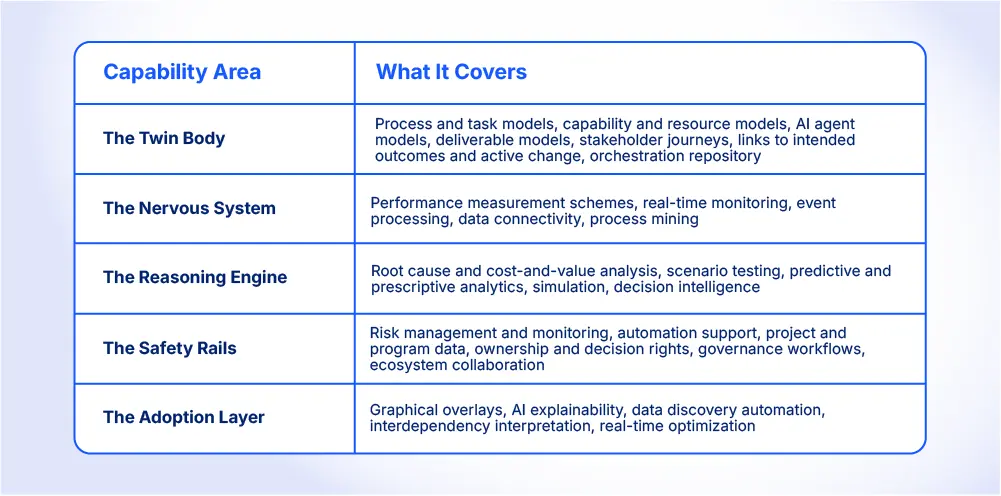
In summary: Building and running a Digital Twin of the Organization requires five foundations. The twin body provides the structural operating model. The nervous system connects it to operational reality through performance measurement, real-time monitoring, event processing, data connectivity, and process mining. The reasoning engine translates findings into quantified trade-offs and decision-ready options. The safety rails make governance continuous rather than periodic. And the adoption layer makes the twin accessible to the people who need to act on it. These capabilities can be developed progressively around a focused use case rather than implemented across the entire enterprise at once.
How to Start Building a Digital Twin of the Organization
Start small and expand deliberately
A Digital Twin of the Organization (DTO) doesn't need to represent the entire enterprise before it can create value. The most practical starting point is a clearly defined decision, outcome, or business problem where connecting intended outcomes and enterprise design with operational evidence will improve action.
Choose an initial use case with enough business weight to justify the effort, but narrow enough to govern and validate cleanly. This might be a critical value stream, a transformation initiative, an application modernization decision, a compliance domain, or an operational issue with measurable business impact. It could also be a portfolio or resource decision where leaders need stronger evidence about dependencies, expected value, or execution performance. The first scope should have a clear owner, accessible evidence, and an outcome that can be assessed.
A minimum viable Digital Twin of the Organization should include:
- One clearly defined decision, business problem, or desired outcome.
- A governed model of the outcome and the capabilities, processes, applications, resources, risks, and initiatives most relevant to that scope.
- At least one reliable source of operational evidence against which the model can be validated.
- Named owners for the business outcome, enterprise model, and supporting data.
- Agreed measures for determining whether action has produced the intended result.
- A mechanism for reflecting approved changes back into the governed baseline.
The starting model doesn't need to be complete, and the operational evidence doesn't need to be available in real time. Advanced simulation, predictive analytics, AI-supported optimization, and enterprise-wide data connectivity can be introduced later. The initial requirement is a sufficiently trusted baseline, relevant evidence, clear ownership, and a decision process in which the resulting insight can be used.
Expand beyond the first use case when the model and data are being maintained, ownership is stable, the DTO is supporting repeatable decisions, and the resulting outcomes can be measured. New domains and capabilities should be added because they support another valuable decision or strengthen the existing one, not simply to make the twin more comprehensive. The five-step lifecycle that follows provides a practical route for building that first use case and expanding it over time.
In summary: Start with one meaningful, bounded decision, outcome, or business problem. Build a sufficiently trusted governed model around that scope, connect it to reliable operational evidence, assign ownership, agree how success will be measured, and expand only when the DTO is supporting repeatable decisions and measurable outcomes.
The Five-Step Digital Twin of the Organization Lifecycle
From mirror to decision engine
The journey from a static operating model to a continuously validated decision-making instrument follows five steps. Each one builds on the last, and together they close the loop between how the organization is designed to work and how it does in practice.
The five steps are to build the governed twin, connect it to runtime evidence, enrich operational findings with cross-domain enterprise context, quantify the business impact, and prioritize and execute action while validating the results continuously. Throughout, the twin connects three perspectives that are often managed separately: what the organization intends to achieve, how it's designed and changed to deliver it, and what operational evidence shows is happening in practice.
The steps should be applied to the focused decision, outcome, or domain selected at the outset. The output at the end of each step provides a practical indication that the organization is ready to progress.
Step 1: Build the Twin
Establish a governed, connected operating model that represents how work is designed to happen, scoped to the decision or outcome defined at the outset.
At the start of the DTO lifecycle, the goal is to create a governed, connected representation of how the organization is designed to operate, the design-time foundation everything else will be measured and improved against. Using the focused decision, outcome, or domain already defined, connect the relevant capabilities, value streams, processes, applications, resources, data, risks, controls, and active change initiatives to it.
Where detailed process execution is central to the use case, critical processes can then be modeled in Business Process Model and Notation (BPMN) and connected to the people and organizational units that perform the work, the machines and systems that enable it, the applications and integrations that support execution, the data flows that carry information, and the risks and controls that govern it. The orchestration repository holds all of those connections in a single governed environment.
Most organizations don't start from scratch. The foundation is typically built by combining architect and analyst expertise with reference models and taxonomies, then enriched through system imports for application and infrastructure context. The most common difficulty at this step is data quality, poor data quality or delays in making structured data available will reduce the impact of early deliverables.
Typical sources:
- Architect and analyst expertise
- Reference models and taxonomies
- System imports for application and infrastructure context
Output: A baseline model with ownership and governance, stored as a repository of connected objects that can power reporting, analysis, and closed-loop measurement in the steps that follow, connected to the initiatives and investments the intended outcome depends on where relevant.
Ready to progress when: The organization has a sufficiently trusted view of the domain in scope, the critical relationships are represented, and responsibility for maintaining and using the baseline is clear.
Step 2: Measure It with Runtime Truth
Validate and enrich the twin with what really happens in operations.
Once the design-time baseline exists, the twin needs to be connected to operational reality; otherwise it remains a sort of elegant mirror. This step establishes runtime truth, evidence of how the organization is operating, by linking operational data, including event logs, transactions, sensor signals, and timestamps, to the modeled processes and operational objects built in Step 1. The specific evidence used will depend on the scope and decision in question, but its purpose stays the same: to show what's happening against what was designed.
Process mining, including object-centric approaches when multiple interacting objects matter, reconstructs what happens across the organization in practice; meaning the pathways work takes, the wait times it accumulates, and the outcomes it produces. That picture is then compared to the design-time baseline through conformance and variant analysis, quantifying how often the intended flow is followed, where work deviates, and which deviations drive rework, delay, quality defects, or compliance exposure.
Measurement at this stage goes beyond retrospective reporting. A mature twin uses near real-time monitoring and KPI dashboards so performance indicators refresh continuously, thresholds trigger alerts, and event-driven signals surface emerging bottlenecks or drift before they become systemic. The output of Step 2 is a runtime performance layer overlaid onto the process models built in Step 1, making deviations visible, measurable, and attributable rather than anecdotal.
The most common difficulty at this step is data readiness. Event log preparation, complex data extraction, and connecting operational systems to the twin require structured, reliable data. Organizations that underinvest in data connectivity at this stage find that the gap between the design-time model and runtime evidence stays wide, limiting what the twin can do in the steps that follow.
Once that evidence is reliably connected to the baseline, Step 3 places it in the wider enterprise context needed to explain why a finding matters, who owns it, and which outcomes and dependencies are affected.
Key methods:
- Process mining, including object-centric approaches where relevant
- Conformance and variant analysis: intended flow versus deviations
- Near real-time monitoring and KPI dashboards
Output: A runtime performance layer overlaid on the modeled processes, with evidence-based visibility into bottlenecks, rework loops, skipped steps, and the deviations, risks, and outcomes they drive. Where required by the use case, this may also include alerting and event-driven monitoring.
Ready to progress when: The relevant operational evidence can be reliably connected to the baseline, its quality and refresh frequency are understood, and the organization can distinguish meaningful divergence from expected variation.
Step 3: Fuel It with Cross-Domain Intelligence
Turn operational findings into enterprise context: why they matter, who owns them, what they impact, and how they relate to the outcomes the organization is trying to deliver.
Runtime insights only create value when they're placed in context. Step 3 turns what was learned in Step 2 into cross-domain intelligence by connecting operational findings to the broader operating model: which capabilities are affected, which applications and integrations are involved, which resources are constrained, which risks and controls are implicated, and which customers or suppliers feel the impact. This is where the digital twin becomes enterprise-grade, because the question shifts from "where is the bottleneck?" to "why does it matter, who owns it, what depends on it, how does it affect the intended outcome, and what wider consequences should be considered before acting?"
In practice, each deviation or performance issue gets enriched with enterprise relationships such as ownership and accountability, upstream and downstream handoffs, technology dependencies, data lineage, control coverage, and journey-stage consequences. It should also be connected to the strategic objectives, expected business outcomes, transformation initiatives, and portfolio investments it may affect. This is the point at which operational evidence informs not only local improvement, but also decisions about transformation priorities, investment, sequencing, and expected benefits.
Systemic patterns also surface at this step, recurring issues tied to specific shifts, equipment, sites, customer segments, or system behaviors that wouldn't be visible without the cross-domain connections the twin holds.
The output is a contextualized, dependency-aware view of issues and opportunities that can be taken forward for quantification and prioritization. Without this step, improvement efforts tend toward local optimization. With it, the organization gains an understanding of ripple effects and trade-offs across domains before committing to change.
Ownership gaps are the most common difficulty here. Without agreed business, model, and data owners, findings can be visible but remain unactionable. Cross-domain intelligence requires that the operating model built in Step 1 has clear accountability at every layer. Where ownership is unclear or contested, contextualizing findings becomes slow and the prioritization Step 3 is meant to enable can stall before findings are quantified and taken forward for decision.
Connect runtime signals to:
- Capabilities and strategic objectives
- Applications and technology dependencies
- Resources and capacity constraints
- Risk controls and compliance requirements
- Customer and supplier journey impacts
- Transformation initiatives, portfolio priorities, and expected benefits
Output: A contextualized set of issues and opportunities with dependency-aware understanding of ripple effects across domains, ready for quantification, including their relevance to strategic objectives, active investments, and expected transformation outcomes.
Ready to progress when: The organization understands why the finding matters, who owns it, which strategic and operational outcomes it affects, and which dependencies must be considered before action is taken.
Step 4: Quantify the Business Impact
Translate operational evidence into financial, operational, strategic, and risk implications to enable prioritization.
Step 3 surfaces where execution is diverging from intent and why it matters. Step 4 assesses the financial, operational, strategic, and risk implications so that leaders can compare possible responses. Operational deviations are difficult to prioritize effectively when framed only as process problems or technical problems. To mobilize investment and ownership, the impact needs to be quantified in terms leadership can compare: money, capacity, customer outcomes, and risk exposure.
Using runtime truth, actual volumes, cycle times, rework rates, defect rates, utilization, and SLA performance, the analysis can estimate direct costs including labor time, scrap, expedited freight, and overtime, and indirect costs including lost throughput, delayed shipments, customer dissatisfaction, accelerated asset wear, and increased audit effort. Because the twin links processes to resources, technology, and stakeholder journeys, second-order impacts like downstream constraints, service backlog growth, or compliance controls that become ineffective under certain conditions are traceable too.
Where the finding affects a strategic priority or active transformation initiative, the assessment can also show whether expected benefits are at risk and whether the current allocation of investment and resources remains justified.
The output is a decision-ready business case per finding, including the scale of opportunity, confidence level, constraints, and the most plausible levers, so that prioritization is grounded in quantified trade-offs rather than intuition.
The most common difficulty at this step is the absence of a quantification framework. Without agreed measures, assumptions, confidence levels, and decision criteria, even well-contextualized findings from Step 3 stall at the prioritization stage. Establishing how the organization will measure and compare gaps before this step begins accelerates the path from insight to investment decision.
What you quantify:
- Cost of rework and variance
- Throughput loss, overtime, wear-and-tear, and missed SLAs
- Downstream impacts across the operating model
- Effects on strategic objectives and expected business outcomes
- Expected portfolio or transformation benefits that may be at risk
- Resource and investment trade-offs
- Changes in risk exposure
Output: A quantified business case per gap covering direct and indirect costs, with decision-ready framing including impact, options, expected returns, constraints, assumptions, and confidence.
Ready to progress when: Decision-makers can compare the available options using agreed measures of cost, value, risk, and strategic impact rather than relying primarily on competing opinions.
Step 5: Prioritize, Act, and Adapt
Choose and execute improvements, then validate outcomes continuously.
Step 5 is where the twin becomes a decision-making instrument. With contextualized, quantified evidence and options from Steps 3 and 4, the organization can now choose where and how to act, as well as who is accountable for execution.
Decisions may involve process, resource, technology, or control changes. These can include redesigning processes, removing unnecessary steps, reducing handoff delays, adding earlier quality checks, resource and capacity adjustments covering staffing, equipment, and scheduling, technology changes including application enhancements, integration fixes, and automation, and governance actions covering control redesign, policy enforcement, training, and ownership changes. Where the evidence has wider implications, it may also support portfolio-level responses, covered in the actions below.
The twin supports prioritization by enabling scenario testing and simulation. Options can be compared, constraints tested, and the propagation of benefits and risks across the operating model understood before implementing change. Decision intelligence capabilities, collaborative decision modeling, governance workflows, and an auditable trail of decisions and changes ensure that execution is as disciplined as selection.
Once a target state is approved, it becomes the new baseline. The decision, its owner, expected outcome, assumptions, and measures should be recorded so that delivery and value can be assessed. The closed loop completes when runtime measurement validates whether execution matches intent and whether the intended strategic or operational outcome is being achieved. Continuous conformance monitoring detects drift back to previous behaviors, separates signal from noise, and keeps improvement sustainable over time. The result is a continuous feedback loop between intended design and execution reality, supporting both operational improvement and ongoing alignment between strategy and execution.
The risk at this step is treating it as the end of the process rather than the beginning of the next iteration. A decision that isn’t reflected in the baseline, assigned to an owner, and monitored against its intended outcome doesn’t complete the DTO loop. Organizations that approve a target state and move on without publishing it back to runtime monitoring lose the conformance layer that makes gains sustainable.
Possible actions:
- Process redesign
- Resource and capacity changes
- Technology changes: application updates, integration fixes, automation
- Control changes covering risk and compliance
- Automation opportunities
- Portfolio reprioritization or resequencing
- Changes to roadmaps or capability investments
- Resource or investment reallocation
- Reassessment of transformation assumptions or targets
How you decide:
- Scenario testing and simulation
- Decision intelligence: collaborative decision modeling and governance workflows
- Auditable trail of decisions and changes
Output: An improvement roadmap with ownership and measurable targets, updated target-state baselines published back to runtime monitoring, and continuous conformance monitoring to detect drift and sustain gains. Where the evidence has implications beyond the initial use case, the findings should also feed back into strategy, architecture, portfolio planning, and investment decisions.
Ready to continue the cycle when: The action has a named owner, measurable intended outcomes, an updated governed baseline, and an agreed method for validating whether the decision is producing the expected value.
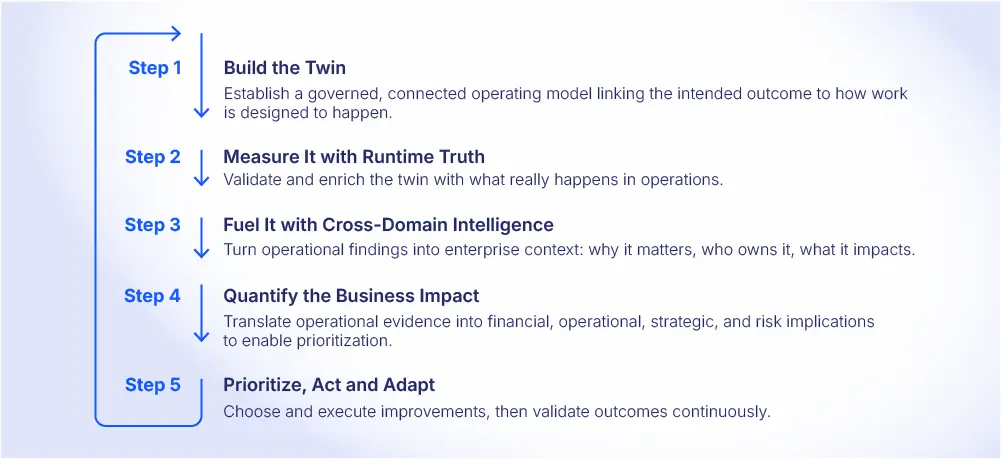
In summary: Step 1 establishes the governed design-time foundation and connects the outcome in scope to the relevant enterprise context. Step 2 connects it to runtime truth through process mining and conformance analysis. Step 3 places operational findings in business, architectural, strategic, and transformation context. Step 4 translates gaps into quantified business impact. Step 5 closes the loop: decisions are selected, executed, reflected in the baseline, and continuously validated against their intended outcomes.
Building a Digital Twin of the Organization with Bizzdesign
Building and running a DTO at enterprise scale requires the foundations described in this guide to work together to create a connected and governed view of the enterprise. When strategic, architectural, portfolio, process, and operational perspectives remain disconnected, organizations struggle to maintain the relationships and feedback loops on which a DTO depends.
Bizzdesign enables organizations to develop a DTO progressively by connecting capabilities across the Bizzdesign Enterprise Transformation Suite with relevant operational data and intelligence. Rather than approaching the DTO as an isolated application, this brings together the planning, design, and governance capabilities required to create and maintain the wider enterprise outcome.
Enterprise architecture provides the governed context of capabilities, processes, applications, resources, risks, and dependencies. Strategic portfolio management ties that context to strategic priorities, roadmaps, investments, and transformation initiatives. Operational intelligence then validates the intended design and planned change against what’s happening in execution.
Bizzdesign's partnership with mpmX integrates that runtime layer with enterprise architecture through process mining and process intelligence, closing the loop between design-time and runtime. Where a process mining tool alone shows what's happening in execution, Bizzdesign shows what it means for the capabilities, priorities, and investments built in the steps above.
In summary: Bizzdesign supports the development of a Digital Twin of the Organization by connecting enterprise architecture, strategic portfolio management, process and governance capabilities with operational data and process intelligence. This creates the governed enterprise context and continuous feedback loop needed to align transformation decisions with execution reality.
A More Coherent Enterprise
Ultimately, the value of a DTO comes from seeing the enterprise as a connected system of intended outcomes, enterprise design, active change, resources, risk, and operations. Linking processes and capabilities to the applications, resources, risks, initiatives, priorities, and runtime evidence behind them gives organizations the visibility needed to understand where execution is diverging from intent, why it matters, and what each decision will affect across the enterprise.
The five steps in this guide provide a practical route to building that view. The result is an enterprise that can act with confidence even as conditions keep changing, because the model changes with them.
That's what it means to move from mirror to decision engine.
FAQs
Readiness for a Digital Twin of the Organization depends on five capability foundations: core modeling, measurement and intelligence, advanced analytics and decisioning, governance, risk, and execution enablement, and human experience and explainability. Gaps across any of these don't prevent you from starting, but they shape where you start and how quickly the twin can move from a governed model to a decision-making instrument. A strong modeling foundation with no measurement layer, for example, produces a well-governed mirror that can't yet be validated against operational evidence. The practical starting point is to assess where your organization stands across all five, identify one high-value decision, outcome, or business problem where design-time and runtime evidence can be connected early, and build from there.
Start with one meaningful but bounded decision, outcome, or business problem where connecting enterprise design with operational evidence would improve action. The initial scope might be a critical value stream, transformation initiative, application modernization decision, compliance domain, portfolio decision, or operational issue with measurable business impact. It should have a clear owner, accessible evidence, agreed success measures, and a mechanism for reflecting approved changes back into the governed baseline. The first DTO does not need to represent the entire enterprise.
No. A Digital Twin of the Organization needs operational evidence that is reliable enough for the decision in scope, but that evidence does not need to cover the whole enterprise or refresh continuously from the outset. Event logs, transactions, performance indicators, system data, and other trusted sources can provide a useful starting point. Near-real-time monitoring, complex event processing, predictive analytics, and continuous optimization can be introduced later as the use case matures and the value justifies the additional capability.
A Digital Twin of the Organization can create value without modeling the entire enterprise. The initial model should include only the capabilities, processes, applications, resources, risks, controls, initiatives, and outcomes required to understand and act on the selected use case. The baseline does not need to be exhaustive or perfect. It needs to be sufficiently trusted, governed, and connected to the operational evidence required for the decision. Additional domains should be added only when they strengthen an existing decision or support another valuable use case.
Building a Digital Twin of the Organization involves five steps: build the governed twin, connect it to runtime evidence, enrich operational findings with cross-domain enterprise context, quantify the business impact, and prioritize and execute action while validating the results continuously. Step 1 establishes the governed design-time baseline. Step 2 connects that baseline to operational evidence. Step 3 explains why findings matter across capabilities, applications, resources, risks, priorities, and transformation initiatives. Step 4 translates those findings into financial, operational, strategic, and risk implications. Step 5 selects and executes action, updates the governed baseline, and monitors whether the intended outcome is achieved.