
Reduce federal IT costs and govern AI with Bizzdesign GovCloud, now FedRAMP® Certified.
Architect Your Change with Clarity: Why Design Must Be Central to Your Enterprise Transformation
Enterprise transformation places sustained demands on how organizations make decisions and coordinate change. Strategic direction may feel clear at the outset, yet execution often introduces friction as initiatives progress across portfolios, teams, and governance forums. Decisions taken in one area shape constraints elsewhere, sometimes without leaders seeing the full impact until late in delivery.
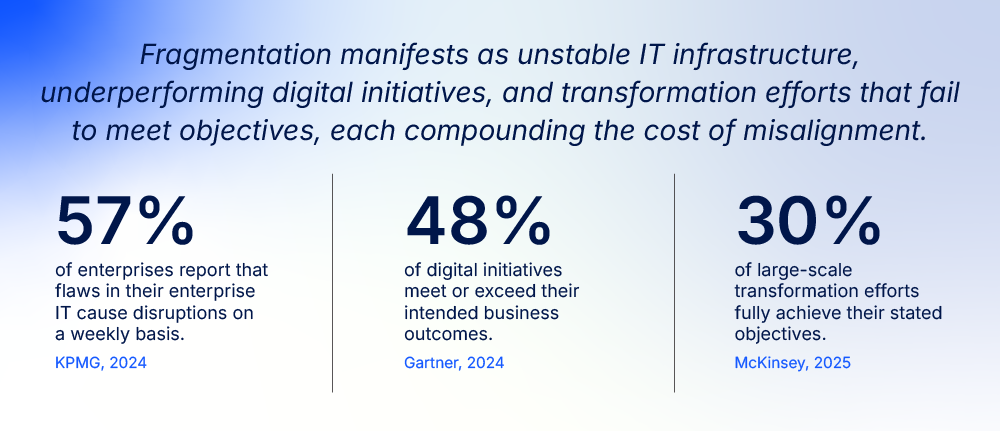
Operational evidence reflects this challenge. KPMG’s 2024 Global Tech Report finds that 57% of organizations experience weekly disruptions caused by weaknesses in foundational enterprise IT. These disruptions tend to persist when dependencies across systems, processes, and investments remain insufficiently visible.
We advise leaders to step back before accelerating and take ownership of transformation as a design responsibility. Treating change as a design discipline brings structure to intent, decisions, and execution. Instead of running isolated projects, transformation becomes a coordinated design effort where decisions are modeled, dependencies are mapped, and trade-offs are made visible before delivery begins. This helps leaders surface risks earlier, make better choices, and steer transformation with consistency as complexity grows.
From Vision to Action
Strategy rarely fails because of lack of ambition. It fails in translation.
Leaders define direction. Data and analytics inform decisions. But neither can resolve competing priorities or turn intent into action on their own. That responsibility still sits with leadership — to define what matters and translate it into choices the organization can execute.
This is where friction appears. Recent evidence shows a significant strategy-execution gap. In a January 2026 Harvard Business Review survey of roughly 400 leaders, 91% say strategic alignment is critical, yet fewer than one in seven believe their organization is actually aligned in practice, highlighting a persistent disconnect between strategic intent and execution.
When organizations lack a shared way to translate strategy into operational decisions, these gaps compound. Teams struggle to understand what strategic change means for people, processes, technology, and data — and how decisions in one area create constraints in another. Priorities drift. Dependencies surface too late. Execution fragments.
Design provides the missing structure. It does so by establishing a shared, governed view of the enterprise that keeps strategy coherent as it moves toward delivery. A governed view means working from a living model of business capabilities, technology, dependencies, and investments that leaders and teams use as a single source of truth for decision-making.
When a capability model shows, for example, that three initiatives depend on the same legacy platform, leaders can sequence investments to avoid bottlenecks instead of discovering them mid-execution, ensuring decisions are made with full context and enabling coordinated execution across portfolios and time horizons.
It All Starts with a Plan
The modernist architect Le Corbusier observed in 1923 that "the plan is the generator." A century later, the observation holds: As structures grow more complex, early decisions shape everything that follows.
AI adoption has created a new risk landscape for enterprise transformation. What begins as a local decision, for example, deploying a generative AI tool in one department, now creates cascading exposure across regulatory compliance, data privacy, ethical frameworks, and security protocols. A choice that seems contained can introduce compliance risk under emerging AI regulations, amplify data governance gaps, create dependencies that constrain future technology decisions, and expose the organization to reputational harm.
These risks compound quickly because they're interconnected. Deloitte's 2025 analysis points to compliance, organizational readiness, and data governance as the top obstacles enterprises face in scaling AI. These are symptoms of the same problem: Organizations lack the architectural visibility to see how AI decisions interact across the enterprise. Without that visibility, they can't assess exposure, can'tsequence mitigation, and can't maintain control as adoption accelerates.
A design-led plan addresses this by creating a stable frame for decision-making and risk management over time. The value sits in its ongoing use as a living design artifact. When leaders can map AI dependencies, assess cross-domain risk exposure, and revisit trade-offs as conditions change, they maintain clarity and control as transformation unfolds.
The Limits of a Fragmented Approach
As transformation moves into execution, the role of the plan begins to shift. What initially provided clarity and direction must now support a growing number of parallel decisions across portfolios, teams, and governance forums. When that shared frame weakens, fragmentation doesn’t appear all at once. It accumulates.
Industry data reflects this gradual loss of coherence. Gartner’s 2024 survey shows that only 48% of digital initiatives meet or exceed their intended business outcomes. In other words, more than half of digital initiatives fail to deliver their expected value. Viewed in isolation, this says little. Viewed across a portfolio, it points to a more familiar pattern. Initiatives move forward with momentum, but without the linking mechanisms needed to keep priorities, dependencies, and sequencing aligned. Over time, the cumulative cost of misalignment far exceeds the impact of any single project.
At transformation scale, the effect becomes more pronounced. McKinsey research indicates that only around 30% of large-scale transformation efforts fully achieve their stated objectives. This, of course, isn’t a verdict on intent or capability. It reflects how easily value dissipates when decisions multiply faster than the structures that connect them. Alignment holds early, then stretches, then thins.
Why does fragmentation persist even in well-intentioned organizations? The patterns we observe are more structural than cultural. Teams often work in disconnected tools without a shared data model, making it difficult to see how decisions in one domain affect another. Governance processes may exist on paper but lack the real-time visibility needed to intervene when initiatives drift. Business and IT operate with different frameworks, success measures, and, as we often say, different "languages". Without a shared architectural view, these gaps widen under pressure.
What starts as reasonable autonomy becomes costly duplication. What looks like agility becomes technical debt. And what feels like local progress can undermine coherence across the enterprise.
When plans stop anchoring decisions in this way, leaders feel the impact indirectly. Trade-offs surface late. Dependencies emerge under pressure. Teams do the right thing locally, while the enterprise picture becomes harder to hold steady. Design does not remove these pressures, but it gives organizations a way to absorb them without losing clarity as transformation unfolds.
Disjointed Strategies Come with Costs
Towards Transformation That Flows
Addressing fragmentation requires a shift in how transformation is designed and governed. When enterprises architect change so that business and IT decisions remain aligned, execution becomes more predictable. Gartner research shows that organizations where business and IT jointly own digital delivery are up to twice as likely to meet or exceed their strategic objectives. This correlation reflects the value of working from a shared enterprise view, rather than from disconnected plans and systems.
Many organizations already have enterprise architecture capabilities that provide visibility into IT landscapes and help manage technical complexity. That visibility matters, but it's rarely sufficient on its own. Designing transformation also requires the ability to model future states, explore alternatives, and communicate implications clearly across the organization. Visual modeling plays a central role here, making complex change accessible to a broader set of stakeholders, including executive leaders responsible for setting direction and making trade-offs.
Design-led transformation depends on four tightly connected disciplines.
Effective transformation starts with understanding how strategic goals map to business capabilities. Business architecture clarifies which capabilities support current objectives, which constrain progress, and where targeted change will have the greatest impact.
When business architecture is absent, transformation efforts tend to organize around projects, technologies, or organizational units rather than the capabilities that actually create and deliver value. Investments are made without understanding their impact on the broader capability landscape. Redundant capabilities proliferate across business units. Strategic priorities remain abstract, disconnected from the operational changes needed to achieve them.
Business architecture creates a capability-based view of the enterprise. It shows how capabilities support strategic objectives, how they depend on one another, and where gaps or overlaps exist. This view becomes the foundation for prioritizing investments, sequencing initiatives, and keeping transformation anchored in business outcomes rather than technical outputs. When leaders can see which capabilities are under-invested, over-complicated, or misaligned with strategy, they can make better decisions about where to focus effort and resources.
Enterprise architecture connects business capabilities to the applications, data, technologies, processes, and organizational structures that enable them. It provides the systemic context needed to understand dependencies, assess implications, and manage complexity across the operating model.
Most organizations have accumulated layers of applications, data, and infrastructure over decades. The challenge lies in turning that landscape into coherent, accessible architecture that stakeholders can actually use to guide decisions. When architecture lives only in the minds of specialists or in documentation that quickly becomes outdated, it can’t support transformation at scale.
Enterprise architecture management creates a living, queryable model of the organization’s operating model. It creates a clear, shared view of how applications support business capabilities, how data flows across systems, where technical debt has accumulated, and which dependencies will constrain future change — giving leaders the insight to assess impact before committing resources and enabling teams to reduce duplication, manage risk, and collaborate effectively across business and IT.
Solution Architecture Management
Solution architecture translates designed strategic intent into executable initiatives. It supports decisions around scope, sequencing, dependencies, and investment, helping ensure that strategy survives the transition from design into delivery.
Even when strategic direction is clear and enterprise architecture provides context, individual initiatives often start from scratch — reinventing design patterns, making localized technology choices, and creating solutions that drift from enterprise standards.
Solution architecture management provides reusable design patterns, reference architectures, and governance guardrails that guide initiative teams without slowing delivery. It ensures that solutions are designed with the enterprise context in mind: aligned with architectural principles, compliant with standards, and integrated in ways that reduce long-term complexity. When solution architecture is managed consistently, organizations see faster delivery, fewer integration issues, and greater reuse of proven patterns.
Business Process Management
Business process management embeds designed change into day-to-day operations. It makes visible how work flows across the organization, how risk accumulates, and how customer and employee experiences are shaped as transformation progresses.
Transformation ultimately succeeds or fails based on whether new ways of working take hold in daily operations. Business process management provides the visibility and control needed to ensure that happens.
Through modeling, analyzing, and optimizing business processes, organizations can identify bottlenecks, eliminate waste, and ensure compliance with regulatory and internal standards. Process management also creates the foundation for continuous improvement. When processes are documented, measured, and governed, teams can identify opportunities for automation, standardization, or redesign based on evidence. And when processes are linked to the broader enterprise architecture, leaders can see how operational changes affect capabilities, applications, and strategic outcomes — closing the loop between design and execution.
Individually, each of these disciplines addresses a different dimension of change. Together, they create a coherent foundation for transformation by linking strategy, architecture, delivery, and operations. When organizations apply them in concert, they gain clearer line of sight from vision through execution, and greater confidence that change will hold as priorities evolve.
A Snapshot of Success
So, what does design-led successful transformation look like in practice? It rarely announces itself through a single milestone. Instead, it shows up in how clearly leaders can navigate change as initiatives unfold.
When organizations apply a design-led approach — whether the focus is AI adoption, cloud migration, post-merger integration, customer experience improvement, or digital product development — certain advantages follow. Decision-making becomes more transparent. Coordination improves across portfolios. Leaders gain greater confidence that initiatives remain aligned as priorities evolve.
Organizations applying this approach work toward:
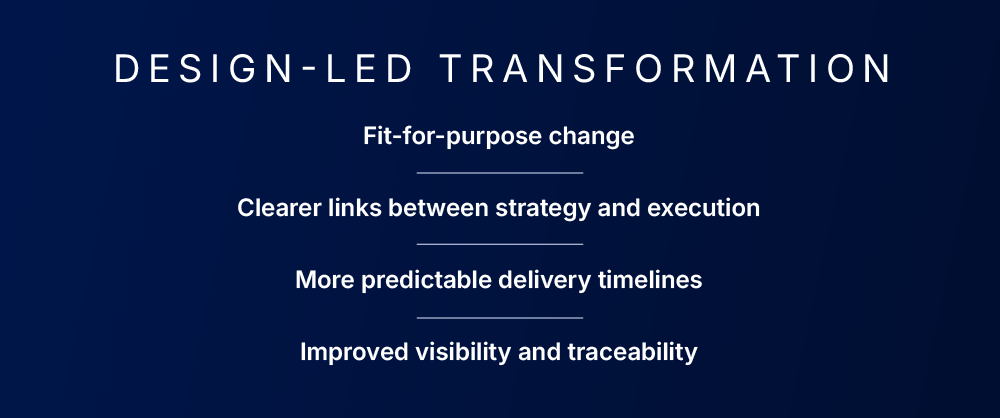
Fit-for-purpose change
By designing transformation around business capabilities, organizations can create a clearer link between strategic intent and operational change. Business architecture helps anchor initiatives in how value is created and delivered, rather than in isolated projects or technical upgrades. As a result, stakeholders across business and IT work from a shared frame of reference when shaping change, improving collaboration without requiring constant alignment effort.
Clearer links between strategy and execution
Translating intent into execution introduces risk when decisions are made in isolation or without visibility into downstream impact. A design-led approach allows teams to explore alternatives, assess implications, and adjust sequencing before commitments are made. This reduces late-stage correction and helps ensure that execution remains connected to strategic direction as initiatives progress.
More predictable delivery timelines
Reusable models, shared templates, and consistent analytics help stabilize planning and coordination across initiatives. Rather than accelerating change indiscriminately, design improves predictability by reducing rework and clarifying dependencies early. Over time, this supports steadier progress across complex portfolios, even as scope and priorities shift.
Improved visibility and traceability
Sustained transformation depends on maintaining a clear line of sight across business objectives, architectural decisions, and delivery activity. A consolidated enterprise view enables organizations to trace how decisions interact, where risk accumulates, and how changes affect existing systems and processes more easily. This visibility supports more informed decision-making as transformation evolves.
What This Looks Like in Practice
Take the case of Ameren Corporation, a Fortune 500 energy utility serving 2.4 million electric and 900,000 natural gas customers.
Ameren’s enterprise architecture practice includes 35 architects across portfolio, solution, domain, and network architecture. Before establishing a dedicated solution architecture function, technical domain architects handled project reviews. Their work focused on engineering and system-level design, making it challenging to prioritize solution architecture activities. Teams relied on manual tools such as PowerPoint and Visio instead of modeling platforms, which led to late discovery of design issues, project delays, and budget overruns.
Ameren addressed these challenges by centralizing solution architecture within Enterprise Architecture. The team aligned solution architecture with its Technology Work Assessment (TWA) process and introduced standardized Coach Views for every project. Solution architects now map business cases directly to initiatives and populate dashboards with consistent, decision-ready information. Today, the team designs roughly 90% of portfolio roadmaps using this approach.
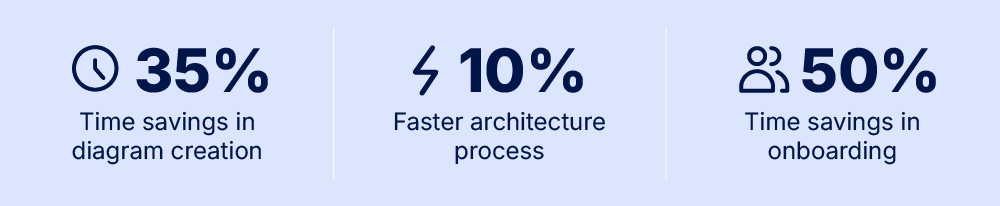
Using templates and Coach Views, Ameren streamlined business case imports and automated the creation of visual models. The team reduced diagram creation time by 35% compared to manual Visio work and expects an additional 10% efficiency gain as processes continue to mature. The organization is also experiencing a 50% timesaving in getting stakeholders up-to-speed with new projects. Standardization has promoted consistency, increased collaboration has improved decision-making, and the ability to reuse existing materials has allowed teams to work smarter.
More than 200 stakeholders can access shared views during planning and governance discussions, and solution architecture review meetings now finish early instead of running over.
Don’t Adapt, Design
Periods of accelerated change place greater weight on how organizations frame decisions, sequence investment, and govern execution over time. As initiatives multiply and dependencies deepen, sustaining clarity requires deliberate structure.
A design-led approach provides that structure. It gives organizations a shared frame to absorb change while preserving coherence across strategy, architecture, delivery, and operations. This continuity helps leaders guide transformation with confidence as priorities evolve.
Organizations applying these principles often benefit from working with partners who understand transformation at enterprise scale. Bizzdesign supports transformation leaders across industries facing this challenge. The company has been named a Leader in Gartner’s Magic Quadrant™ for Enterprise Architecture Tools for eighteen consecutive years, reflecting a sustained focus on enterprise-scale transformation design.
Looking to cut complexity and accelerate change?
Let's talk about your goals and how our experts can support you. Contact us.
FAQs
Design-led transformation treats enterprise change as a deliberate design discipline rather than a series of isolated projects. It means modeling decisions, mapping dependencies, and making trade-offs visible before execution begins. Organizations work from a shared, governed view of their enterprise so strategy stays coherent as it moves into delivery.
Enterprise architecture management creates a living, queryable model that connects business capabilities to the applications, data, technologies, processes, and organizational structures that enable them. Most organizations have accumulated layers of applications, data, and infrastructure over decades; the challenge is turning that landscape into coherent architecture that leaders and teams can actually use to make decisions.
A managed enterprise architecture makes visible how applications support business capabilities, how data flows across systems, where technical debt has accumulated, and which dependencies will constrain future change. This visibility allows leaders to assess impact before committing resources, helps teams identify reuse opportunities and avoid duplication, and provides a shared language for business and IT to collaborate on transformation decisions.
Business architecture management creates a capability-based view of the enterprise that anchors transformation in how value is created and delivered. It shows which capabilities support strategic objectives, which constrain progress, and where targeted change will have the greatest impact.
This view becomes the foundation for prioritizing investments and sequencing initiatives based on capability gaps and overlaps rather than isolated business cases. When business and IT work from a shared frame of reference, collaboration improves and transformation stays connected to business outcomes rather than drifting toward technical outputs.
Solution architecture management translates strategic intent into executable initiatives by providing reusable design patterns, reference architectures, and governance guardrails. Without it, initiatives often start from scratch, reinventing design patterns and making localized technology choices that drift from enterprise standards.
When solution architecture is managed consistently, teams work with proven templates that guide delivery without constraining execution. Solutions stay aligned with architectural principles, comply with standards, and integrate with existing systems in ways that reduce long-term complexity.
Business process management embeds designed change into day-to-day operations by making visible how work flows across the organization, how risk accumulates, and how customer and employee experiences are affected as transformation progresses.
By modeling, analyzing, and optimizing business processes, organizations can identify bottlenecks, eliminate waste, and ensure compliance with regulatory and internal standards. When processes are documented, measured, and governed, teams can improve performance based on evidence rather than intuition and ensure new ways of working take hold across the enterprise.



Ready to Design Transformation With Clarity?
Let's talk about your transformation goals and how our end-to-end suite can support you.