Five Days to 30 Minutes: How Bizzdesign Helped IFM Investors’ Lean Architecture Team Keep Pace with Change
Challenges
- 8 of 10 business units affected by the integration of IFM Investors and ISPT
- Approximately 250–300 systems across the two organizations
- Up to five days to update business architecture across multiple views
- A lean business architecture team supporting complex integration and parallel strategic initiatives
Results
- Architecture updates reduced from up to five days to around 30 minutes
- Approximately A$600,000 in estimated avoided resourcing costs, equivalent to around three FTEs
- Existing business architecture reused to support Real Estate Operating Model Optimization, without rebuilding the model from scratch
- Enterprise views used to identify dependencies between strategic initiatives and support better-sequenced business decisions
IFM Investors, a global private markets investment manager, has grown significantly over the past decade. It has evolved from a relatively small organization into a multinational team of around 1,500 people, managing approximately A$243.3 billion in capital. As IFM grew, its operating model became more complex, requiring more controls, processes, data, and technology to support the business. This created a need for a more process-driven approach to running the organization.
The merger with ISPT, an Australian property funds manager, added to the complexity and brought real estate into IFM’s investment portfolio as a new asset class. IFM needed to understand how ISPT’s business, capabilities, functions, and technology would fit within its existing model. Bizzdesign gave IFM’s lean business architecture function an enterprise-wide view to support this work, without requiring a large business architecture team or large-scale upfront implementation.
The Challenge: Connecting the Pieces of a Complex Merger
Before Bizzdesign, IFM managed its operating model through spreadsheets and diagrams, while individual project and delivery teams carried out solution architecture for their own initiatives. As the organization managed multiple initiatives and increasing complexity, the lack of a business-wide view beyond individual projects made it difficult to understand how different parts of the business fit together and how changes could affect other areas.
The merger exposed the limitations of this approach. It affected eight of IFM’s 10 business units and brought together a new asset class, different business models, investment teams, corporate functions, legal, IT, and shared services. IFM needed to map these different parts of the organization and determine how the two businesses would fit together.
Additionally, ISPT brought approximately 100 systems into an environment where IFM already had around 150 to 200. David estimated that while around 30% of the systems could remain untouched and 20% could be removed, the remaining half required IFM to determine how they would be integrated or used together. ISPT was also further ahead in data maturity, adding another consideration to the integration.
“We can’t make decisions across the whole business without understanding how they impact each other. Before Bizzdesign, we were trying to manage that in spreadsheets while everything was happening in parallel. That wasn't really viable.” — David Gwilliam, Transformation Specialist, IFM Investors
Why IFM Investors Chose Bizzdesign
IFM needed an architecture platform that could make enterprise context more accessible to the wider business while supporting the way the organization managed initiatives. Bizzdesign stood out for its business-friendly approach, ability to support a common architecture language with audience-specific views, and flexible model that allowed IFM to start with a focused use case rather than invest heavily upfront.
- Business-friendly architecture. David found many other enterprise architecture tools highly technical and geared primarily toward architects. IFM wanted to make enterprise context accessible and meaningful to people across the business, particularly when managing initiatives and solution design. With Bizzdesign, IFM could organize architecture work around individual initiatives while retaining the wider business context needed to inform solution design.
- A common language for decision-making. Bizzdesign offered a way to structure enterprise architecture consistently while presenting information in a format relevant to different stakeholders. This was important for IFM, where multiple delivery teams were working on strategic initiatives involving significant operating model change. Tailored views of the organization gave teams a consistent basis for discussing complex situations and making design decisions.
- A flexible way to start small. IFM could begin with a focused business architecture use case and a small financial footprint, with room to expand over time rather than investing heavily upfront.
“Bizzdesign is very business-friendly because it gives us a way to get enterprise context out to people in a way they can relate to. We can create a common architecture language while giving people the views and models they need for their particular context.” — David Gwilliam, Transformation Specialist, IFM Investors
The Approach: Building an Enterprise-Wide Business Architecture View with a Lean Team
Having selected Bizzdesign, IFM took a focused approach to business architecture, using the platform to support the integration of Real Estate alongside the broader portfolio of change. Rather than building a large business architecture team around the implementation, David remained the core resource and brought in two business analysts for specialist work.
IFM started with a small number of Bizzdesign licenses, keeping the cost base limited while establishing its business architecture capability. David populated the initial data himself, using the training he received to build the enterprise-wide view.
“With the training, I was able to upload my spreadsheet-based model, including its multiple layered relationships, and build an enterprise-wide view in two weeks. I found the process relatively straightforward and was impressed by how quickly I could build on the model.” — David Gwilliam, Transformation Specialist, IFM Investors
The initial view brought together several elements of the business:
- Business capabilities: A capability model that provided a common foundation across all architecture views.
- Processes and organization: Process architecture and an organizational view.
- Applications and ownership: Overlays connecting business capabilities to application components and process owners, represented by teams rather than individual roles.
David subsequently introduced a functional model and developed solution-specific views for focused areas of the business in response to project needs. Investment Operations was prioritized because of the complexity of the integration and dependencies on other projects being delivered in parallel.
The Impact: Faster Decisions and More Efficient Business Architecture
Bizzdesign helped IFM manage the complexity of a major merger without building a large business architecture team. By making dependencies across strategic initiatives visible, cutting architecture updates from days to minutes, and enabling teams to reuse existing models, IFM could support more change with the resources it already had.
Better-informed decisions across business change
Bizzdesign was used to manage a maturity assessment of the operational functions supporting IFM’s Real Estate product, giving the Chief Operating Officer a structured basis for determining the scale and scope of change required. The assessment also supported prioritization, engagement with third parties through a consistent operating model view, and traceability from processes to applications across parallel changes within the program and IFM’s wider portfolio.
IFM also uses enterprise views to identify dependencies between strategic initiatives affecting the operating model, helping executives sequence decisions and reduce rework.
“The enterprise views help us identify dependencies between strategic initiatives impacting the operating model in parallel. This feeds into the sequencing of decisions and has reduced rework and the need to revisit operating model design decisions.” — David Gwilliam, Transformation Specialist, IFM Investors
Faster architecture updates
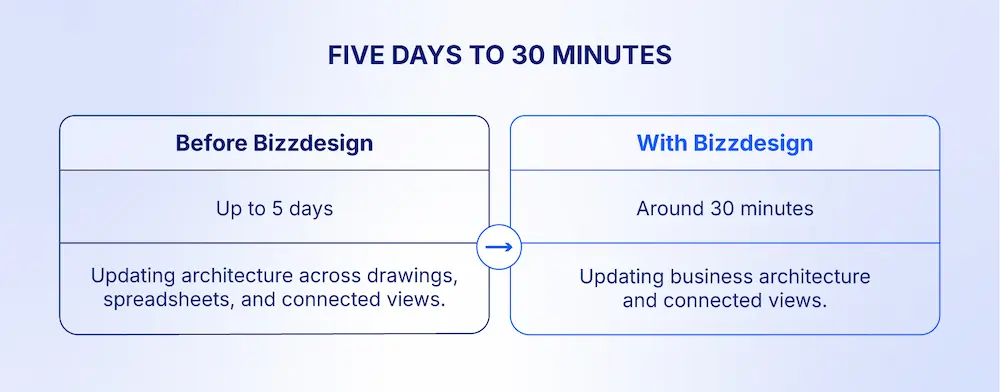
Bizzdesign has also reduced the time needed to maintain IFM’s business architecture. Previously, introducing or updating a capability or process, or changing a relationship, could require updates across one to three enterprise views, which underpinned five to ten solution architecture-specific views. The work also involved updating the underlying meta-model and supporting relationship matrices in spreadsheets.
At the peak of the integration, these changes occurred once or twice a week. Updates that could previously take up to five days can now be completed in around 30 minutes. The work now happens more frequently because IFM has the capacity to respond to more requests.
Supporting integration with a lean team
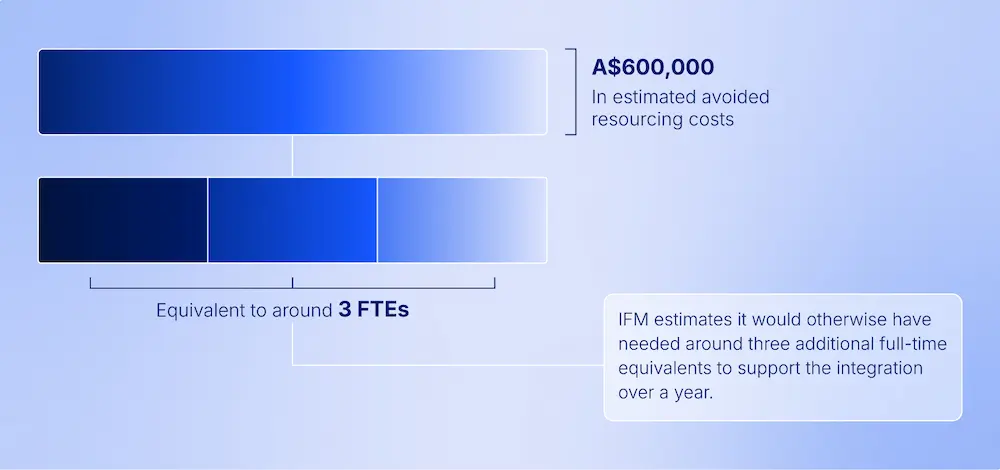
For the integration, David remained the core resource, supported by two business analysts for specialist work. He estimates that IFM would otherwise have needed around three additional full-time equivalents (FTEs) over the year. Based on an estimated cost of A$200,000 per business analyst, this represents approximately A$600,000 in avoided resourcing costs.“Bizzdesign enables us to manage complex business models in a scalable, effective way. Just as importantly, it lets us structure that information and give people enterprise context they can understand and use.” — David Gwilliam, Transformation Specialist, IFM Investors
Reusing architecture beyond the merger
IFM has also used its existing business architecture to support change beyond the original integration. After the Real Estate integration closed, the Real Estate Operating Model Optimization project reused the existing model without modification and linked it to the previous solution design. This removed the need to engage a third party to interview stakeholders and define an operating model structure from scratch.
What’s Next: Extending the Architecture Foundation
IFM’s next priority is to extend the use of connected architecture beyond the current business architecture function. David described the need to get the rest of the architecture functions using a shared approach and make architecture something people can relate to and use in their day-to-day work.
The organization is also continuing to develop the connections between business architecture, risk, portfolio management, and other transformation information. As those capabilities mature, IFM expects to better understand how proposed changes affect business capabilities, where risks are concentrated, and what that means for portfolio decisions.
David described the broader direction as “democratizing enterprise architecture”, turning complex models into focused views that executives and others across the business can understand and use, with less need for architects to translate them.

FAQs
Understanding the impact of a merger or acquisition means seeing how the two organizations' operating models fit together and where changes in one area could affect another. This includes understanding the relationships between business capabilities, functions, processes, and systems.
Business architecture helps organizations build this understanding by connecting information across the enterprise and making dependencies easier to identify.
When ISPT was integrated into IFM Investors, eight of IFM's ten business units were affected, and around 100 incoming systems had to be considered alongside IFM's existing application landscape. Using Bizzdesign, IFM Investors built an enterprise-wide view to identify dependencies between strategic initiatives, sequence decisions more effectively, and reduce rework.
Use shared architecture information across multiple views to avoid updating the same information manually in different places. Business architecture management helps organizations connect and maintain this information, keeping views aligned as the business changes.
At IFM Investors, updating a capability, process, or relationship previously took up to five days. This involved making changes across one to three enterprise views, five to ten supporting views, and spreadsheets. Because these views draw on shared underlying architecture information, IFM Investors can now complete these updates in around 30 minutes with Bizzdesign. This allows the team to maintain its architecture more frequently and respond to more requests as the business changes.
A small architecture team can support a major transformation by reusing reliable information rather than repeatedly rebuilding it for different stakeholders. An enterprise-wide view also helps the team respond to questions about the impact of change without needing to analyze every part of the business from scratch.
An example of this comes from when Bizzdesign helped IFM Investors support a complex integration with a lean business architecture function. David Gwilliam remained the core resource, supported by two business analysts for specialist work, while building and maintaining an enterprise-wide view of the business. David estimates that IFM would otherwise have needed around three additional full-time equivalents to support the integration over a year. Based on estimated resourcing costs, this represents approximately A$600,000 in avoided costs.
You can avoid starting from scratch by reusing existing business architecture, including capability models, processes, and organizational views, as the foundation for planning future change. This gives teams an established understanding of the business to build on, rather than having to recreate that knowledge for every new initiative.
After completing the integration of ISPT, IFM Investors moved on to a Real Estate Operating Model Optimization project. Using Bizzdesign Horizzon, the team reused the business architecture developed for the integration without modifying the model, linking it to the previous solution design. This meant IFM Investors could build on its existing work and avoid engaging a third party to interview stakeholders and define the operating model from scratch.
Give leaders a clear view of the business capabilities, processes, and systems affected by proposed changes, alongside the dependencies between initiatives. This helps them understand how decisions in one area could affect the wider operating model, identify what needs to happen first, and sequence change more effectively. Business architecture management helps organizations connect this information and make those relationships visible.
At IFM Investors, Bizzdesign's enterprise views helped leaders identify dependencies between strategic initiatives affecting the operating model. This supported better decision sequencing, reduced rework, and minimized the need to revisit design decisions. IFM also used Bizzdesign to assess the maturity of the operational functions supporting its Real Estate product, giving the COO a structured basis for deciding where to scale and focus change.